Shutdown ritual: how to switch off after work and actually leave it there
The easiest way to switch off after work is a short ritual at the end of the day: you write down what is still unfinished, note for each item when and how you will pick it up, and then clearly “close” work – notifications off, laptop shut, a change of scene. Research on psychological detachment shows that people who don’t think about work in the evening are more satisfied and less exhausted, without being less engaged at work. What holds on to your mind most are unfinished goals – and experiments show that a concrete plan for tomorrow helps you let them go.
- Mentally detaching from work during free time is linked with higher life satisfaction and less exhaustion, with no drop in work engagement (Sonnentag, 2012).
- A meta-analysis of 91 samples with more than 38,000 employees linked detachment with better sleep, less fatigue and better performance (Wendsche & Lohmann-Haislah, 2017).
- Unfinished work goals hold the mind most; planning where, when and how to finish them increased detachment in people who otherwise struggle to switch off (Smit, 2016).
- A brief “ready to resume” plan reduced attention residue after interrupted work (Leroy & Glomb, 2018).
- The ritual takes ten minutes: write it down, plan it, close it, switch.
Why work follows you home
You are home in the evening, but in your head you are still dealing with the email you didn’t send or tomorrow’s meeting. Psychologists call this a lack of psychological detachment. Sabine Sonnentag (2012) describes it as the state of not thinking about work when you are away from it – and people who manage it are more satisfied with life and less exhausted, without being less engaged at work.
Brandon Smit (2016) found what holds on to the mind most: unfinished goals, especially ones you care about. Finished things are let go; half-done ones keep coming back. That is why after a day when you started lots of things and finished none, your mind is still “running” in bed.
What research shows: a plan for tomorrow helps you let go
- Detachment pays off. Johannes Wendsche and Andrea Lohmann-Haislah (2017) summarised 86 publications with over 38,000 employees. Detaching from work was linked with less exhaustion, better sleep, higher well-being and better performance.
- A plan frees your mind. In Smit’s experiment (2016), people wrote at the end of the day where, when and how they would finish their unfinished goals. For those who otherwise struggled to switch off, this increased detachment.
- “Ready to resume”. Sophie Leroy and Theresa Glomb (2018) showed that a brief plan for where you will continue after an interruption reduces attention residue and helps you focus on what you are doing now.
- A plan is enough, you don’t have to finish. E. J. Masicampo and Roy Baumeister (2011) found that an unfinished task stops intruding on your thoughts as soon as you have a concrete plan for it.
A 10-minute shutdown ritual
- Write down everything open (3 minutes). Half-done tasks, promises, ideas, worries. One item per line.
- For each, write when and how you will pick it up (3 minutes). “Tomorrow 9:00 finish paragraph 3.” “Thursday call the supplier.” Anything without a date goes on a “later” list.
- Choose three things for tomorrow (2 minutes). In the morning you don’t start from zero.
- Close (1 minute). Close the windows, turn off work notifications, shut the laptop. Say it out loud or in your head: “Done for today.”
- Switch (1 minute or more). Change clothes, go for a walk, make tea. A physical change tells your brain that work mode is over.
What else helps you switch off
- A fixed end to the day. When work has no end, it spreads. Set a time and stick to it at least four days a week.
- Work notifications only during work hours. Every message in the evening reopens your head.
- Movement. Sonnentag and Fritz (2007) include activities that fully absorb you – sport, music, crafts – among the experiences that aid recovery.
- Something you control. A sense of control over your free time is part of recovery too: choose for yourself what you do in the evening.
- Separate work and sleep. If thoughts come in bed, a notepad by the bed and a quick note help (how to stop overthinking).
A full evening routine before bed is described in evening routine.
When you can’t switch off
If you think about work almost all the time, sleep badly, feel exhausted for weeks and nothing feels enjoyable, it may not just be a missing ritual. It may be overload or early burnout. Talk to your manager about your workload and see your doctor or a psychologist.
Try it now in CORTEX
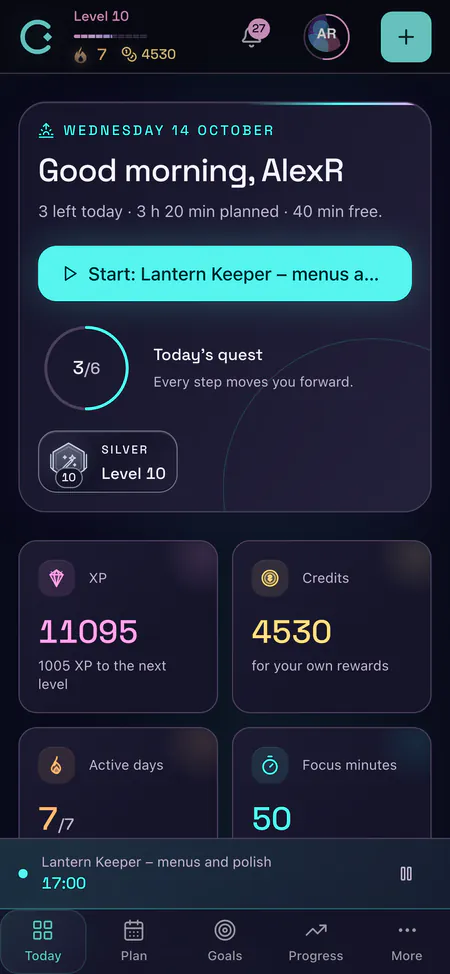
In CORTEX (free for everyone) there is a template for this: “Evening switch-off” (More → Templates). You choose when your switch-off starts and answer “When and where?” – what you will do it after. The template creates an evening routine: empty out what is running in your head, write three things for tomorrow, put worries on a list and put the screens away. You then tick off the whole routine in one pass. In the morning, CORTEX offers your unfinished tasks as Tomorrow, Later or Let go. If you have an account, open the Evening switch-off template.
Frequently asked questions
How do I switch off after work?
Do a ten-minute ritual at the end of the day: write down everything unfinished, note for each item when you will pick it up, choose three things for tomorrow and clearly close work – turn off notifications, shut the laptop and change your surroundings.
Why can’t I stop thinking about work?
Most often because of unfinished tasks that matter to you. The mind keeps returning to them until they have a plan. A heavy workload, work messages in the evening and no fixed end to the day add to it.
What is a shutdown ritual?
A shutdown ritual is a short, fixed routine at the end of the workday that closes work: you check open items, plan next steps and symbolically end the day. It helps your brain switch into time off.
How do I switch off when working from home?
Have a fixed end time, put work things out of sight afterwards, turn off work notifications and do something that switches you over – a walk, changing clothes, cooking. A physical change matters even more at home.
When is it more than tiredness?
When you think about work almost constantly, sleep badly for weeks, feel exhausted even after the weekend and nothing feels enjoyable, it may be overload or burnout. Talk to a doctor or psychologist. In a crisis, use findahelpline.com.
Sources and further reading
- Sonnentag, S. (2012): Psychological detachment from work during leisure time: The benefits of mentally disengaging from work – Current Directions in Psychological Science
- Wendsche, J. & Lohmann-Haislah, A. (2017): A meta-analysis on antecedents and outcomes of detachment from work – Frontiers in Psychology
- Smit, B. W. (2016): Successfully leaving work at work: The self-regulatory underpinnings of psychological detachment – Journal of Occupational and Organizational Psychology
- Leroy, S. & Glomb, T. M. (2018): Tasks interrupted: How anticipating time pressure on resumption of an interrupted task causes attention residue and low performance on interrupting tasks and how a “ready-to-resume” plan mitigates the effects – Organization Science
- Masicampo, E. J. & Baumeister, R. F. (2011): Consider it done! Plan making can eliminate the cognitive effects of unfulfilled goals – Journal of Personality and Social Psychology
- Sonnentag, S. & Fritz, C. (2007): The Recovery Experience Questionnaire – Journal of Occupational Health Psychology
Level up your life
CORTEX is free for everyone. Tasks, a one-click day plan, time tracking, habits and rewards in one system – on desktop and mobile.
CREATE A FREE ACCOUNT