Self-discipline: how to build it when motivation runs out
Self-discipline is the ability to do what you decided to do, even when you do not feel like it – and research suggests the people who seem most disciplined rely less on willpower and more on habits, routines and environments that make the right choice easy. This guide explains the difference between discipline, motivation and willpower, gives you a 30-day plan with a printable tracker and lists the self-discipline books that are actually worth your time.
- Self-discipline is acting on your own decisions despite short-term impulses; motivation is the desire to act, and willpower is the effort of resisting in the moment.
- In a 2005 study of eighth graders, self-discipline predicted academic performance more strongly than IQ (Duckworth & Seligman).
- People high in self-control report fewer temptations in daily life and rely on beneficial habits rather than constant resistance (Hofmann et al., 2012; Galla & Duckworth, 2015).
- The popular "ego depletion" idea that willpower is a fuel tank did not replicate in a 23-lab study with over 2,000 participants (Hagger et al., 2016).
- If-then plans ("If it is 7:00, then I put on running shoes") had a medium-to-large effect on reaching goals across 94 independent tests (Gollwitzer & Sheeran, 2006).
Discipline vs motivation vs willpower
These three words get used as if they mean the same thing. They do not, and mixing them up is why most "get disciplined" attempts fail.
| Motivation | Willpower | Self-discipline | |
|---|---|---|---|
| What it is | Wanting to do something | Forcing yourself in the moment | Doing what you decided, consistently |
| How long it lasts | Hours to days | Minutes | Months to years, if built into systems |
| Where it comes from | Feelings, goals, inspiration | In-the-moment effort | Habits, routines, environment, identity |
| Weakness | Disappears on a bad day | Tiring, unreliable under stress | Takes weeks to build |
Motivation gets you started. Willpower gets you through a single hard moment. Self-discipline is the system that makes the hard moments rarer. That is the part you can actually build.
What research says about self-discipline (carefully)
Self-help writing about discipline is full of shaky claims, so here is what holds up and what does not:
- It matters. Duckworth and Seligman (2005) found that self-discipline in eighth graders predicted final grades, attendance and other academic outcomes more strongly than IQ did.
- Disciplined people resist less, not more. In an experience-sampling study, Hofmann and colleagues (2012) found that people high in trait self-control reported experiencing fewer temptations in the first place. Galla and Duckworth (2015) found that beneficial habits explained much of the link between self-control and good outcomes.
- Willpower is probably not a fuel tank. The famous "ego depletion" theory (Baumeister et al., 1998) said self-control runs out like a battery. A preregistered replication across 23 labs and more than 2,000 participants found an effect close to zero (Hagger et al., 2016). The debate continues, but "I used up my willpower" is not a solid scientific excuse.
- Beliefs may play a role. Job, Dweck and Walton (2010) found that people who believed willpower is not easily exhausted did not show the usual drop in performance after a demanding task.
- Planning beats intending. A meta-analysis of 94 independent tests by Gollwitzer and Sheeran (2006) found that if-then plans (implementation intentions) had a medium-to-large effect on goal attainment.
The practical conclusion is consistent: stop trying to win more willpower battles, and set up your life so fewer battles happen.
How to build self-discipline: 7 principles
- Decide in advance, not in the moment. Write if-then plans: "If it is 21:30, then my phone goes on the charger in the kitchen." The decision is made once, not every night.
- Shrink the minimum. Each behavior gets a "bad day version" that takes under two minutes: one push-up, one paragraph, one flashcard. Showing up counts more than intensity in the first weeks.
- Design the environment. Add friction to what you want less of (apps logged out, snacks out of sight) and remove friction from what you want more of (gym bag packed, book on the pillow).
- Make it visible. Track the behavior daily. A filled-in row is a small reward and an honest mirror.
- Never miss twice. Missing once is life. Missing twice is the start of a new habit. Plan your comeback, not your perfect streak.
- Do the hard thing first. Put the behavior that needs the most discipline early in the day, before meetings and messages use up your attention.
- Tie it to who you are. "I am someone who trains" survives a bad week better than "I am trying to work out more".
The 30-day self-discipline plan
Thirty days is not enough to make a behavior fully automatic – in a study by Lally et al. (2009), forming a habit took a median of 66 days, with a range of 18 to 254 – but it is enough to prove to yourself that you can keep a promise. Pick one to three "pillars" (behaviors), not ten.
| Week | Focus | Actions |
|---|---|---|
| 1 – Commit | Start tiny | Choose 1–3 pillars. Write a minimum version and an if-then plan for each. Remove one temptation from your environment. |
| 2 – Track | Consistency | Tick the tracker every evening. Apply "never miss twice". Note what triggered misses. |
| 3 – Strengthen | Raise the bar slightly | Increase one pillar by ~10–20% (more minutes, more reps). Move the hardest pillar to the morning. |
| 4 – Lock in | Review and decide | Count completed days. Keep, adjust or drop each pillar. Plan the next 30 days. |
Example pillars:
- Body: 20-minute walk or workout every day (minimum: put on shoes and walk to the corner).
- Mind: 60 minutes of focused work before checking messages (minimum: 10 minutes).
- Restraint: no phone in bed (minimum: phone charges outside the bedroom).
Morning and evening routines are where most pillars live – see morning routine and evening routine for templates.
Printable 30-day self-discipline tracker
Print it, write your pillars in the header, and tick each day before bed. Use the note column for what got in the way.
30-day self-discipline tracker
Start date: __________ My why: ____________________________________________
| Day | Pillar 1: ________ | Pillar 2: ________ | Pillar 3: ________ | Note |
|---|---|---|---|---|
| 1 | ||||
| 2 | ||||
| 3 | ||||
| 4 | ||||
| 5 | ||||
| 6 | ||||
| 7 | ||||
| 8 | ||||
| 9 | ||||
| 10 | ||||
| 11 | ||||
| 12 | ||||
| 13 | ||||
| 14 | ||||
| 15 | ||||
| 16 | ||||
| 17 | ||||
| 18 | ||||
| 19 | ||||
| 20 | ||||
| 21 | ||||
| 22 | ||||
| 23 | ||||
| 24 | ||||
| 25 | ||||
| 26 | ||||
| 27 | ||||
| 28 | ||||
| 29 | ||||
| 30 |
Rule: never miss twice. Days completed: ____ / 30
Prefer a monthly grid for many habits? Use the free printable habit tracker.
Optional: make it a commitment contract
A commitment device is a choice you make now that makes it harder to back out later. Economists have tested them in the real world: in a study by Giné, Karlan and Zinman (2010), smokers who were offered a savings account they would lose if they failed a nicotine test were more likely to pass surprise tests six and twelve months later than those who were not offered one.
You do not need money on the line. A written contract with yourself works because it makes the promise concrete:
- Duration: 30 days, with a start and end date.
- Up to three pillars, each with a frequency (daily, workdays, every other day, weekly).
- Your "why" in one or two sentences.
- A signature. Yes, it feels silly. It also works on your brain.
- Optionally, a witness – a friend who gets a message on day 30.
Building self-discipline with CORTEX
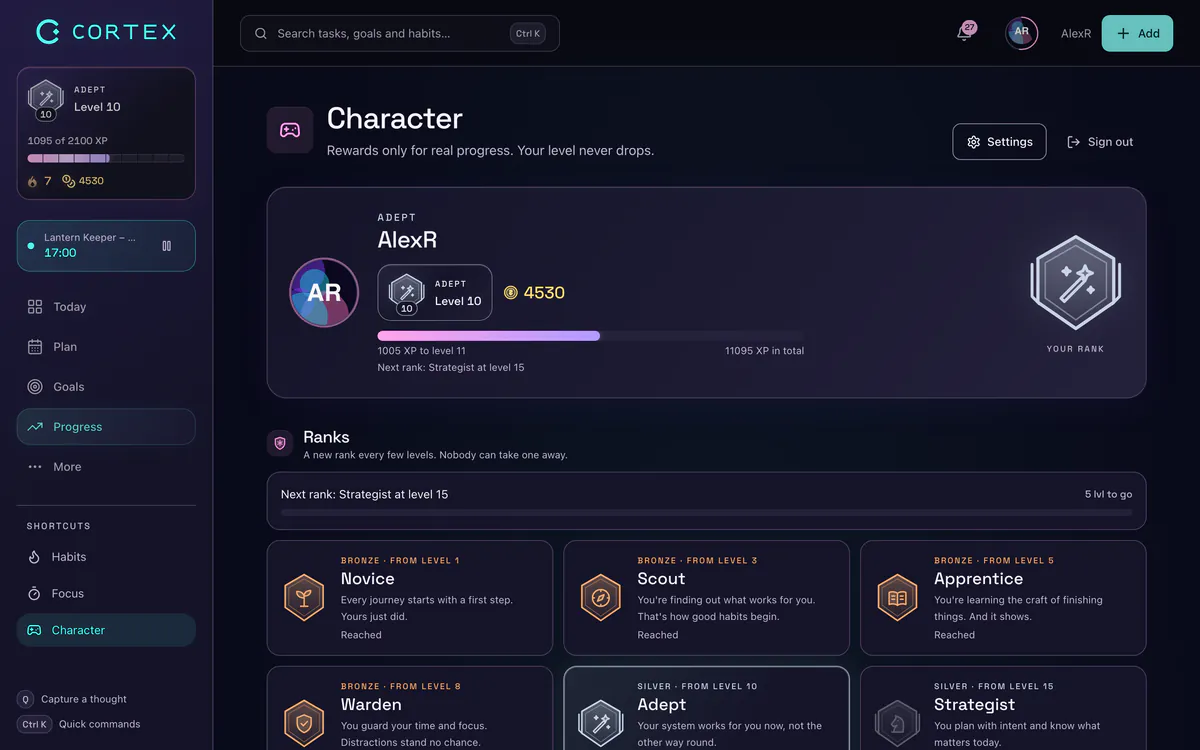
CORTEX is a free gamified productivity app – tasks, a one-click day plan, time tracking and habits, with XP, levels and real-life rewards. A few features map directly onto the plan above:
- Personal commitment contract (optional): a 30-day contract with up to three pillars and their frequency, optional habits, your "why" and a hand-drawn signature. CORTEX turns it into a goal plus the tasks and habits, and keeps a contract history. Details on the commitment contract page.
- Habits as buffs and debuffs: good habits (yes/no or a numeric daily target) and bad habits that fail when you exceed your limit. CORTEX keeps an overall activity streak, not per-habit streaks – which fits "never miss twice" better than a fragile streak per habit.
- Visible progress: finished tasks give XP, raise your level and grow five attributes (STR, INT, WIS, CHR, DEX) tied to task categories. Credits buy rewards you define yourself.

The best self-discipline books (and who each is for)
| Book | Author, year | Best for |
|---|---|---|
| Atomic Habits | James Clear, 2018 | Building systems so discipline is not needed every day. Start here. |
| Discipline Equals Freedom: Field Manual | Jocko Willink, 2017 | Short, blunt motivation and a no-excuses mindset, plus basic workouts. |
| Discipline Is Destiny: The Power of Self-Control | Ryan Holiday, 2022 | Stoic philosophy and historical stories about temperance and self-control. |
| How to Change | Katy Milkman, 2021 | Evidence-based tactics: commitment devices, fresh starts, temptation bundling. |
| Tiny Habits | BJ Fogg, 2019 | Starting ridiculously small when you have failed before. |
| Grit | Angela Duckworth, 2016 | Long-term perseverance and passion for big goals. |
| The Willpower Instinct | Kelly McGonigal, 2011 | Practical self-control experiments based on her Stanford course. |
A note on older willpower books: titles written before the replication crisis, such as Baumeister and Tierney's Willpower (2011), lean heavily on ego depletion research that has since been challenged. They are still interesting, but read them with that in mind.
If you are stuck before discipline even comes into play, start with how to stop procrastinating and how to build habits that stick.
Frequently asked questions
What is self-discipline?
Self-discipline is the ability to act on what you decided to do even when you do not feel like it, and to hold back from impulses that work against your goals. In practice it is built from habits, routines and environment more than from raw willpower.
How do I build self-discipline?
Pick one to three behaviors, give each a tiny minimum version and an if-then plan, remove temptations from your environment and track daily. Follow the "never miss twice" rule and raise the bar slowly after two weeks. The 30-day plan above walks you through it.
Is self-discipline better than motivation?
They do different jobs. Motivation is useful for starting but fades quickly; self-discipline keeps you going when motivation is gone. The best approach uses motivation to set up systems that make discipline easier.
What are the best books on self-discipline?
Atomic Habits by James Clear is the most practical starting point. Discipline Equals Freedom by Jocko Willink is for blunt motivation, Discipline Is Destiny by Ryan Holiday for a Stoic angle, and How to Change by Katy Milkman for research-based tactics.
Is willpower a limited resource?
The idea that willpower runs out like fuel (ego depletion) was very popular, but a large 23-lab replication in 2016 found almost no effect. Fatigue, stress and hunger still affect behavior, but designing your environment is more reliable than rationing willpower.
How long does it take to build self-discipline?
You can feel a difference in a few weeks, but turning behaviors into habits takes longer: in one study the median was 66 days, with a range of 18 to 254. Think in months and focus on consistency over intensity.
Sources and further reading
- Duckworth, A. L. & Seligman, M. E. P. (2005). Self-discipline outdoes IQ in predicting academic performance of adolescents. Psychological Science
- Hofmann, W., Baumeister, R. F., Förster, G. & Vohs, K. D. (2012). Everyday temptations: An experience sampling study of desire, conflict, and self-control. JPSP
- Galla, B. M. & Duckworth, A. L. (2015). More than resisting temptation: Beneficial habits mediate the relationship between self-control and positive life outcomes. JPSP
- Hagger, M. S. et al. (2016). A multilab preregistered replication of the ego-depletion effect. Perspectives on Psychological Science
- Job, V., Dweck, C. S. & Walton, G. M. (2010). Ego depletion – Is it all in your head? Psychological Science
- Gollwitzer, P. M. & Sheeran, P. (2006). Implementation intentions and goal achievement: A meta-analysis. Advances in Experimental Social Psychology
- Giné, X., Karlan, D. & Zinman, J. (2010). Put your money where your butt is: A commitment contract for smoking cessation. AEJ: Applied
- Lally, P. et al. (2009). How are habits formed: Modelling habit formation in the real world. European Journal of Social Psychology
- Ryan Holiday – Discipline Is Destiny (Penguin Random House)
- James Clear – Atomic Habits
Level up your life
CORTEX is free for everyone. Tasks, a one-click day plan, time tracking, habits and rewards in one system – on desktop and mobile.
CREATE A FREE ACCOUNT