Morning routine: build one that survives real life (3 templates)
A good morning routine is a short, fixed sequence of actions you do after waking up that gets your body moving, your head clear and your most important task started – it does not need to start at 5 a.m. or take two hours. Below you will find a menu of building blocks, ready-made 15, 30 and 60-minute templates, a version for students, a 3-minute fallback for bad mornings and a printable checklist.
- A morning routine works best as a short, fixed order of 3–6 steps, done at roughly the same wake-up time every day.
- Light is the strongest cue for your body clock; opening the curtains or stepping outside soon after waking is a simple, low-effort first step (Sleep Foundation).
- The most useful morning routines end with planning or starting your single most important task, not with more self-care steps.
- Every routine needs a bad-morning fallback: a 3-minute minimum version that keeps the chain alive on days you oversleep.
- Good mornings start the night before: preparing clothes, bag and tomorrow's top task in the evening removes most morning decisions.
What makes a good morning routine
Forget the celebrity routines with ice baths, three journals and a sunrise hike. The mornings that last share four traits:
- Short. 15–60 minutes. Anything longer breaks the first time you have an early meeting.
- Fixed order. The same steps in the same sequence, so each step triggers the next without a decision.
- Consistent wake time. Roughly the same time on workdays and weekends helps your body clock – sleep experts recommend a regular schedule where possible.
- A clear finish line. The routine ends with a plan for the day or the first minutes of your most important task.
There is no single "best morning routine". The best one is the one you still do on a Wednesday in February. Start with the template that fits your time, then adjust.
Morning routine list: the building blocks
Pick 3–6 blocks from this list. Start with the ones that take the least effort and give the most noticeable benefit for you.
| Block | Time | Why it helps |
|---|---|---|
| Get up at your set time (no snooze) | 0 min | Starts the chain; consistency helps your body clock |
| Glass of water | 1 min | Easy first win; put the glass out the night before |
| Daylight: open curtains or step outside | 2–10 min | Light is the strongest signal for your internal clock |
| Make the bed | 2 min | A visible "done" before anything else |
| Movement: stretch, walk, short workout | 5–30 min | Wakes you up; a habit that is easy to anchor here |
| Shower and get dressed | 10–15 min | Clear switch from "home mode" to "day mode" |
| Breakfast without a screen | 10–15 min | Food plus a few minutes of quiet |
| Journal or quiet time | 3–10 min | Notice your mood and energy before the day reacts for you |
| Read (a book, not the news) | 10–20 min | Input you choose instead of input that chooses you |
| Plan the day: top 3 tasks | 5 min | Turns a good morning into a productive day |
| First focus block | 25–60 min | Your most important task while your head is fresh |
Morning routine templates: 15, 30 and 60 minutes
| 15 minutes (busy) | 30 minutes (standard) | 60 minutes (ambitious) |
|---|---|---|
| 0:00 Up, water | 0:00 Up, water, curtains open | 0:00 Up, water, curtains open |
| 0:02 Curtains open, 5 stretches | 0:03 10-minute walk or mobility | 0:05 20-minute walk or workout |
| 0:05 Shower, dress | 0:13 Shower, dress | 0:25 Shower, dress |
| 0:12 Write today's top 3 tasks | 0:25 Breakfast + top 3 tasks | 0:35 Breakfast, no screen |
| 0:15 Go | 0:30 Go | 0:45 Journal (3 lines) + plan the day |
| 0:50 First 10 minutes of your most important task |
Not into the gym-first approach? Swap movement for reading or a quiet coffee. The order matters more than the exact content: start with something physical and easy, end with planning.
If you like a ready-made framework, Hal Elrod's The Miracle Morning (2012) packs six practices into an acronym, SAVERS – Silence, Affirmations, Visualization, Exercise, Reading and Scribing (journaling). It is a good menu, but you do not need all six to have a good morning.
Morning routine for students
Students have two problems adults often do not: wildly different schedules between days, and late nights. Two adjustments make routines work anyway:
- Anchor to your first commitment, not the clock. "Routine starts 60 minutes before my first class" adapts to a 8:00 and a 10:00 start.
- Pack everything the night before. Bag, laptop charged, clothes out, keys in one spot. The morning then has zero logistics.
A 30-minute student routine:
- Up, water, open the curtains (2 min).
- Shower, dress (12 min).
- Breakfast, even a small one (10 min).
- Check today's timetable and write the one study task you will do today (3 min).
- On exam weeks: 3 minutes of flashcards from yesterday's material on the way out (3 min).
For actual study sessions, see how to focus on studying and the Pomodoro Technique.
The bad-morning fallback (3 minutes)
You will oversleep, wake up sick or have a 7 a.m. flight. On those days, do the minimum version so the routine stays alive:
- Drink a glass of water.
- Open the curtains.
- Write the one thing that must happen today.
That is it. The point is not the three steps themselves – it is telling yourself "I still did my routine", which makes tomorrow's full version much more likely. Missing once is normal; the rule that keeps habits alive is "never miss twice". More on that in how to build habits that stick.
Great mornings start the night before
Most morning chaos is caused by decisions you could have made yesterday. A 10-minute evening prep pays back double:
- Clothes out, bag packed, phone and laptop charging outside the bedroom.
- Glass and water bottle filled on the kitchen counter.
- Tomorrow's top task written down, with its start time.
- Alarm set for your consistent wake time – and a lights-out time that allows enough sleep. The CDC recommends 7 or more hours for adults aged 18–60.
The full version, with a shutdown ritual and wind-down, is in our evening routine guide.
Morning routine ideas by goal
If you are not sure which blocks to pick, start from what you want more of:
| Your goal | Add these blocks | Skip for now |
|---|---|---|
| More energy | Daylight right after waking, 10-minute walk, real breakfast | Long journaling sessions |
| Get more done | Top 3 tasks, first focus block before email | Reading the news |
| Feel calmer | 5 minutes of quiet, gratitude list, no phone until planned | Intense workouts if they stress you |
| Get fit | Clothes laid out, workout before shower | Elaborate breakfast prep |
| Learn something | 20 minutes of reading or language practice with breakfast | Several new habits at once |
Common mistakes: adding six new habits on day one, copying someone else's 5 a.m. routine, letting the phone decide the first 20 minutes, and treating one missed morning as failure. Add one block at a time, and only add the next when the current routine runs without thinking. That patience is most of what self-discipline really is. If you want to see the routine as a streak of ticks, a simple habit tracker does the job, and the first focus block fits neatly into a time-blocked day.
Printable morning routine checklist
Write your steps in the left column, then tick each day. After two weeks you will see which steps actually happen and which only look good on paper.
My morning routine – wake-up time: ______
| Step | Mon | Tue | Wed | Thu | Fri | Sat | Sun |
|---|---|---|---|---|---|---|---|
| 1. Water + curtains open | |||||||
| 2. | |||||||
| 3. | |||||||
| 4. | |||||||
| 5. | |||||||
| 6. Top 3 tasks written | |||||||
| Bad-morning fallback used |
Your morning routine in CORTEX
CORTEX is a free gamified productivity app – tasks, a one-click day plan, time tracking and habits, with XP, levels and real-life rewards. Its daily log and Today screen are built around the start of the day:
- Morning Briefing: the first tab of the daily log. You set your Prime Directive – the one thing you must accomplish today – and write three things you are grateful for. That is the "write your top task" step from every template above, in under a minute.
- Vital signs: the same daily log records sleep hours and quality, exercise, diet, water and weight. After a few weeks you can see how sleep and routine line up with your days. An optional push notification gives you a morning summary.
- Habits: add routine steps as good habits (yes/no, or a number like glasses of water) and see them every morning.
- Plan My Day: one click places today's and overdue tasks into free time slots, so the planning step takes seconds. See the day planner page for how it works.
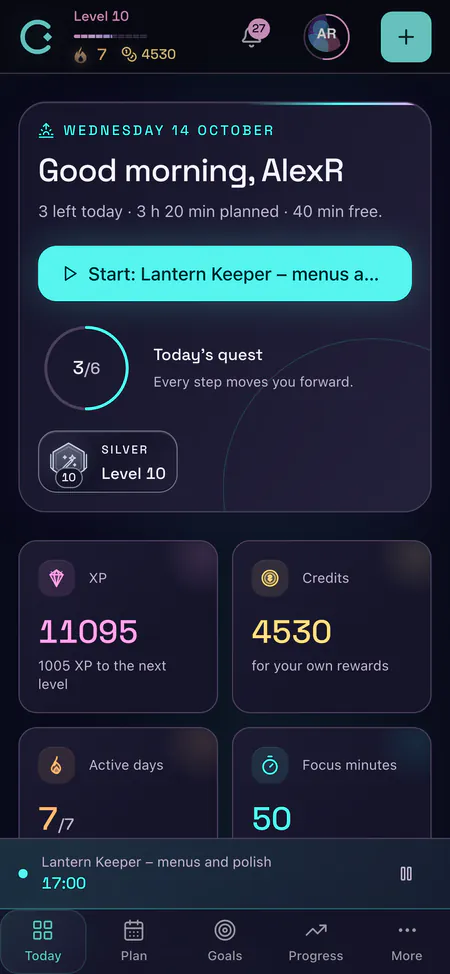
Completing tasks and daily logs earns XP, so even a 15-minute morning moves your character forward. CORTEX runs in the browser and installs to your home screen as a web app on iOS and Android.
Frequently asked questions
What is a good morning routine?
A good morning routine is a short, fixed sequence of 3–6 steps after waking: for example water, daylight, movement, shower, breakfast and writing your top task for the day. It should fit your schedule on busy days and end with planning or starting your most important task.
What is the best morning routine for students?
Anchor it to your first class rather than a fixed clock time, pack your bag the night before, and keep it to about 30 minutes: water and daylight, shower, breakfast, a quick look at the timetable and one study task for the day.
How long should a morning routine be?
Between 15 and 60 minutes for most people. Start with 15–30 minutes; a short routine you do every day beats a long one you skip half the time. Add steps only after the basic version runs on autopilot.
What should I do first thing in the morning?
Something easy and physical: drink water and open the curtains or step outside. Light is the strongest cue for your body clock, and an easy first win makes the next steps more likely. Leave email and social media until after you have planned the day.
Do I need to wake up at 5 a.m.?
No. A consistent wake-up time matters more than an early one. Choose a time that lets you get enough sleep – the CDC recommends 7 or more hours for adults aged 18–60 – and keep it roughly the same every day.
How do I stick to a morning routine?
Keep it short, prepare everything the evening before, track it daily and have a 3-minute fallback for bad mornings. Follow the "never miss twice" rule instead of chasing a perfect streak.
Sources and further reading
Level up your life
CORTEX is free for everyone. Tasks, a one-click day plan, time tracking, habits and rewards in one system – on desktop and mobile.
CREATE A FREE ACCOUNT