How to break a bad habit: change the situation, not just the resolution
The best way to break a bad habit is to change the situation that triggers it and decide in advance what you will do instead. A bad habit is an automatic response to a specific cue – a place, a time, a mood or certain people. That is why “I won’t do it any more” rarely lasts: the cue is still there, and the response starts before you notice. What helps is making the habit harder (more steps, more distance), having a “When…, then…” plan for the risky moment, staying alert in the trigger situation and tracking clean days without punishing yourself for slips.
- A bad habit is a learned automatic response to a cue; good intentions alone don’t change it because it runs without a decision (Wood & Rünger, 2016).
- People with a strong cinema popcorn habit ate as much stale popcorn as fresh – but only in a cinema; outside the usual setting the habit lost its pull (Neal et al., 2011).
- In diary studies, strong bad habits were controlled best by vigilant monitoring (“don’t do it”, watching for risky moments), not by avoiding temptation alone (Quinn et al., 2010).
- A “When X happens, I will do Y instead” plan weakens the old habit’s head start and gives you a choice in the critical moment (Adriaanse et al., 2011).
- Life changes – moving house, a new job, a rearranged desk – are when habits are easiest to change (Verplanken & Wood, 2006).
What a bad habit is, and why it won’t stop on command
A bad habit is a repeated behaviour you do almost automatically even though it works against you: scrolling in bed, biting your nails, snacking in front of the TV, putting off emails. The key word is automatically. Wendy Wood and Dennis Rünger (2016) describe a habit as a link between a situation and a response stored in memory. When the situation occurs, the response starts by itself.
That is why resolutions so often fail. You decide “no more” in a calm moment, but the habit kicks in at a different moment – tired, rushed, phone already in hand. The good news: once you know what triggers it, you know where to intervene.
Mind the difference between a bad habit and an addiction. If it involves alcohol, smoking, gambling or medication, or if you can’t change the behaviour despite real effort, it is not a matter of “weak willpower”. Talk to your doctor or an addiction service.
The stale popcorn experiment
David Neal, Wendy Wood and colleagues (2011) gave cinema-goers popcorn that was either fresh or a week old. People who regularly eat popcorn at the cinema ate about the same amount of both, even though they disliked the stale one. Habit beat taste. But when the same test took place in a meeting room while watching music videos, the habit lost its power and people ate according to how much they liked the popcorn. The habit also weakened when they had to eat with their non-dominant hand.
The practical lesson: a habit is tightly bound to its situation. Change the situation, or even just how you perform the behaviour, and your conscious mind gets a say again.
7 steps to break a bad habit
- Map the triggers. For three days, note when the habit happened: time, place, mood, who was there, what happened just before. Two or three patterns usually stand out.
- Name what the habit gives you. Relief from boredom, a break, comfort, a reward. You will need to meet that need another way, or the habit comes back.
- Add friction. Make the habit a few steps harder: charge your phone in the kitchen, don’t stock sweets at home, log out of the app you open mindlessly. Angela Duckworth and colleagues (2016) show that changing the situation tends to work better than resisting in the moment of temptation.
- Write a “When…, then…” plan. “When I sit down in front of the TV in the evening and want something sweet, I make a cup of tea.” Marieke Adriaanse and colleagues (2011) found that such a plan weakens the old habit’s advantage in the critical moment. More in implementation intentions.
- Stay alert in risky moments. Jeffrey Quinn and colleagues (2010) tracked how people handle bad habits in daily life. For strong habits, vigilant monitoring worked best: noticing that a risky situation is coming and telling yourself “not now”. Avoidance alone was not enough.
- Use a life change. A new flat, a new desk, the start of a month. Bas Verplanken and Wendy Wood (2006) describe periods of change as the time when habits are most vulnerable – the old cues are gone and new ones are not yet set.
- Count clean days, not failures. Track days without the habit. A slip does not send you back to zero – it tells you which trigger you haven’t handled yet.
Examples: trigger, friction, replacement
| Bad habit | Common trigger | Friction | Replacement (if–then plan) |
|---|---|---|---|
| Scrolling in bed | Phone on the nightstand | Charger outside the bedroom | When I get into bed, I read two pages of a book |
| Snacking in front of the TV | Evening on the sofa | No snacks stocked at home | When I turn on the TV, I make a cup of tea |
| Nail biting | Stress at the computer | Short nails, a plaster on one finger | When my hand goes to my mouth, I squeeze a stress ball |
| Checking social media at work | A hard task, boredom | Log out, icon off the home screen | When I feel the pull, I write the next small step of my task |
| Going to bed late | “Just one more episode” | Turn off autoplay | When the episode ends, I get up and brush my teeth |
If your phone keeps you up at night, see also bedtime procrastination. If the habit is mainly putting off work, start with why do I procrastinate.
How long it takes, and what to do after a slip
There is no fixed number. Unlearning, like learning, is gradual: the cue still tugs at you for a while even when you respond differently. In Lally et al. (2010), forming a new automatic behaviour took between 18 and 254 days. Breaking one is similarly variable.
Slips are part of the process. What helps:
- No “well, it doesn’t matter now”. One day breaks nothing. Giving up does.
- A quick review instead of guilt. Which trigger was it? What will I add so the friction or the plan works next time?
- Make tomorrow easy. In the morning, do one small thing you are in control of.
Why guilt tends to backfire is explained in perfectionism and procrastination. How to set up the system for the long run: self-discipline.
Try it now in CORTEX
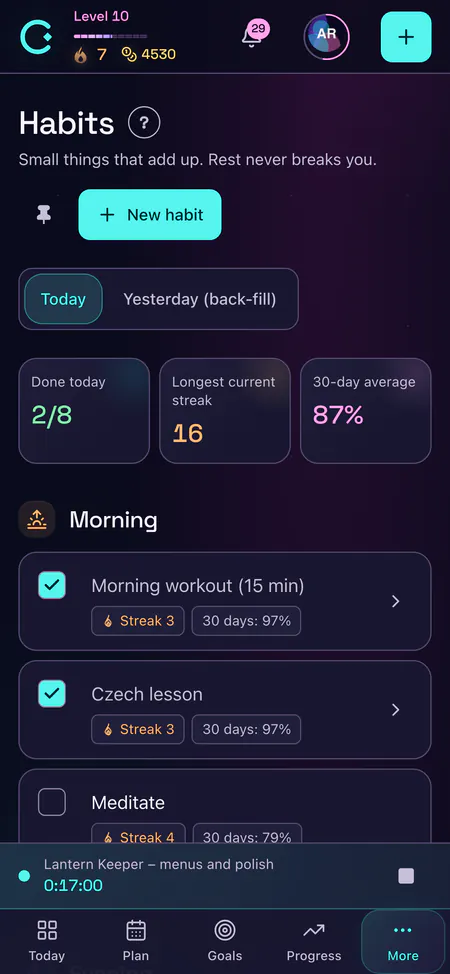
In CORTEX (free for everyone) create a “New habit” in Habits and choose Quit as the type. The habit is then tracked as a “clean day” – no minus points or penalties, just a streak of days without it and a yearly heatmap. Write your “When…, then…” plan into the habit’s description. For sweets there is a ready-made plan in the “30 days without sugar” template (More → Templates): it counts clean days and gives you a plan for cravings. If you have an account, open the 30 days without sugar template directly.
Frequently asked questions
How do you break a bad habit fast?
There is no instant fix, but changing your environment usually works fastest: remove or block what triggers the habit (phone out of the bedroom, no snacks at home) and prepare a replacement for the risky moment. Then count clean days.
Why can’t I stop a bad habit with willpower alone?
Because a habit is an automatic response to a cue and starts before you have time to decide. Willpower helps in the moment you notice the situation, but changing the situation and having a plan for what to do instead is more reliable.
How long does it take to break a bad habit?
It varies from weeks to months, depending on how strong the habit is, how often the cue occurs and whether you have a replacement. A single slip doesn’t reset the process; what matters is carrying on the next day.
Should I replace a bad habit with a good one?
Yes, where possible. A bad habit usually gives you something – relief, a break, a reward. If you meet that need another way and have a “When X happens, I will do Y” plan, the habit is less likely to return.
When is it an addiction rather than a bad habit?
When the behaviour continues despite serious harm, you can’t cut down despite real effort, or it involves alcohol, nicotine, drugs or gambling. Then talk to your doctor or an addiction service. In a crisis, findahelpline.com lists free helplines.
Sources and further reading
- Wood, W. & Rünger, D. (2016): Psychology of Habit – Annual Review of Psychology
- Neal, D. T., Wood, W., Wu, M. & Kurlander, D. (2011): The pull of the past: When do habits persist despite conflict with motives? – Personality and Social Psychology Bulletin
- Quinn, J. M., Pascoe, A., Wood, W. & Neal, D. T. (2010): Can’t control yourself? Monitor those bad habits – Personality and Social Psychology Bulletin
- Adriaanse, M. A., Gollwitzer, P. M., De Ridder, D. T. D., de Wit, J. B. F. & Kroese, F. M. (2011): Breaking habits with implementation intentions: A test of underlying processes – Personality and Social Psychology Bulletin
- Verplanken, B. & Wood, W. (2006): Interventions to break and create consumer habits – Journal of Public Policy & Marketing
- Duckworth, A. L., Gendler, T. S. & Gross, J. J. (2016): Situational strategies for self-control – Perspectives on Psychological Science
Level up your life
CORTEX is free for everyone. Tasks, a one-click day plan, time tracking, habits and rewards in one system – on desktop and mobile.
CREATE A FREE ACCOUNT