How to get motivated to do anything – even when you really don't want to
To get motivated, stop waiting for motivation: shrink the start to five minutes, decide in advance exactly when and where you will do it, and set up your surroundings so that starting is easier than not starting. The urge usually shows up during the work, not before it. Below: why willpower alone fails, five starting rituals that get you through the first minute, quick plans for studying, working out, cleaning and work, and rewards that help rather than backfire.
- Forcing yourself with willpower works briefly; systems last – a tiny first step, a pre-decided "when and where" and surroundings that make starting easy.
- The five-minute rule: promise yourself only five minutes with permission to stop. Starting is the hard part; continuing is usually easier.
- If–then plans ("When X happens, I will do Y") clearly raise follow-through across many studies (Gollwitzer & Sheeran, 2006).
- Pairing an unpleasant task with something you enjoy works: people with gripping audiobooks available only at the gym went more often, though the effect faded over time (Milkman et al., 2014).
- If you cannot make yourself do anything for weeks and nothing feels enjoyable, it may not be about motivation – talk to a doctor or therapist.
Motivation vs. systems: why "just force yourself" fails
Getting yourself to do something means acting for your future self while your present self wants something else. The trouble is that we rely on motivation, and motivation is like the weather: sunny one day, raining the next. If you only exercise on days you feel like it, you will not exercise often.
A system is more like central heating: it works whatever the weather. It has four parts:
- A clearly set start – when, where and what exactly.
- A tiny first step – so small it would be silly to skip.
- Prepared surroundings – things ready, distractions out of reach.
- Instant feedback – a tick, a record, a small reward.
Peter Gollwitzer and Paschal Sheeran (2006) combined 94 independent tests of implementation intentions – plans in the form "when situation X arises, I will do Y". People who set such plans followed through noticeably more often than people with only a general goal. "I need to start studying" and "Tuesday at 5 pm at my desk I open chapter 4" are further apart than they look. More in implementation intentions.
5 starting rituals that get you through the first minute
1. The five-minute rule
Promise yourself just five minutes. If you want to stop after that, stop – no guilt. Usually you won't, because the hardest moment is switching from "not doing" to "doing". And even if you do, five minutes are done.
2. The smallest possible version
Not "go for a run" but "put on my shoes and step outside". Not "clean the flat" but "clear one surface". The point is to start, not to finish straight away – see the two-minute rule.
3. Decide when and where in advance
Put it in your calendar like a meeting: "Wednesday 7:00, living room, 15 minutes of a workout video." When the moment comes you are not deciding, just keeping a promise. Repeated often enough, it becomes a habit – though it takes longer than the famous 21 days: in a study by Phillippa Lally and colleagues (2010), new daily habits took a median of about 66 days to feel automatic. See how to build habits.
4. Set up the night before
Workout clothes on the chair, notes open on the desk, the vacuum by the door. Everything you do not have to look for in the morning is one less excuse.
5. A starting cue
The same song, the same tea, the same headphones before each start. After a few repetitions, the ritual helps you slip into work almost automatically.
How to get motivated: quick plans by situation
| Situation | Why it feels hard | First step (under 5 min) | Detailed guide |
|---|---|---|---|
| Study | Lots of material, the payoff is far away | Open your notes and write 3 questions you will answer today | motivation to study |
| Work out | Discomfort, changing, getting there | Change clothes and do one exercise | motivation to work out |
| Clean | The mess feels endless | A 10-minute timer and one surface | motivation to clean |
| Work | No structure, no boundaries | Sit at your workspace and write the day's first output | motivation to work |
| Write | Fear it won't be good | Write three sentences, badly on purpose | perfectionism and procrastination |
| Paperwork | Boring, unclear steps | List the documents you need | break down a big task |
If it is not one task but your drive in general, start with no motivation to do anything.
Rewards that work (and ones that backfire)
The brain favours whatever pays off now. Distraction pays off instantly; work pays off in weeks. A reward can even the odds – if you use it well.
- It comes right after the effort, not "at the end of the month".
- It does not work against the goal. Cake for a workout or an hour of scrolling for an hour of study undermine the goal.
- It is proportionate. Small rewards for small steps, bigger ones for milestones.
- It is decided in advance, not negotiated with yourself afterwards.
Katherine Milkman and colleagues (2014) tested temptation bundling: allowing a favourite activity only during the unpleasant one. Participants whose gripping audiobooks were available only at the gym went more often at first than the control group; the effect faded over time. At home it works too: a favourite podcast only while cleaning, a favourite coffee only while writing. More in how to reward yourself.
When you cannot make yourself do anything
Sometimes it is not one annoying task but a general slump: nothing appeals, not even things you used to enjoy. That is not laziness, and a stricter plan will not fix it.
- Short term (a few days): cut your day to the minimum – food, sleep, one necessary thing. Rest is legitimate.
- Longer (weeks): if the slump lasts, worsens or comes with sadness or hopelessness, talk to your doctor or a therapist. If you are in crisis, call your local emergency number or find a free helpline at findahelpline.com.
Try it now: set up your start in CORTEX
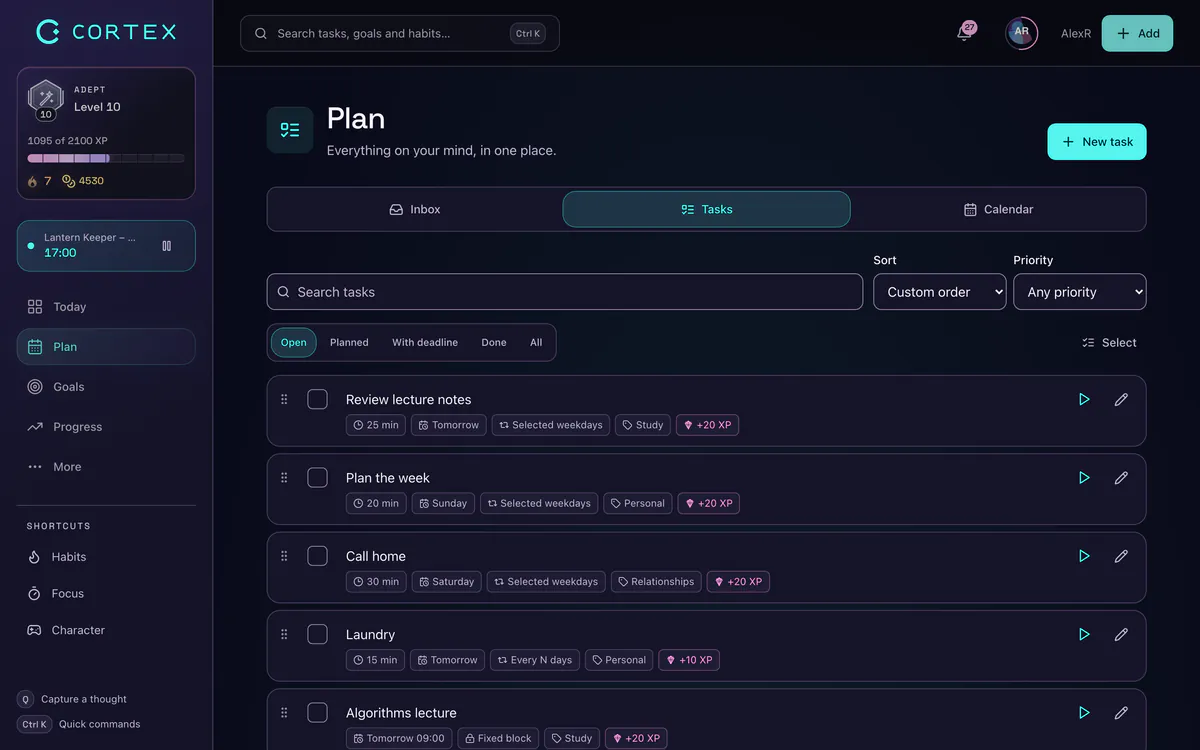
CORTEX (free for everyone) brings these principles into one system:
- When and where in advance: quick capture (key Q) understands "Workout tomorrow @7:00 ~15m *weekly" – time, length and repetition included.
- Small steps: split a big task into subtasks and watch progress. Every finished task earns XP based on its priority.
- Instant rewards: XP and credits you spend in the shop on rewards you define yourself ("episode tonight", "new book").
- No deciding during the day: Plan My Day fits tasks into free slots, so you know what is next.
Frequently asked questions
How do I get motivated to do anything?
Do not wait for the mood. Shrink the first step to five minutes, decide exactly when and where you will do it, and prepare your surroundings so starting is easy. Motivation usually arrives once you are moving.
How can I force myself to do something I don't want to do?
Make the start tiny, give yourself permission to stop after five minutes, and pair the task with something pleasant, like a podcast you only allow during it. Plan a small reward that comes right after, decided in advance.
Why can't I motivate myself?
Common reasons are tiredness, a vague or huge task, fear of doing it badly and rewards that are too far away. Address the specific reason: rest, a concrete first step, a deliberately rough draft or a quick reward.
What is the five-minute rule?
You commit to only five minutes of a task, with permission to stop afterwards. The hardest part is usually starting, so most people continue; and if you stop, you have still made progress.
Is it normal to have no motivation for anything?
A short slump happens to everyone and rest and a simpler day help. If it lasts for weeks, gets worse or nothing feels enjoyable any more, talk to a doctor or a mental health professional.
Sources and further reading
- Gollwitzer, P. M. & Sheeran, P. (2006). Implementation intentions and goal achievement: A meta-analysis of effects and processes. Advances in Experimental Social Psychology, 38, 69–119
- Milkman, K. L., Minson, J. A. & Volpp, K. G. M. (2014). Holding the Hunger Games hostage at the gym: An evaluation of temptation bundling. Management Science, 60(2), 283–299
- Lally, P. et al. (2010). How are habits formed: Modelling habit formation in the real world. European Journal of Social Psychology, 40(6), 998–1009
Level up your life
CORTEX is free for everyone. Tasks, a one-click day plan, time tracking, habits and rewards in one system – on desktop and mobile.
CREATE A FREE ACCOUNT