Eat the frog: start with your hardest task (and when not to)
Eat the frog means doing your most important – and least appealing – task first, before email and small stuff. Coach Brian Tracy built a whole method around it in Eat That Frog! (2001). The metaphor is usually credited to Mark Twain, though there is no solid evidence he said it. Below: how to spot your frog with the ABCDE method, a five-step routine for tomorrow, sample days for a freelancer and a student, the book’s key ideas – and, honestly, when a morning frog doesn’t work.
- “Eat the frog” is the rule of doing the most important task you are most likely to put off as the first task of the day.
- It comes from Brian Tracy’s book Eat That Frog! (1st edition 2001, 3rd edition 2017), 21 short chapters on beating procrastination.
- Find the frog with ABCDE: A = must do, serious consequences; B = should do; C = nice to do; D = delegate; E = eliminate. Your frog is your top A task.
- Two rules: if you have two frogs, eat the uglier one first; and don’t stare at it too long – start.
- A morning frog may not suit people with low morning energy, ADHD or reactive jobs; then the frog is your first focused block after warming up.
What “eat the frog” means
The image is simple: if you have to eat a live frog, do it first thing in the morning – the worst part of the day is then behind you. In Tracy’s version the frog is your biggest, hardest and most important task: the one you most want to postpone and the one with the biggest impact on your results.
He adds two rules:
- If you have to eat two frogs, eat the ugliest one first. Facing two unpleasant tasks, start with the harder and more important one, not the one that looks more bearable.
- If you have to eat a live frog, it does not pay to sit and look at it for very long. Planning, “thinking it over” and tidying your desk are elegant forms of delay. Sit down and start.
There is research behind the “stay with it until it’s done” part, too. Sophie Leroy (2009) described attention residue: when you switch away from an unfinished task, part of your attention stays with it and you perform worse on the next one. More on that in deep work.
How to find your frog: the ABCDE method
The frog is not “the most unpleasant thing on the list”. It is the most important thing you are putting off. Tracy’s ABCDE method finds it: go through tomorrow’s tasks and put a letter next to each.
| Letter | Meaning | Freelancer example | Student example |
|---|---|---|---|
| A | Must do – serious consequences if you don’t | Send the client the proposal by the deadline | Finish the essay due tomorrow |
| B | Should do – mild consequences | Reply to a non-urgent enquiry | Review lecture notes |
| C | Nice to do – no consequences | Swap a photo on the website | Reorganise folders |
| D | Delegate what someone else can do | Hand bookkeeping to an accountant | Split topics with classmates |
| E | Eliminate what no longer matters | A newsletter nobody reads | A third rewrite of finished notes |
Number your A tasks (A-1, A-2, A-3). A-1 is your frog. Tracy’s rule: never do a B task while an A task is left undone. If sorting by urgency and importance suits you better, the Eisenhower Matrix does the same job.
A five-step routine for tomorrow
- Pick the frog the evening before. Run tomorrow’s tasks through ABCDE and mark one A-1. Deciding at night means no willpower spent deciding in the morning – it fits nicely into an evening routine.
- Cut it down to a first bite. “Write the proposal” is too big. “Open the template and write three bullets on what the client wants” is not.
- Make the frog your first block. Not after email, not after “a coffee and a quick look at messages”. Coffee yes, messages no.
- Phone away, one window. Set a 25- or 50-minute countdown and work on nothing but the frog. The Pomodoro Technique explains how to set up the blocks.
- Reward yourself. A finished frog is a good reason for a break, a walk or your favourite coffee – your brain starts to link the hard start with a good finish.
Sample days: a freelancer and a student
Freelance designer
| Time | What she does |
|---|---|
| 8:30 | Coffee, a look at the plan (no email) |
| 8:45–9:35 | Frog: logo concept for a new client, first version (50 min) |
| 9:35–9:45 | Break, stretch |
| 9:45–10:35 | Frog continues: second version and send |
| 10:35–11:15 | Email and messages in one batch |
| 11:15–12:30 | B tasks: small edits for regular clients |
| Afternoon | A meeting, invoicing, admin |
Student in exam season
| Time | What he does |
|---|---|
| 9:00 | Breakfast, phone stays in the bedroom |
| 9:20–9:45 | Frog: the hardest statistics topic (25 min) |
| 9:45–9:50 | Break |
| 9:50–10:40 | Frog: two more blocks on the same topic |
| 10:40–11:00 | Longer break, messages |
| 11:00–12:30 | Easier topics, self-testing |
In both cases the frog is done – or well under way – by eleven. The rest of the day can be chaotic and it was still a good day.
The book’s key ideas in brief
The 3rd edition of Eat That Frog! has 21 short chapters. The most practical ones, in our own words:
- Set the table: decide exactly what you want and write it down.
- Plan every day in advance, ideally the evening before.
- The 80/20 rule: a few tasks bring most of the results; the frog is usually one of them.
- Consider the consequences: what matters is what has long-term impact.
- Practise creative procrastination: you will always put something off, so put off the low-value things on purpose.
- Use the ABCDE method (above).
- Prepare thoroughly: have everything you need at hand, so there is no excuse to get up.
- Take it one oil barrel at a time: a huge task is doable if you only look at the next step.
- Slice and dice the task and create large chunks of uninterrupted time.
- Single-handle every task: once you start, keep going until it’s done.
The book is written in a motivational style and leans little on research, but as a set of rules for planning a day it works well. If you want to know why we postpone things in the first place, read how to stop procrastinating.
When eating the frog first doesn’t work
- Low morning energy. If you only get going around noon, a morning frog is a punishment. Put it in your first high-energy block and start the day with something lighter. The principle stays: the frog comes before email and small stuff.
- ADHD and similar attention styles. Many people can’t start a hard task “cold”. A quick win first (5–10 minutes), the frog straight after, a ridiculously small first step and a visible countdown help. This is not medical advice – see the ADHD planner page for more.
- Reactive jobs. Support, shifts, operations – you don’t control the morning. Reserve the first calmer window of the day for the frog and protect it.
- Fixed deadlines. With a client meeting at 10:00, preparing for it matters more than the “big project”. The frog is what has the biggest consequences today, not always the biggest task.
Eating the frog in CORTEX
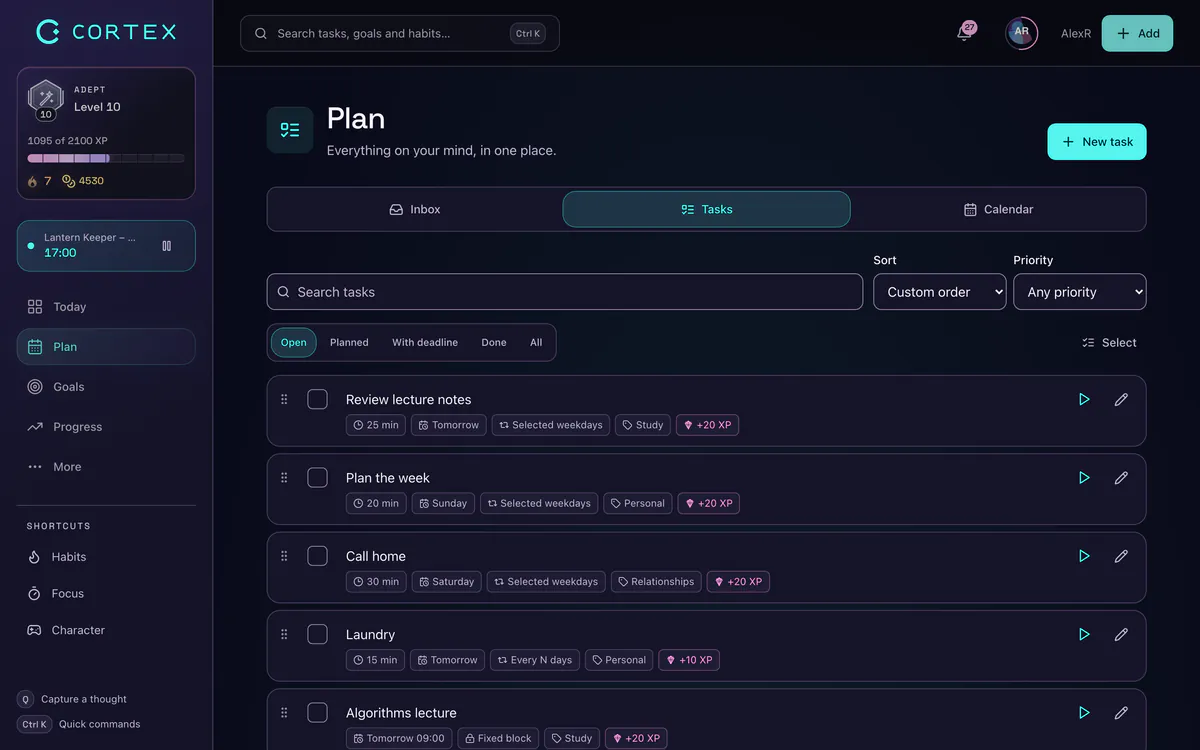
In CORTEX (free for everyone) you set the frog up the night before and just start in the morning:
- In the evening, give the frog critical priority and an estimate. Quick capture (press Q) does it in one line:
Write the client proposal tomorrow 9:00 ~50m !!!– a task for tomorrow at 9:00, 50 minutes, critical priority. - In the morning press Plan my day. The day planner keeps tasks with a fixed time where they are and fits the rest around them by deadline and priority, with a buffer – so the frog at 9:00 stays your first block.
- Start a focus session on the frog – Pomodoro 25/5 or 50/10 – with background music if it helps.
- Tick it off and take the XP. A critical task pays 50 XP, a low-priority one 10 – one eaten frog is worth five small wins.
Frequently asked questions
What does eat the frog mean?
It is the rule of doing the most important task you are most likely to put off as your first task of the day. Once it’s done, the rest of the day is easier and small stuff can’t eat the time your real work needs.
Who came up with Eat That Frog?
The method was described by Brian Tracy in his book Eat That Frog! (2001; 3rd edition 2017). The frog metaphor is traditionally credited to Mark Twain, but there is no reliable evidence that he said it.
What is the ABCDE method?
A way of sorting tasks from Brian Tracy’s book: A = must do, serious consequences; B = should do, mild consequences; C = nice to do; D = delegate; E = eliminate. Your most important A task is your frog.
What if I have two frogs?
According to Tracy, eat the uglier one first – the task that is harder and has bigger consequences. Put the second frog in your next block, before email and small tasks.
Does eating the frog work with ADHD?
Many people with ADHD can’t start a hard task first thing. Starting with a short quick win, putting the frog right after it, shrinking the first step and using a visible countdown helps. This is not medical advice.
Sources and further reading
- Brian Tracy: Eat That Frog! 21 Great Ways to Stop Procrastinating and Get More Done in Less Time, 3rd edition, Berrett-Koehler 2017, ISBN 9781626569416 (Google Books)
- Brian Tracy: The truth about frogs (blog)
- Leroy (2009): Why is it so hard to do my work? The challenge of attention residue when switching between work tasks – Organizational Behavior and Human Decision Processes
Level up your life
CORTEX is free for everyone. Tasks, a one-click day plan, time tracking, habits and rewards in one system – on desktop and mobile.
CREATE A FREE ACCOUNT