How to focus with ADHD: strategies that build scaffolding around attention
With ADHD, focus works best when you don’t leave attention to willpower alone but build outside support around it: the task written outside your head, time you can see counting down, short blocks with a clear end, fewer distractions within reach and movement between blocks. ADHD is not laziness or a lack of effort; the brain finds it harder to hold a plan and a distant reward in mind, so it needs them to be visible. Below: nine strategies, what research says about them and when it is time to see a professional.
- ADHD is a neurodevelopmental condition with difficulties in attention, impulsivity or hyperactivity that often continues into adulthood (Faraone et al., 2021).
- The best-supported non-drug approaches for adults teach exactly these outside structures: planning, organising and breaking tasks down (Safren et al., 2010; Solanto et al., 2010).
- White and pink noise gave people with ADHD a small improvement on lab tasks, and people without ADHD none; the evidence is still weak (Nigg et al., 2024).
- Exercise improves some symptoms in children with ADHD in the short term, most for attention and hyperactivity (Cerrillo-Urbina et al., 2015).
- Treatment, including medication, belongs with a doctor; these strategies don’t replace it but complement it well.
Why focusing is harder with ADHD
ADHD (attention-deficit/hyperactivity disorder) is, according to an international expert consensus, a neurodevelopmental condition showing up as difficulties with attention, impulsivity or hyperactivity that persists into adulthood for many people (Faraone et al., 2021). It doesn’t mean a person with ADHD can’t focus at all – on things that grab them, they often focus intensely. The difficulty is regulating attention: switching it on for a dull task, holding it when a distraction appears and getting back after an interruption.
The practical consequence: what lives “only in your head” easily disappears. The plan, the time and the reward need to be outside and visible. That is why the strategies below are not about trying harder, but about scaffolding.
The link with putting things off is covered in procrastination and ADHD.
9 strategies that help
- One task, outside your head. Before you start, write on paper or on screen just the one thing you are working on now and a concrete first step. Park everything else elsewhere (brain dump).
- Visible time. A countdown you can see helps with “time blindness”. A short block has a clear end, which makes starting easier.
- Short blocks with a break. Start with 10 to 25 minutes. Extend only when it works. Set the break too, so it doesn’t melt into an hour.
- Distractions out of reach. Phone in another room, one tab, notifications off. With ADHD the difference between “on the desk” and “in another room” is especially big.
- Start with the tiniest step. “Open the document and type the heading” instead of “write the report”. Getting started is often the hardest part.
- Someone next to you. Many people with ADHD say it helps to work alongside someone else, even online (“body doubling”). Research is only just beginning, but it is a cheap experiment.
- Movement between blocks. A short walk or a few exercises. In children with ADHD, exercise improved attention and hyperactivity (Cerrillo-Urbina et al., 2015).
- Background sound, if it suits you. White or pink noise gave people with ADHD a small improvement on lab tasks (Nigg et al., 2024). Music with lyrics tends to get in the way of reading.
- An immediate reward. A tick, a small point, a coffee after the block. A distant reward (“the exam is in a month”) pulls an ADHD brain even less than others.
What research shows (and what it doesn’t)
- Structure and skills work. Steven Safren and colleagues (2010) found that cognitive behavioural therapy focused on organisation, planning and managing distractions helped adults with ADHD more than relaxation training. Mary Solanto and colleagues’ (2010) group “meta-cognitive” therapy, which teaches planning and breaking tasks down, worked similarly.
- Noise has a small effect. A meta-analysis by Joel Nigg and colleagues (2024) found a small benefit of white and pink noise on lab tasks for people with ADHD, and none for others. The authors point to small studies and low certainty. An earlier experiment by Söderlund and colleagues (2007) pointed in the same direction in children.
- Body doubling is so far mostly lived experience, not a tested method. See if it works for you.
- “Attention training games” and supplements have weak or disputed evidence; don’t rely on them instead of professional help.
International guidelines such as the UK’s NICE (NG87) combine education, support, adjustments to the environment and, where needed, treatment led by a doctor.
Focusing with ADHD when studying and at work
| Situation | What to try |
|---|---|
| Studying | 15–25 minutes, then quiz yourself from memory instead of rereading; walk during the break (how to get motivated to study) |
| Email and small tasks | One block a day for all the small stuff, not throughout the day (task batching) |
| Meetings | Take notes by hand, write down action items with a date straight away |
| Housework | A 10-minute timer and one room; music only for routine chores |
| A long project | Break it into steps of 15–60 minutes, each with a date |
Planning a day with ADHD gets easier when the plan builds itself and includes a buffer (ADHD planner app).
When to see a professional
If difficulties with focus limit you at school, at work or in relationships over a long period, it makes sense to get advice. Start with your family doctor (GP), who can refer you to a psychiatrist or psychologist. Diagnosis and decisions about medication belong with a doctor – this article is general information, not medical advice.
Try it now in CORTEX
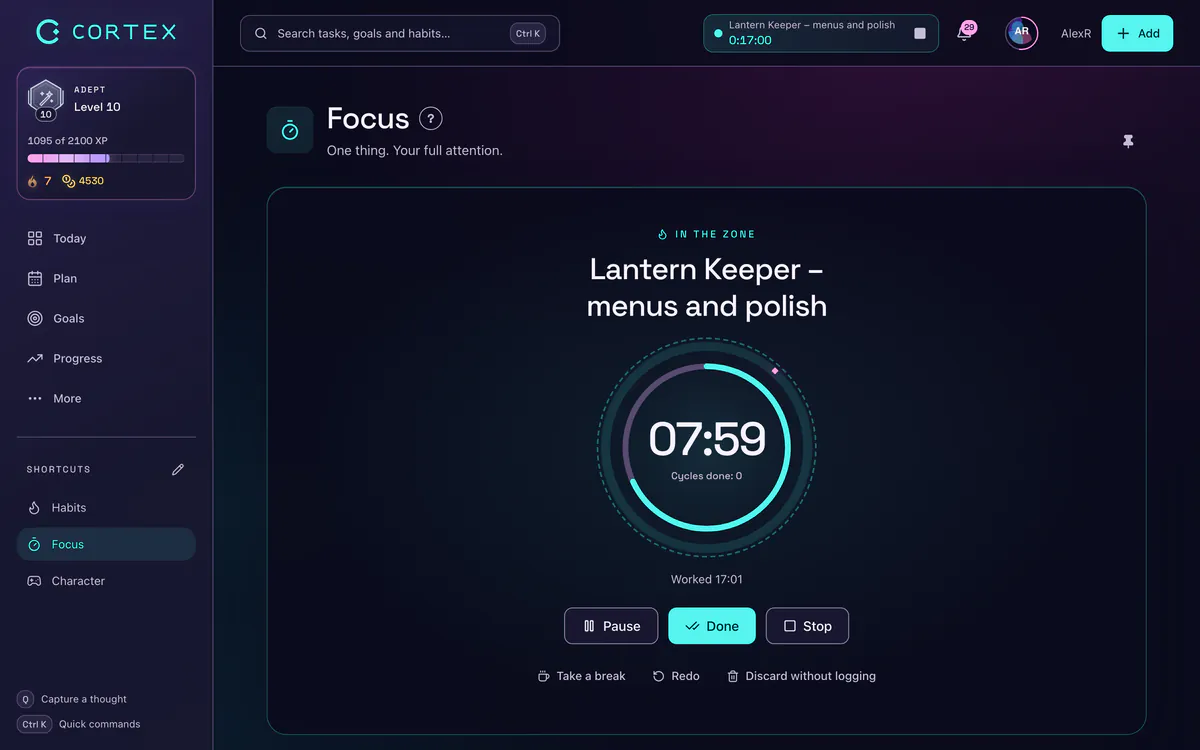
In CORTEX (free for everyone) press Q and type the task in one sentence, for example “Essay intro today ~25m”. Then start Focus on it with a custom length or Pomodoro 25/5: the countdown is visible, the time is logged automatically and you get XP the moment the task is done. If background sound helps you, turn on the Focus music module (Nature, Lo-fi and other stations). Picking three main things every morning is set up by the “Daily plan: 3 most important tasks” template (More → Templates). If you have an account, open the template.
Frequently asked questions
How can I focus with ADHD without medication?
Outside supports help: one task written outside your head, a visible countdown, short blocks with a break, distractions out of reach, movement and an immediate reward. The best-supported option is therapy that teaches these skills. Decisions about medication belong with a doctor; these strategies don’t replace treatment.
Does white noise help people with ADHD?
A 2024 meta-analysis found a small improvement on lab tasks with white or pink noise in people with ADHD, and none in people without ADHD. The evidence is still weak, but it is a cheap experiment. Music with lyrics tends to disrupt reading.
What is body doubling?
Body doubling means working in the presence of another person, in person or online, even if each of you does something different. Many people with ADHD say it helps them start and keep going. It has been little studied so far.
What work block length is best with ADHD?
There is no universal number. Start with short blocks, such as 10 to 25 minutes, with a clear break, and extend when it works. More important than the length is that the end of the block is visible and the start is small.
When should I see a doctor about focus problems?
When the difficulties limit you at school, at work or in relationships over a long period, or when they come with anxiety or low mood. Start with your family doctor. In a crisis, call your local emergency number or use findahelpline.com.
Sources and further reading
- Faraone, S. V. et al. (2021): The World Federation of ADHD International Consensus Statement: 208 evidence-based conclusions about the disorder – Neuroscience & Biobehavioral Reviews
- Safren, S. A. et al. (2010): Cognitive behavioral therapy vs relaxation with educational support for medication-treated adults with ADHD and persistent symptoms – JAMA
- Solanto, M. V. et al. (2010): Efficacy of meta-cognitive therapy for adult ADHD – American Journal of Psychiatry
- Nigg, J. T. et al. (2024): Systematic review and meta-analysis: Do white noise or pink noise help with task performance in youth with ADHD or elevated ADHD symptoms? – Journal of the American Academy of Child & Adolescent Psychiatry
- Söderlund, G., Sikström, S. & Smart, A. (2007): Listen to the noise: noise is beneficial for cognitive performance in ADHD – Journal of Child Psychology and Psychiatry
- Cerrillo-Urbina, A. J. et al. (2015): The effects of physical exercise in children with ADHD: a systematic review and meta-analysis of randomized control trials – Child: Care, Health and Development
- NICE (2018, updated 2019): Attention deficit hyperactivity disorder: diagnosis and management (NG87)
Level up your life
CORTEX is free for everyone. Tasks, a one-click day plan, time tracking, habits and rewards in one system – on desktop and mobile.
CREATE A FREE ACCOUNT