Intrinsic motivation: what it is, how it differs from extrinsic, and how to grow it
Intrinsic motivation means doing something because it is interesting, enjoyable or meaningful in itself – not for a reward, a grade or to avoid punishment. Extrinsic motivation is the opposite: the driver is something outside the activity, such as money or praise. According to self-determination theory, intrinsic motivation grows when you feel a sense of choice, competence and connection with others. Rewards can weaken it, but only under certain conditions. Below: definitions, examples, what the research actually says and how to support intrinsic motivation in yourself and others.
- Intrinsic motivation is wanting to do an activity for its own sake; extrinsic motivation is wanting to do it for what follows from it (a reward, recognition, avoiding punishment).
- Self-determination theory (Ryan & Deci, 2000) names three needs that feed intrinsic motivation: autonomy, competence and relatedness.
- A meta-analysis of 128 experiments found that expected tangible rewards tied to doing a task lower intrinsic motivation, while praise and informative feedback do not (Deci, Koestner & Ryan, 1999).
- Intrinsic motivation predicts mainly the quality of performance, incentives more its quantity; the two can work together (Cerasoli, Nicklin & Ford, 2014).
- Immediate enjoyment predicted persistence with long-term goals better than distant benefits (Woolley & Fishbach, 2017).
Intrinsic and extrinsic motivation: definitions and examples
Intrinsic motivation is when the activity pulls you in by itself. You read a book because it interests you. You play the guitar because you enjoy it. You help a friend because you care about them.
Extrinsic motivation means the reason lies outside the activity: you study for the grade, work for the pay cheque, exercise to look good in photos, tidy up because guests are coming.
| Activity | Intrinsic motivation | Extrinsic motivation |
|---|---|---|
| Studying | The topic fascinates me, I want to understand it | I need to pass the exam |
| Exercise | I love how I feel after a run | I want to lose weight by summer |
| Work | I enjoy solving problems | A bonus, a promotion |
| Tidying | I feel good in a tidy room | Guests are coming |
Between the two poles there is a spectrum. Richard Ryan and Edward Deci (2000) describe how you can make even an external reason your own: you exercise because you value your health, even if exercise itself doesn’t thrill you. This internalised motivation works almost as well as intrinsic motivation.
Three needs that feed intrinsic motivation
According to self-determination theory (Ryan & Deci, 2000), intrinsic motivation grows when three basic psychological needs are met:
- Autonomy – the feeling that it is your choice. Nobody checks on you every minute; you can choose how.
- Competence – the feeling that you can do it and are getting better. The task is a challenge, not a hopeless mountain.
- Relatedness – a sense of belonging. You do it with or for people you care about.
When one of these needs is missing, motivation weakens. That is why even a favourite activity stops being fun when someone constantly monitors it (autonomy), when you see no improvement (competence) or when you are doing everything alone (relatedness).
When rewards hurt and when they don’t
A classic experiment by Mark Lepper, David Greene and Richard Nisbett (1973): children who liked drawing were promised a certificate for drawing. Later, when the reward was gone, they drew less in their free time than children who had received no reward. This is called the overjustification effect – the external reason “overrides” the internal one.
A meta-analysis of 128 experiments (Deci, Koestner & Ryan, 1999), however, showed that this does not apply to all rewards:
- what hurts is mainly tangible rewards promised in advance and conditional on doing or completing an activity you already enjoy;
- unexpected rewards don’t hurt, and praise and feedback that tells you about improvement (“that went better than last time”) help.
Christopher Cerasoli and colleagues (2014) summarised 40 years of research: intrinsic motivation predicts mainly the quality of performance, external incentives more its quantity. They are not enemies – for boring routine (paperwork, cleaning) an external reward can help.
How to grow your own intrinsic motivation
- Find your reason. For each goal, write one sentence: “I’m doing this because…”. If all you find is “I have to”, look for the part that matters to you.
- Choose your way. Even with obligations, keep some choice: when, where, in what order, with what music. A small choice strengthens autonomy.
- Set the challenge just right. Too easy is boring, too hard is scary. In between is where flow happens too.
- Watch your improvement. Record progress, not just completed items. More in small wins.
- Bring in people. A partner or a group with the same goal meets the need for relatedness (accountability partner).
- Make the activity more enjoyable now. Kaitlin Woolley and Ayelet Fishbach (2017) found that with resolutions, persistence was predicted more by immediate enjoyment than by distant benefits. Choose a form of exercise you enjoy, not the “most efficient” one.
Intrinsic motivation in children, students and teams
The same principles apply when you want to motivate others:
- Offer choices where you can: the order of tasks, the method, the topic of a project.
- Praise specific improvement and effort, not just results or “talent”.
- Explain why. For required tasks, a meaningful rationale helps.
- Go easy on rewards tied to performance for activities that are already enjoyed.
If motivation has been completely missing for a long time, it is not a matter of technique – see no motivation to do anything.
Try it now in CORTEX
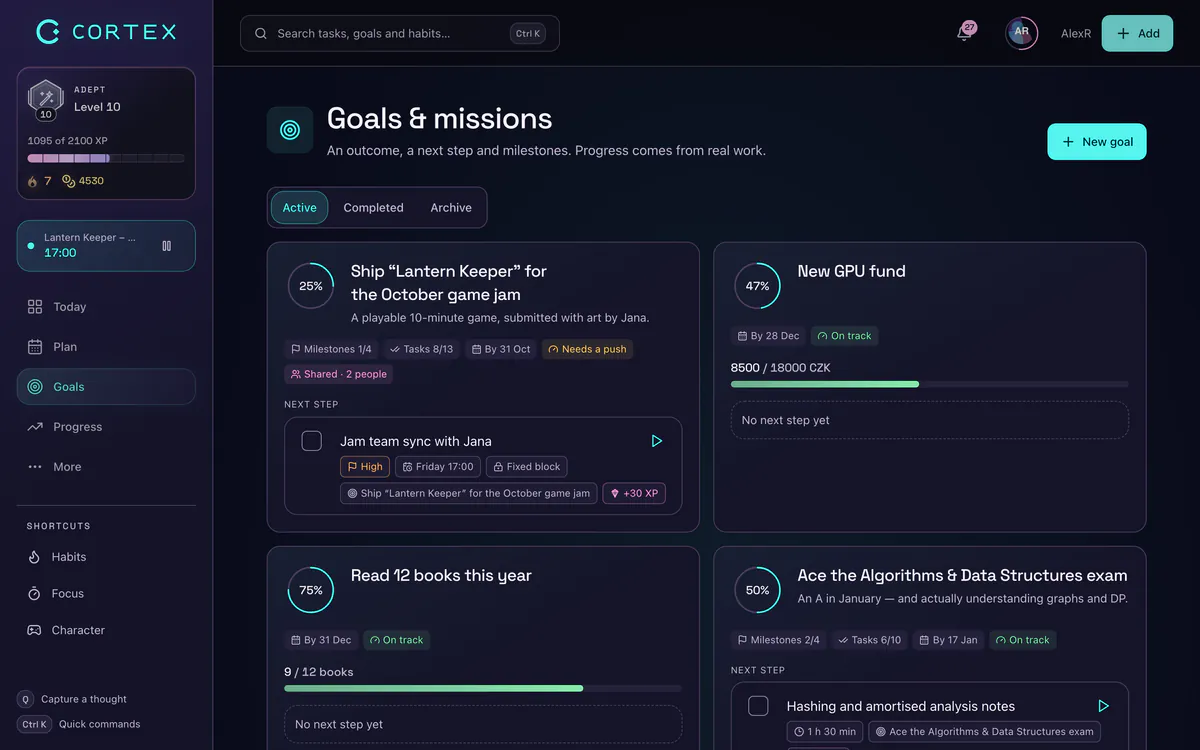
In CORTEX (free for everyone) every goal has a next step and milestones, and progress is calculated from real work – you see improvement, not just a list of chores. The “Goal achievement programme” template (More → Templates) walks you through seven steps, including why you want the goal and a weekly check-in. The need for connection is covered by Community: friends and alliances with a shared chat and weekly challenges. If you have an account, open the Goal achievement programme template.
Frequently asked questions
What is intrinsic motivation?
Intrinsic motivation is wanting to do something for its own sake – because it is enjoyable, interesting or meaningful to you. The opposite is extrinsic motivation, where the reason lies outside the activity: a reward, a grade, recognition or fear of punishment.
What is an example of intrinsic and extrinsic motivation?
A student who studies history because it fascinates them is intrinsically motivated. A student who studies only for the grade is extrinsically motivated. Most people have a mix of both for most activities.
Do rewards kill intrinsic motivation?
Sometimes. Tangible rewards promised in advance and tied to performance can reduce the desire to do something you already enjoy (Deci, Koestner & Ryan, 1999). Unexpected rewards do little harm, and praise or informative feedback tends to strengthen motivation.
How can I increase intrinsic motivation?
Support the three needs from self-determination theory: autonomy (your own choice), competence (a challenge that fits and visible improvement) and relatedness (doing it with people). It also helps to find a personal reason and make the activity more enjoyable right now.
Is extrinsic motivation bad?
No. For boring or necessary activities it is often what works, and research shows external incentives predict the quantity of work well. The ideal is a combination: external structure plus a personal reason.
Sources and further reading
- Ryan, R. M. & Deci, E. L. (2000): Self-determination theory and the facilitation of intrinsic motivation, social development, and well-being – American Psychologist
- Deci, E. L., Koestner, R. & Ryan, R. M. (1999): A meta-analytic review of experiments examining the effects of extrinsic rewards on intrinsic motivation – Psychological Bulletin
- Lepper, M. R., Greene, D. & Nisbett, R. E. (1973): Undermining children’s intrinsic interest with extrinsic reward – Journal of Personality and Social Psychology
- Cerasoli, C. P., Nicklin, J. M. & Ford, M. T. (2014): Intrinsic motivation and extrinsic incentives jointly predict performance: A 40-year meta-analysis – Psychological Bulletin
- Woolley, K. & Fishbach, A. (2017): Immediate rewards predict adherence to long-term goals – Personality and Social Psychology Bulletin
Level up your life
CORTEX is free for everyone. Tasks, a one-click day plan, time tracking, habits and rewards in one system – on desktop and mobile.
CREATE A FREE ACCOUNT