How to break down a big task into steps you can start today
To break down a big task, write the concrete outcome, split it into parts, and break each part into steps that take 15–60 minutes and start with a verb. It makes starting easier, shows progress and gives you more realistic time estimates – in research, unpacking a task into steps produced longer, more accurate estimates. Below is a five-step method and a worked example.
- Big tasks get postponed because it isn't clear where to start; a small, concrete step removes that problem.
- A good step starts with a verb, takes 15–60 minutes and has a clear finish ("Draft the proposal outline", not "Proposal").
- Unpacking a task into subtasks leads to longer, more realistic time estimates (Kruger & Evans, 2004).
- Specific goals outperform "do your best" (Locke & Latham, 2002), and visible progress motivates (Amabile & Kramer, 2011).
- Plan only the first steps in detail; add the rest as you go.
Why we postpone big tasks
"Build the website", "write the thesis", "clear out the garage". Tasks like these sit on a list for weeks because they aren't tasks, they are projects: you don't know where to start, and every glance reminds you how much work is ahead. So your brain reaches for something easier. More on why we delay in how to stop procrastinating.
Breaking it down changes the question from "how do I build the whole website" to "what do I do in the next hour". That one you can answer.
A 5-step method
- Write the outcome and a deadline. Not "website" but "Café website live by November 30". Specific goals lead to better performance than "do your best" (Locke & Latham, 2002).
- Split it into 3–7 parts. Big chunks: content, design, build, launch. More than seven means a level is missing.
- Break each part into steps. A step starts with a verb, takes 15–60 minutes and has a clear end: "Write the homepage copy", "Pick 10 photos".
- Estimate the steps and add them up. Kruger and Evans (2004) showed that unpacking a task into subtasks produces longer, more realistic estimates – the sum of the steps is usually more than your gut guess for the whole.
- Schedule the first step. Day and time: "Tue 9:00 write the homepage copy". A when-and-where plan makes it more likely you actually start (Gollwitzer & Sheeran, 2006).
Example: a website for a café
| Part | Steps (15–60 min) |
|---|---|
| Content | Outline the pages · Write the homepage copy · Write the menu copy · Send copy to the client for approval |
| Design | Collect 3 reference sites · Design the homepage · Pick 10 photos · Apply feedback |
| Build | Set up the project · Build the homepage · Build the menu page · Connect the booking form · Test on mobile |
| Launch | Set up the domain · Check all links · Hand over access · Send the invoice |
One scary task becomes seventeen steps of a few dozen minutes each. It is obvious where to start (outline the pages), and after a week of ticking off six steps you can see the project moving. For the time-tracking side, see the time tracking app.
How big should a step be?
- Too big ("do the design") gets postponed again. If you can't start it within five minutes, break it down further.
- Too small ("open the design file") clutters the list. Merge it with the next one.
- Ideal: 15–60 minutes with one clear result at the end. For deep work, up to 90 minutes is fine.
You don't have to plan the whole project down to the last step. Break the first two parts down in detail and fill in the rest as you get closer – the plan will change anyway.
Breaking down study and personal projects
The method works outside work too:
- An exam: outcome "Pass statistics on January 20", parts = chapters, steps = "Test myself on chapter 2 from memory (45 min)", "Do 10 regression problems". For the study side, see how to gamify studying.
- Moving house: parts = paperwork, packing, the move, the new place; steps = "Book the movers (20 min)", "Pack the bookshelf (60 min)".
- Taxes: parts = documents, calculation, filing; steps = "Download last year's income statement (15 min)", "Send documents to the accountant (15 min)".
- Decluttering: instead of "clean the flat", one room or one cupboard per step.
If you think in pictures, sketch the project as a mind map first and then turn the branches into steps.
Why seeing progress matters
Amabile and Kramer (2011) analysed the diaries of knowledge workers and found that the days people made progress on meaningful work – even small progress – were their most motivated days. Small steps give progress a shape: instead of "the website still isn't done" you see "6 of 17 steps done". Look back at it in your weekly review.
Breaking down big tasks in CORTEX
- A goal with progress – set up the project as a goal with a deadline; progress is calculated from finished tasks. See the goal tracker.
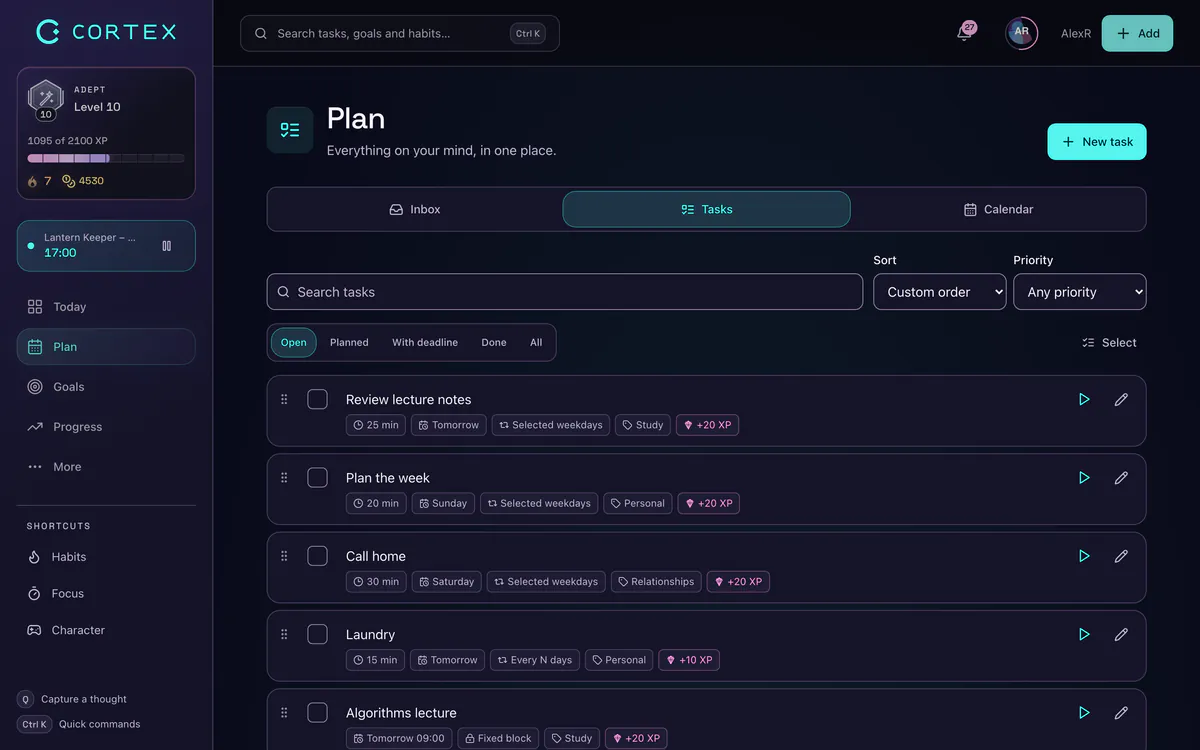
- Tasks and subtasks – parts as tasks, steps as subtasks with a progress bar.
- An estimate on every step – quick capture
Homepage copy tue @9:00 ~45m #website; Plan My Day then schedules steps by their estimates. - Mind map – the whole project as a graph of goal → tasks → subtasks; see the mind map app.
Frequently asked questions
How do I break a big task into smaller tasks?
Write the concrete outcome with a deadline, split it into 3–7 parts and break each part into steps that start with a verb and take 15–60 minutes. Estimate them and schedule the first step for a specific day and time.
How big should one step be?
Ideally 15 to 60 minutes with a clear result at the end. If you can't start a step within five minutes, it is still too big.
Why does breaking a task down help?
You know where to start, progress becomes visible and time estimates get more realistic: in Kruger and Evans (2004), unpacking a task into subtasks led to longer, more accurate estimates.
Do I need to plan the whole project up front?
No. Break the first parts down in detail and add the rest as you go. The plan changes during a project anyway.
What if I don't know the next step?
Then finding out is the next step – for example "Ask the client what they need (15 min)". Research and questions can be scheduled too.
Sources and further reading
- Kruger & Evans (2004): If you don't want to be late, enumerate: Unpacking reduces the planning fallacy, Journal of Experimental Social Psychology
- Locke & Latham (2002): Building a practically useful theory of goal setting and task motivation, American Psychologist
- Amabile & Kramer (2011): The Power of Small Wins, Harvard Business Review
- Gollwitzer & Sheeran (2006): Implementation intentions and goal achievement – a meta-analysis
Level up your life
CORTEX is free for everyone. Tasks, a one-click day plan, time tracking, habits and rewards in one system – on desktop and mobile.
CREATE A FREE ACCOUNT