How to get motivated to clean when you really don't want to
To get motivated to clean, don't take on the whole house – set a timer for 10 minutes and clean one zone, like the kitchen counter or one table. Cleaning is hard mostly because it feels endless; give it a clear start, a clear end and a small target, and your brain resists far less. Add music or a podcast you only allow while cleaning. Below: why we avoid cleaning, five steps for today, a simple weekly room-by-room schedule and how to get everyone at home involved.
- We put off cleaning mainly because it has no clear finish line and the mess feels like an endless task.
- A time frame (10 minutes) and one zone instead of "clean the house" help – a small visible result motivates the next step.
- Pairing an unpleasant task with a pleasant one (a podcast only while cleaning) increased consistency in an exercise experiment (Milkman et al., 2014).
- A specific "when and where" plan makes it more likely you actually follow through (Gollwitzer & Sheeran, 2006).
- A study by Saxbe and Repetti (2010) linked how people described their homes (cluttered, unfinished) with their mood and daily cortisol pattern; it was correlational, not proof of cause.
Why we don't feel like cleaning
Cleaning has features the brain hates: no clear end (there is always more), lots of tiny decisions (where does this go?) and results that vanish fast. When you see the whole mess at once, your brain rates it as a giant task – and the easiest option is to do nothing.
The fix is not more willpower but a smaller task with a start, an end and a visible result. For starting without motivation in general, see how to get motivated to do anything.
How to get motivated to clean: 5 steps for today
- Pick one zone. The kitchen counter, the dining table, the bathroom sink, the hallway floor. Not "the kitchen" – "the counter".
- Set 10 minutes. When it rings, you may stop. Often you will want to continue – but you don't have to.
- Start with what is most visible. An empty sink or a clear table makes the biggest difference in the least time.
- Put on a "cleaning only" podcast or playlist. Something you look forward to and only allow while cleaning.
- Take a before-and-after photo. Visible progress is a reward your brain understands instantly.
A weekly cleaning schedule, room by room
Instead of a big weekend deep-clean you keep postponing, spread it across the week: one area a day for 15–20 minutes, plus a daily 10-minute reset.
| Day | Area (15–20 min) | Daily reset (10 min) |
|---|---|---|
| Monday | Kitchen: counters, hob, sink | Dishes, table, things back in place |
| Tuesday | Bathroom and toilet | Dishes, table, things back in place |
| Wednesday | Vacuuming and floors | Dishes, table, things back in place |
| Thursday | Laundry: wash, hang, put away | Dishes, table, things back in place |
| Friday | Bedroom, bedding (every two weeks) | Dishes, table, things back in place |
| Saturday | One "project": fridge, wardrobe, windows | – |
| Sunday | Off | Prep for the week: bins, shopping list |
The schedule is a starting point – move days around to suit you. What matters is that each job has its day, so your head does not have to keep track.
Cleaning with others: agreements, not blame
- List everything that needs doing – including small things like taking out the bins or buying toilet paper.
- Split the areas and rotate them monthly so nobody is always stuck with the worst job.
- Clean at the same time. Fifteen minutes together on Saturday morning is easier than everyone separately – it works like an accountability partner.
- Turn it into a game for kids – whoever gets the toys into the box first picks the next song.
Why a tidy space pays off
Darby Saxbe and Rena Repetti (2010) asked couples to give a tour of their homes and then analysed how they talked about them. Women who described their homes as cluttered and full of unfinished projects had a worse mood over the day and a less healthy daily pattern of cortisol, a stress hormone. It was a small correlational study – it does not show that clutter causes stress, and the link could run the other way. But it echoes what many people feel: surroundings and mood are connected.
You do not need a perfect home. A few "calm spots" are enough – a clear desk where you work and a bed you look forward to.
If you have felt like doing nothing at all for a long time – not cleaning, not even things you used to enjoy – it may not be laziness. Talk to a doctor or therapist; more in no motivation to do anything.
Try it now: 10 minutes, one zone
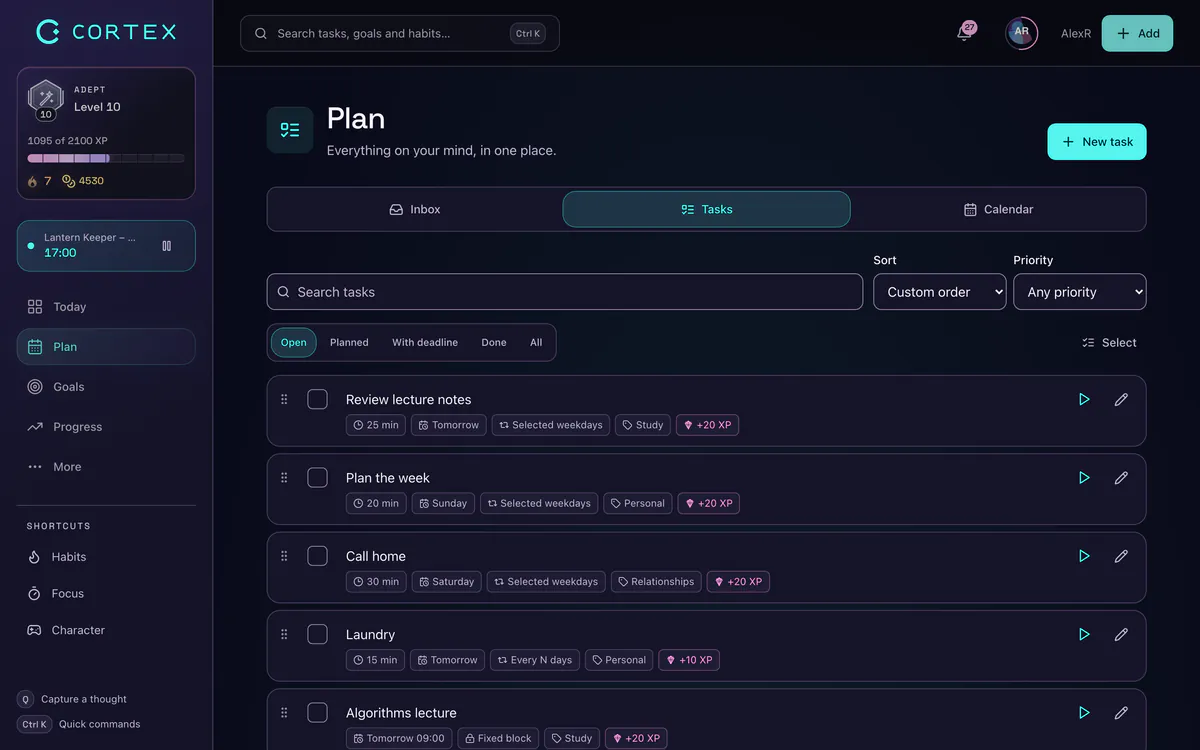
In CORTEX (free for everyone) you can schedule cleaning as repeating tasks: press Q and type "Bathroom Tuesday ~20m *weekly" or "Daily reset ~10m *daily". Tasks show up on the right day and earn XP when done. If you share a home, create a shared goal "Household" and assign tasks to each other inside it.
Frequently asked questions
How do I get motivated to clean when I don't feel like it?
Pick one small zone, like the counter, set a 10-minute timer and start with what is most visible. Put on music or a podcast you only allow while cleaning. After ten minutes you may stop – but you will often want to keep going.
How do I get motivated to clean my house when it is a mess?
Do not start with the whole house. Grab one bag for rubbish and one for things that belong elsewhere, then tackle one zone at a time, the most visible first. Quick visible progress gives you the energy for the next step.
How should I schedule house cleaning?
One area a day for 15–20 minutes (kitchen, bathroom, floors, laundry, bedroom) plus a daily 10-minute reset. Save bigger jobs like the fridge or windows for one day a week, one at a time.
How do I get motivated to clean when I'm tired or low?
Lower the bar: five minutes, one surface, then rest. Be kind to yourself. If you have felt low or unmotivated for weeks, it may not be about cleaning – talk to a doctor or a mental health professional.
How can I get others at home to help?
List everything that needs doing, split the areas and rotate them regularly. Clean at the same time, for example 15 minutes on Saturday morning, and make it a game for kids.
Sources and further reading
- Milkman, K. L., Minson, J. A. & Volpp, K. G. M. (2014). Holding the Hunger Games hostage at the gym: An evaluation of temptation bundling. Management Science, 60(2), 283–299
- Gollwitzer, P. M. & Sheeran, P. (2006). Implementation intentions and goal achievement: A meta-analysis of effects and processes. Advances in Experimental Social Psychology, 38, 69–119
- Saxbe, D. E. & Repetti, R. (2010). No place like home: Home tours correlate with daily patterns of mood and cortisol. Personality and Social Psychology Bulletin, 36(1), 71–81
Level up your life
CORTEX is free for everyone. Tasks, a one-click day plan, time tracking, habits and rewards in one system – on desktop and mobile.
CREATE A FREE ACCOUNT