How to calm down fast: breathing exercises and grounding, step by step
The quickest route to calm runs through your breath: slow it down and make the exhale longer. Two inhales through the nose and one long exhale through the mouth (the cyclic sigh), or slow breathing at five seconds in and five seconds out, can settle your body within a few minutes. When your head is too loud for that, the 5-4-3-2-1 technique brings your attention back to the present. Below: what happens in your body under stress, five techniques with exact steps, what the research really knows about them, what to watch out for and when it is time to get professional help.
- Under acute stress your heart and breathing speed up; breathing is one of the few body functions you can slow down on purpose, and your heart follows a little.
- Five minutes a day of cyclic sighing improved mood and slowed breathing over a month more than the same time spent meditating – but that is one study of about a hundred healthy people (Balban et al., 2023).
- Slow breathing at around six breaths a minute is linked with higher heart rate variability and feeling more relaxed (Zaccaro et al., 2018; Lehrer & Gevirtz, 2014).
- Box breathing, 4-7-8 and 5-4-3-2-1 grounding are popular and gentle, but there is little direct research on them.
- If you feel dizzy, stop and breathe normally. If anxiety or panic are frequent visitors, see a doctor; in a crisis, call your local emergency number or use findahelpline.com.
What happens in your body when you get thrown
When your brain reads a situation as a threat – an argument, an email from your boss, an exam, a piece of news that scares you – the alarm system switches on. The sympathetic nervous system and adrenaline push your heart rate up, your breathing gets faster and moves up into your chest, your muscles tense and your attention narrows. Great for running from danger. Less great in a meeting or at 2 a.m.
Against this “accelerator” there is a “brake”: the parasympathetic system, mainly the vagus nerve. This is where breathing comes in. As you breathe in, your heart speeds up very slightly; as you breathe out, it slows down. Lengthen the exhale and slow the whole breath, and you give the brake more room. A review by Russo and colleagues (2017) describes how slow breathing changes the work of the heart, blood vessels and lungs in healthy people.
Watch out for the opposite extreme: fast, deep breathing (“I can’t get enough air”) blows off more carbon dioxide than your body needs. That can make you dizzy, your fingers tingle and the fear grow. So the rule for every technique below is: slowly, gently, no forcing.
1. The cyclic sigh: the fastest reset
Your body sighs on its own when it needs to “air out” the lungs. For calming down, you repeat it on purpose:
- Breathe in through your nose to about two-thirds full.
- Straight away add a second, shorter sip of air through your nose to top up your lungs.
- Breathe out slowly through your mouth until the air runs out by itself. The exhale should be clearly longer than both inhales together.
- Repeat at your own pace for one to five minutes.
For a quick reset, two or three sighs are often enough. In the study by Melis Yilmaz Balban and colleagues (2023), people practised for five minutes a day for one month.
2. Slow 5/5 breathing (resonance breathing)
The second technique is the easiest rhythm to follow: slow your breathing to roughly six breaths a minute.
- Sit comfortably and let your shoulders drop.
- Breathe in through your nose for five seconds, letting your belly rise rather than your shoulders.
- Breathe out for five seconds, through your nose or mouth.
- Keep going for three to ten minutes. If five seconds feels like too much, start at four and build up.
Why six breaths a minute? Paul Lehrer and Richard Gevirtz (2014) explain that around this pace the rise and fall of your heart rate with each breath lines up with the reflex that keeps blood pressure steady, and heart rate variability is at its largest. Heart rate variability biofeedback is built on this. The exact pace differs a little from person to person; five seconds in and five out is a good place to start.
3. Box breathing 4-4-4-4: calm and focused
“Square” breathing has four sides of equal length. It suits moments when you want to calm down and stay sharp, for example before a presentation.
- Breathe in through your nose for a count of four.
- Hold for four, without straining.
- Breathe out for four.
- Pause with empty lungs for four.
- Repeat for two to five minutes. If the holds feel uncomfortable, shorten them to two.
Box breathing is hugely popular, but there are few direct studies of it. In the Balban study it was one of the groups; it helped too, but the cyclic sigh with its long exhale came out slightly ahead.
4. A longer exhale and 4-7-8 before sleep
In the evening, when you want to wind down, a breath with a much longer exhale fits well. The best-known version is 4-7-8:
- Breathe in through your nose for four.
- Hold for seven.
- Breathe out slowly through your mouth for eight.
- Four rounds are enough. If the long hold is uncomfortable, count faster or simply breathe “in for 4, out for 6”.
To be honest, there is little research on 4-7-8. A small study by Vierra and colleagues (2022) with 43 healthy young adults found that heart rate and systolic blood pressure dropped after a few sets. Whether 4-7-8 helps you fall asleep faster has not really been tested. It is a gentle ritual, though, and you will find more evening tips in how to fall asleep fast.
5. 5-4-3-2-1 grounding: when breathing isn’t enough
When your thoughts are racing or a wave of anxiety hits, breathing can feel like one more task. Then it helps to steer your attention to your senses:
- 5 things you can see. Name them, quietly if you like: “blue mug, window, shadow on the wall…”
- 4 things you can touch. The fabric of your jeans, the back of the chair, the cool desk.
- 3 sounds you can hear. A car outside, a fan, your own breath.
- 2 smells. If you can’t smell anything, recall two you like.
- 1 taste. A sip of water or whatever is in your mouth.
It is a common grounding exercise used by psychologists and therapists. There is little formal research on it; the idea is simple – attention that is busy with your senses has less room for spiralling.
What the research says (honestly)
| Technique | Good for | How strong the evidence is |
|---|---|---|
| Cyclic sigh | A quick reset, or a daily five-minute habit | One remote randomised study, about a hundred healthy adults, one month. Promising, needs confirming. |
| Slow 5/5 breathing | Calming down over a few minutes, regular practice | The best studied: a systematic review of slow breathing and years of biofeedback research. The studies are small and varied, though. |
| Box 4-4-4-4 | Calm and focus before a performance | Popular, few direct studies; in one study it helped about as much as the other breathing exercises. |
| 4-7-8 and longer exhales | Winding down in the evening | Little research; a small study showed an immediate drop in heart rate and blood pressure. Not tested for falling asleep. |
| 5-4-3-2-1 | A wave of anxiety, racing thoughts | Common in clinical practice, little formal research. |
In short: slow breathing with a longer exhale is a simple, free tool that may help you feel calmer. It is not a treatment and does not replace care for an anxiety disorder, depression or other conditions. The systematic review by Zaccaro and colleagues (2018) found only fifteen studies good enough to include, and they were small. For everyday calm, that is enough: try what suits you and notice how you feel.
Safety: what to watch out for
- If you feel dizzy or your fingers tingle, stop and breathe normally for a few minutes. Breathing exercises should never hurt or feel like a test.
- Shorten or skip the holds if they feel unpleasant. Box breathing and 4-7-8 also work without them.
- Fast, energising breathing (breathing in more and faster) is not suitable during pregnancy, with epilepsy, heart conditions or panic disorder. If you have a health condition, check with your doctor.
- Never hold your breath or breathe fast in water or while driving. You could pass out. To calm down at the wheel, plain calm breathing with your eyes open is enough – or pull over.
- Chest pain, breathlessness or a pounding heart that does not settle are not a job for a breathing exercise – call a doctor or your emergency number.
When to get help
Breathing exercises are a tool for everyday stress and tension. See your doctor or a psychologist when:
- anxiety, tension or panic come often and get in the way of work, school or home life,
- you avoid places, people or situations because of fear,
- you have slept badly for weeks or are using alcohol or other substances to cope,
- you have physical symptoms that worry you.
More ways to handle stress, right now and in the long run, are in how to manage stress.
Try it now in CORTEX
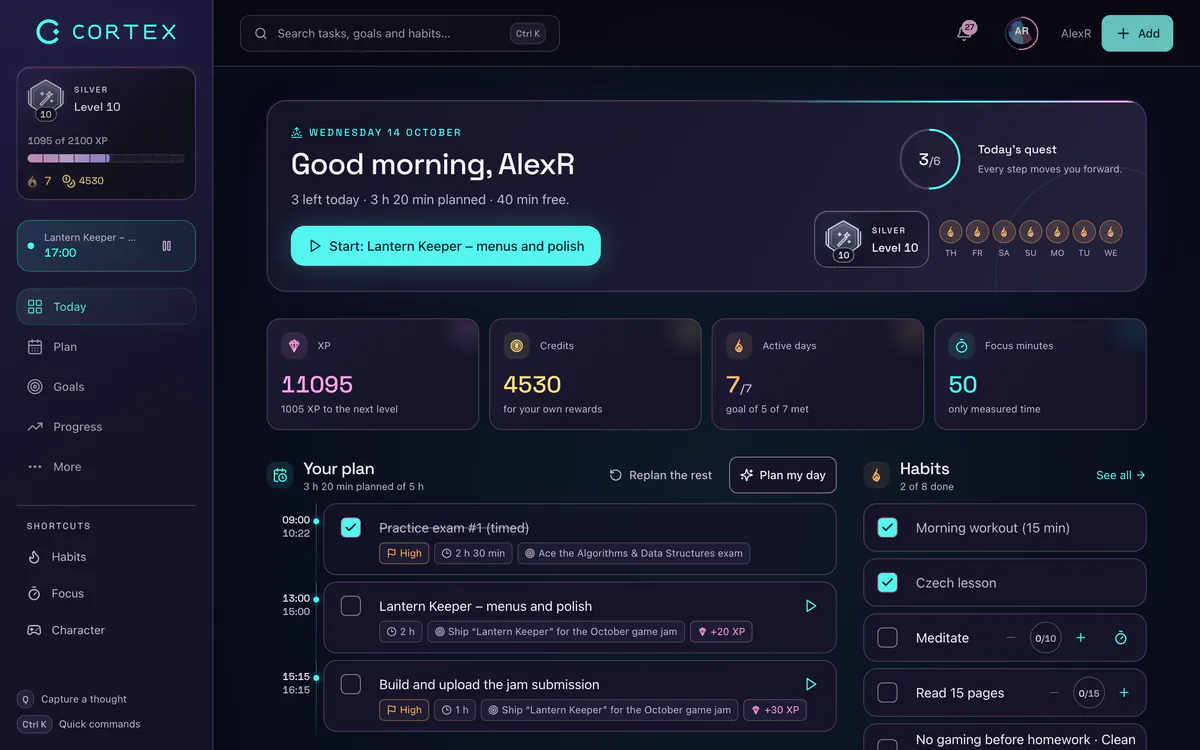
In CORTEX (free for everyone) you will find the Calm module. Breathing exercises follow a shape that grows as you breathe in and shrinks as you breathe out, so you don’t have to count. Pick a pattern – Calm down (cyclic sigh and slow 5/5 breathing), Focus (box 4-4-4-4), Before sleep (4-7-8) or Energy (a mild energising pattern with safety notes) – for 1, 3, 5 or 10 minutes. If you would rather not have motion on screen, a reduced-motion countdown mode is there; gentle haptics and soft sound cues are optional.
There is also a meditation timer with a soft starting bell, optional interval bells and a gentle closing chime that rises slowly, plus short guided scripts: breath focus, a body scan and a 10-minute deep rest. Background sounds (rain, brown noise, pink noise, a soft pad) are generated right in your browser and blended in a mixer.
- An SOS calm button: 60 seconds of 5-4-3-2-1 grounding, the sigh breath and helpline contacts.
- A “Take a breath” widget on your Today screen, and the offer of a one-minute breath before and after a focus block.
- Gentle reminders after long stretches of work, only if you switch them on: never during focus or quiet hours, at most once a day.
- A “10 days of meditation” template to get started, and every finished session adds “calm minutes” and a little XP.
If you have an account, open Calm in the app.
Frequently asked questions
How can I calm down in one minute?
Do two or three cyclic sighs: breathe in through your nose, top up with a short second inhale and breathe out slowly through your mouth. Then breathe slowly for a while, five seconds in and five seconds out. If your thoughts are racing, name five things you can see.
Which breathing exercise is best for stress?
The best supported is slow breathing at around six breaths a minute with a calm or longer exhale. In one study the cyclic sigh improved mood the most, but that result needs confirming. The best technique is the one you will actually do.
Does 4-7-8 breathing help you fall asleep?
There are no proper studies on falling asleep. A small study found that heart rate and blood pressure dropped after a few sets of 4-7-8. You can try it as a calm evening ritual; if the long hold is unpleasant, just breathe with a longer exhale.
Are breathing exercises safe?
Slow breathing is safe for most people. If you feel dizzy, stop and breathe normally. Fast, energising breathing is not suitable during pregnancy, with epilepsy, heart conditions or panic disorder. Never hold your breath in water or while driving.
Can breathing help during a panic attack?
A slow breath with a long exhale and 5-4-3-2-1 grounding may help you ride out the wave, but they are not a treatment. If attacks keep coming back, see a doctor or psychologist. In a crisis, call your local emergency number or find a helpline at findahelpline.com.
Sources and further reading
- Balban, M. Y. et al. (2023): Brief structured respiration practices enhance mood and reduce physiological arousal – Cell Reports Medicine
- Zaccaro, A. et al. (2018): How breath-control can change your life: A systematic review on psycho-physiological correlates of slow breathing – Frontiers in Human Neuroscience
- Lehrer, P. M. & Gevirtz, R. (2014): Heart rate variability biofeedback: how and why does it work? – Frontiers in Psychology
- Russo, M. A., Santarelli, D. M. & O’Rourke, D. (2017): The physiological effects of slow breathing in the healthy human – Breathe
- Vierra, J. et al. (2022): Effects of sleep deprivation and 4-7-8 breathing control on heart rate variability, blood pressure, blood glucose, and endothelial function in healthy young adults – Physiological Reports
Level up your life
CORTEX is free for everyone. Tasks, a one-click day plan, time tracking, habits and rewards in one system – on desktop and mobile.
CREATE A FREE ACCOUNT