Music for studying and focus: when it helps and when it hurts
Music for studying helps mainly by lifting your mood and masking a noisy environment – but music with lyrics usually makes reading and memorising text worse. For learning words, reading and writing, the safest choice is silence or instrumental music at low volume, such as lo-fi, ambient or nature sounds. For routine work, cleaning or sport, music can actually boost performance. The “Mozart effect” and miracle “alpha waves” have weak evidence. Below: what the research found and how to choose sound for each type of task.
- A meta-analysis of background music found that it disrupts reading and slightly impairs memory, but improves mood and sports performance (Kämpfe, Sedlmeier & Renkewitz, 2011).
- Vocal music disrupts short-term memory for words more than instrumental music, which was close to silence for trained participants (Salamé & Baddeley, 1989).
- For reading comprehension, people did best in silence; both liked and disliked music with lyrics lowered performance (Perham & Currie, 2014).
- The Mozart effect doesn’t hold up: the short-term boost is explained by better mood and arousal, not by Mozart (Thompson et al., 2001; Pietschnig et al., 2010).
- Binaural beats and “alpha waves” have mixed evidence from small studies; treat them as pleasant background, not a cure for poor focus.
The short answer: it depends on the task
| Task | What usually works | What to avoid |
|---|---|---|
| Reading, learning text, vocabulary | Silence, noise, quiet instrumental music | Music with lyrics, podcasts |
| Writing, coding | Instrumental, familiar music, ambient, nature | New songs with lyrics, sudden tempo changes |
| Maths, routine, spreadsheets | Favourite instrumental music | Very loud music |
| Cleaning, sport, monotonous work | Rhythmic music, lyrics are fine | – |
| Noisy places (café, open-plan office) | Noise, nature, lo-fi in headphones | A volume that tires you |
What the research says
- A null effect overall, with exceptions. Juliane Kämpfe and colleagues (2011) combined dozens of studies. On average, background music doesn’t change performance because positive and negative effects cancel out. Specifically, though, it disrupts reading, slightly impairs memory and improves mood and sports performance.
- Words compete with words. Pierre Salamé and Alan Baddeley (1989) showed that vocal music disrupts short-term memory for words more than instrumental music. For trained participants, instrumental music was not significantly worse than silence. The brain processes heard words automatically, even when you are not listening.
- Reading in silence wins. Nick Perham and Harriet Currie (2014) tested reading comprehension. People did best in silence; music with lyrics lowered performance even when they liked it.
- A review for learning. A systematic review by Daniela de la Mora Velasco and Atsusi Hirumi (2020) confirms that results are mixed and depend heavily on the type of music, the task and the person.
Mozart effect, lo-fi, alpha waves: myths and facts
- The Mozart effect. The claim that listening to Mozart raises intelligence was not supported by a meta-analysis by Jakob Pietschnig and colleagues (2010). William Thompson and colleagues (2001) showed that the short-term test boost after music is linked to better mood and arousal – and other enjoyable music worked just as well.
- Lo-fi. Hardly anyone has studied lo-fi specifically. But it has qualities research considers gentle: no lyrics, slow tempo, few surprises. It is a sensible choice, not a miracle.
- Alpha waves and binaural beats. A meta-analysis by Miguel Garcia-Argibay and colleagues (2019) found a medium effect of binaural beats on memory, attention and anxiety, but from 22 smallish, very varied studies. Treat the evidence as preliminary. “Alpha waves” on music services are also often not binaural beats at all, just calm music.
- White and pink noise. For people with ADHD they gave a small improvement in the lab, for others none (more in how to focus with ADHD).
How to choose music for studying
- No lyrics for anything made of words. Reading, vocabulary, writing.
- Familiar rather than new. New music grabs attention. A repeated playlist fades into the background.
- Quietly. Low enough to tune out.
- One source for the whole block. No skipping tracks; start the music at the beginning of the block and leave it.
- Test yourself. Two days with music, two without. Compare how much you get done per block or how much you remember.
Focus isn’t only about sound. Keeping your phone out of reach and sticking to one task does more (how to focus). How to study so your brain remembers: how to get motivated to study.
Music as a starting ritual
One quiet advantage: the same playlist at the start of every block can become a cue. You press play and your brain knows it’s work time. It works like habit stacking – an existing habit (music) triggers a new one (studying). The music doesn’t have to boost performance by itself; it is enough that it helps you start.
If you want to sink deeper into work, read about the flow state too.
Try it now in CORTEX
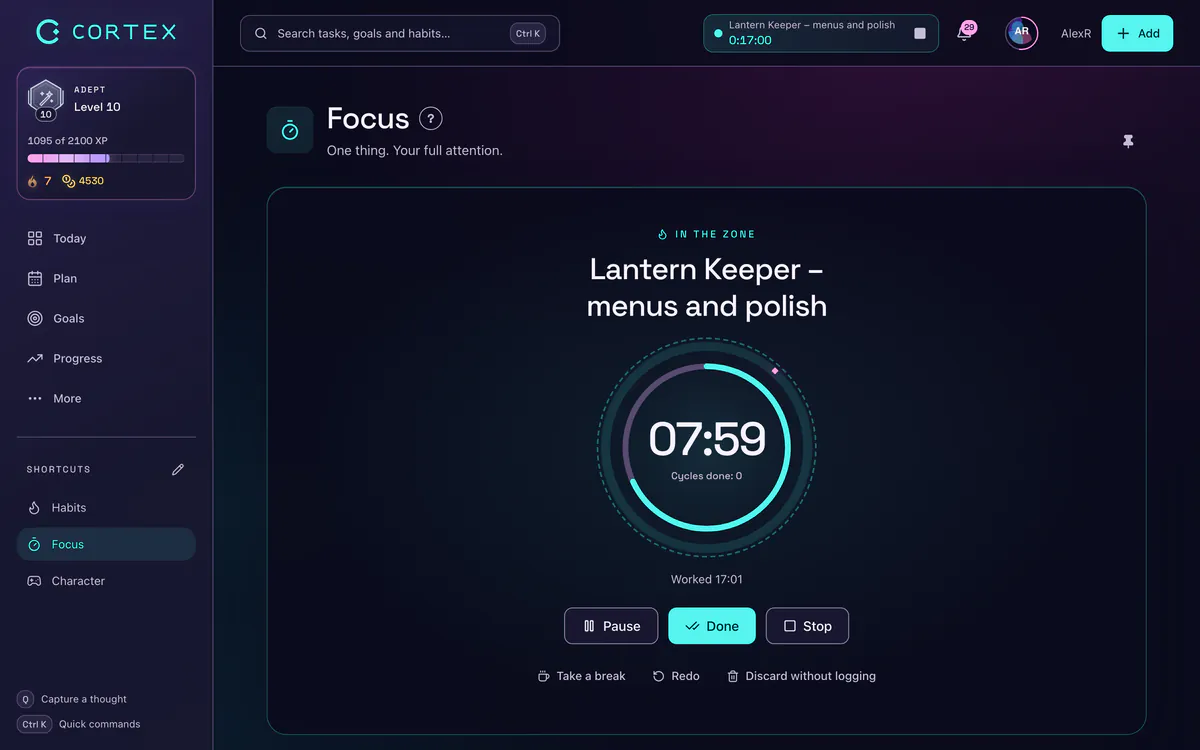
In CORTEX (free for everyone) turn on the Focus music module (Settings → Modules). In Focus you can then pick the Lo-fi, Synthwave, Nature, Zen or Alpha waves station, or your own video or playlist link. Stations only connect when you click, so nothing plays by itself. Two weeks of studying in 25 + 5 minute blocks are set up by the “Study focus” template (More → Templates). If you have an account, open the Study focus template.
Frequently asked questions
Does music help you study?
It depends on the task. For reading and learning from text, music with lyrics usually hurts, and even instrumental music can slightly distract. For routine work or in a noisy place, it can help by lifting your mood and masking noise. The safest option is silence or quiet music without lyrics.
What is the best music for focus?
Instrumental, calm, familiar and quiet: lo-fi, ambient, slow classical music or nature sounds. Avoid lyrics for word-based tasks and new music that grabs your attention.
Does the Mozart effect work?
Not in the way it is usually claimed. Meta-analyses found no lasting boost to intelligence. The short-term improvement after listening is explained by better mood and arousal and works with other enjoyable music too.
Do alpha waves and binaural beats work?
The evidence is mixed and comes mainly from small studies. One meta-analysis found a medium effect, but the studies varied a lot. Treat them as pleasant background that suits some people, not a proven method.
Is it better to study in silence?
For reading and memorising text, mostly yes – in studies, people did best in silence. If your surroundings are noisy, noise or quiet music without lyrics in headphones helps.
Sources and further reading
- Kämpfe, J., Sedlmeier, P. & Renkewitz, F. (2011): The impact of background music on adult listeners: A meta-analysis – Psychology of Music
- Salamé, P. & Baddeley, A. (1989): Effects of background music on phonological short-term memory – Quarterly Journal of Experimental Psychology
- Perham, N. & Currie, H. (2014): Does listening to preferred music improve reading comprehension performance? – Applied Cognitive Psychology
- Thompson, W. F., Schellenberg, E. G. & Husain, G. (2001): Arousal, mood, and the Mozart effect – Psychological Science
- Pietschnig, J., Voracek, M. & Formann, A. K. (2010): Mozart effect–Shmozart effect: A meta-analysis – Intelligence
- Garcia-Argibay, M., Santed, M. A. & Reales, J. M. (2019): Efficacy of binaural auditory beats in cognition, anxiety, and pain perception: a meta-analysis – Psychological Research
- de la Mora Velasco, E. & Hirumi, A. (2020): The effects of background music on learning: a systematic review of literature to guide future research and practice – Educational Technology Research and Development
Level up your life
CORTEX is free for everyone. Tasks, a one-click day plan, time tracking, habits and rewards in one system – on desktop and mobile.
CREATE A FREE ACCOUNT