Why do I procrastinate? Your brain is trying to feel better, fast
You procrastinate mainly because your brain wants quick relief from a bad feeling. A task stirs up boredom, uncertainty or fear of being judged, and the fastest fix is to do something else. The relief arrives now; the bill arrives later and lands on your future self. It is not laziness or a lack of willpower – it is a common, well-studied mechanism you can work with. Here is what happens, which tasks trigger it most, and five ways to weaken it.
- Procrastination is voluntarily delaying something you intended to do, even though you expect the delay to make things worse.
- Researchers Fuschia Sirois and Timothy Pychyl (2013) describe it as putting short-term relief from a bad mood ahead of long-term goals.
- We delay most the tasks that feel unpleasant, vague, far away and slow to pay off (Steel, 2007).
- The relief is short-lived: students who procrastinated were less stressed early in the semester but more stressed, and scored lower, by the end (Tice & Baumeister, 1997).
- Shrinking the first step, naming the feeling and forgiving past delays help; harsh self-criticism tends to keep the loop going (Wohl et al., 2010).
What procrastination is – and what it is not
Procrastination is putting off something you planned to do, by choice, while suspecting the delay will cost you. That last part matters: if you postpone a task because something more important came up, that is prioritising, not procrastinating.
It also is not the same as being lazy. A lazy person does not want to do anything and feels fine about it. A procrastinator usually does want to – and feels bad about not doing it. That bad feeling is the key to the whole pattern. More on the difference in how to stop being lazy.
The main reason: short-term mood repair
Picture a tricky email to your manager. You open it and feel a small knot: what if I get this wrong? Your brain instantly offers a way out – "let me check the news first". And it works: you feel better. That relief is a reward, and the brain remembers that escaping pays off.
Sirois and Pychyl (2013) summarised the research in exactly these terms: procrastination is mostly about managing emotions, not managing time. Experiments point the same way. Tice, Bratslavsky and Baumeister (2001) put people in a bad mood before a test; when participants believed their mood could change, they spent more of their prep time on fun distractions. When they were told their mood was temporarily "frozen", the bad mood no longer increased procrastination – escaping no longer promised relief.
Which tasks we put off most
Piers Steel (2007) reviewed hundreds of studies on procrastination and found a recurring pattern. We delay most the tasks that are:
- unpleasant or boring – paperwork, cleaning, revision,
- vague – "do the presentation" instead of "write three bullet points for slide one",
- far away – the deadline is next month, so why today,
- slow to pay off – an exam in June, your health in ten years.
The person matters too: people who are more impulsive, more easily distracted or less confident they can succeed delay more. Steel condensed this into a simplified "procrastination equation": motivation rises with your expectation of success and the value of the reward, and falls with how far away the reward is and how impulsive you are. Treat it as a map of where to push, not a precise formula.
| What makes the task feel bad | What helps |
|---|---|
| It is boring | Pair it with something you enjoy (a podcast only while cleaning), a short time box |
| It is vague | Write the first physical step – something you could film |
| It is far away | Set your own mini-deadline this week and tell someone |
| You fear judgement | Write a deliberately rough first draft for 15 minutes |
| You doubt yourself | Make the step so small you could do it on your worst day |
Why procrastination hurts more in the end
The relief is real, but brief. Dianne Tice and Roy Baumeister (1997) followed college students across a semester. The procrastinators started out happier and less stressed. By the end it flipped: more stress, more illness symptoms and lower grades. Delaying did not save anything; it moved the discomfort to later and added interest.
Research on the "future self" adds a piece of the puzzle. Hal Hershfield (2011) describes how people tend to see their future self a little like a stranger – which makes it easy to hand tomorrow's you the work, as if it were someone else.
Why beating yourself up backfires
Scolding yourself after procrastinating makes you feel worse – and feeling worse is exactly what pushes you to procrastinate. Michael Wohl, Timothy Pychyl and Shannon Bennett (2010) followed students between two exams: those who forgave themselves for putting off revision for the first exam procrastinated less before the second.
Forgiving yourself is not making excuses. It means saying "That happened. It is common. What will I do now?" and moving on without the extra weight.
5 steps that weaken the procrastination loop
- Name the feeling. Write one line: "I am avoiding X because it feels unclear / boring / scary."
- Shrink the first step. Not "write the essay" but "open the document and type the title". See how to break down a big task.
- Use a short timer. Five minutes, with permission to stop. Starting is usually the worst part; once you are moving, you tend to keep going.
- Decide when and where. "When I finish my coffee, I open the spreadsheet." These plans are called implementation intentions.
- Let go of yesterday. No "I'll start on Monday". Now is a fine moment for a small step.
For a ten-minute emergency plan and more techniques, read how to stop procrastinating.
Try it now: a two-minute experiment
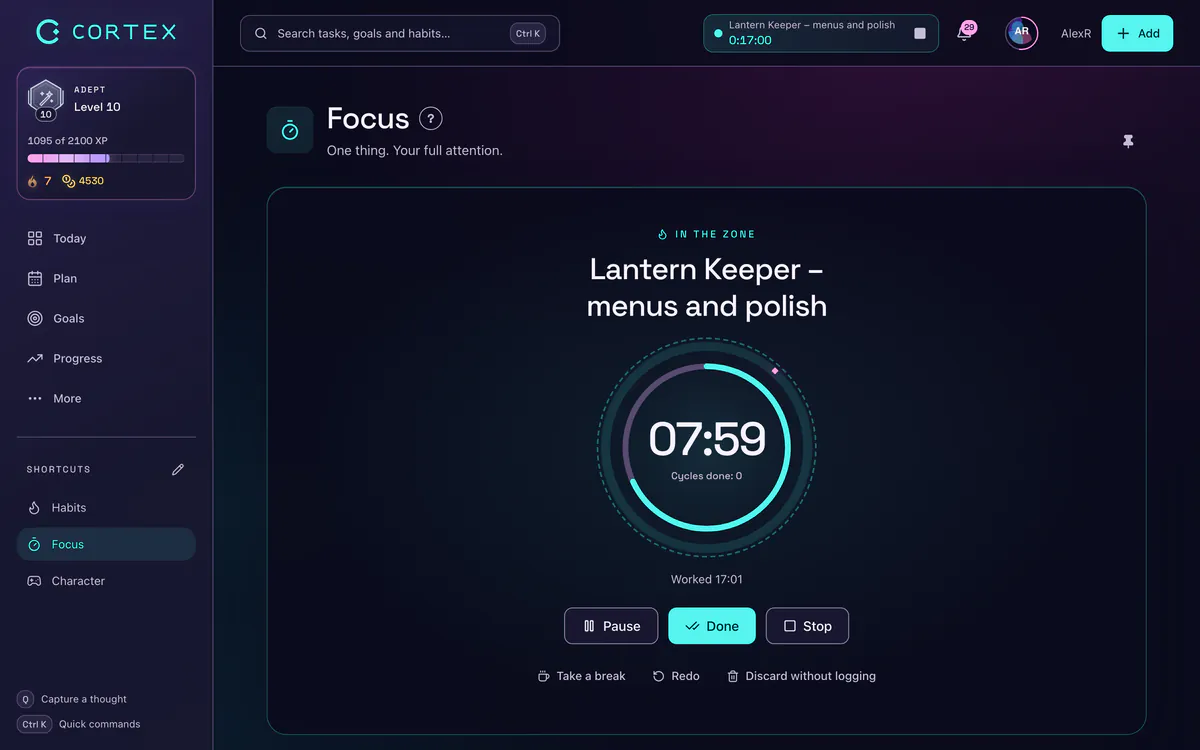
In CORTEX (free for everyone) this takes a minute: press Q and type the task, e.g. "Open essay today ~5m". Then start a Focus session with a custom length of five minutes. Finishing earns XP – a small, instant reward that reminds your brain that starting pays off.
Frequently asked questions
Why do I procrastinate even when I know I shouldn't?
Because procrastination is not a knowledge problem but a feeling problem. The task triggers discomfort and delaying brings instant relief. The brain prefers quick relief over a distant reward, even though you know it will be worse later.
Why do I procrastinate things I enjoy?
Even enjoyable things can carry pressure: you want them to go well, they take effort to start, or they compete with tiredness. If the start feels heavy, the same mood-repair loop kicks in. A tiny, low-stakes first step usually helps.
Is procrastination the same as laziness?
No. A lazy person does not want to do anything and is not bothered. A procrastinator usually wants to do the task and feels bad about delaying it. It is a way of avoiding an unpleasant feeling, not a character flaw.
Can ADHD or depression cause procrastination?
Procrastination is common with both, but it does not diagnose anything on its own. If delaying holds you back for a long time, or comes with low mood and loss of interest, talk to a doctor or a mental health professional.
How do I stop procrastinating right now?
Name the feeling the task gives you, shrink the first step to two to five minutes and do it. Remove one distraction, such as putting your phone in another room. Starting is the hardest part; after that you usually keep going.
Sources and further reading
- Sirois, F. & Pychyl, T. (2013). Procrastination and the priority of short-term mood regulation. Social and Personality Psychology Compass, 7(2), 115–127
- Steel, P. (2007). The nature of procrastination: A meta-analytic and theoretical review of quintessential self-regulatory failure. Psychological Bulletin, 133(1), 65–94
- Tice, D. M., Bratslavsky, E. & Baumeister, R. F. (2001). Emotional distress regulation takes precedence over impulse control. Journal of Personality and Social Psychology, 80(1), 53–67
- Tice, D. M. & Baumeister, R. F. (1997). Longitudinal study of procrastination, performance, stress, and health. Psychological Science, 8(6), 454–458
- Hershfield, H. E. (2011). Future self-continuity: How conceptions of the future self transform intertemporal choice. Annals of the New York Academy of Sciences, 1235, 30–43
- Wohl, M. J. A., Pychyl, T. A. & Bennett, S. H. (2010). I forgive myself, now I can study. Personality and Individual Differences, 48(7), 803–808
Level up your life
CORTEX is free for everyone. Tasks, a one-click day plan, time tracking, habits and rewards in one system – on desktop and mobile.
CREATE A FREE ACCOUNT