Dopamine detox: does it work? What dopamine really does
A dopamine detox does not work the way it is usually sold – you cannot drain or flush dopamine out of your brain. Your brain makes it all the time and needs it for movement, learning and motivation. Dopamine is not the "pleasure chemical" either; it is mostly a signal that says "this is worth the effort". What does work is the core idea hidden under the trendy name: cut back on specific habits that pull you in (like your phone in bed) and replace them with something that is good for you. Here is what dopamine really does, why scrolling hooks you and how to run a sensible version of a "detox".
- Dopamine is a neurotransmitter your brain produces constantly; a week without your phone does not "empty" or "reset" it.
- Research by Kent Berridge and Terry Robinson (1998) showed dopamine is linked mainly to wanting and motivation, not to pleasure itself.
- Dopamine neurons respond most to rewards that are better than expected, and later to the cues that announce them (Schultz, Dayan & Montague, 1997).
- The original "dopamine fasting" was about limiting specific compulsive behaviours, not fasting from dopamine – a misunderstanding Harvard Health pointed out in 2020.
- A sensible "detox" means picking one or two habits, adding friction and preparing a replacement – not banning everything enjoyable.
What a dopamine detox is and where it came from
A dopamine detox (or "dopamine fast") usually means a day or a week of avoiding anything pleasant or stimulating: phone, social media, games, sugar, music, sometimes even conversation. The promise is that your brain "resets" and ordinary things like work or reading feel interesting again.
The trend took off around 2019. Psychologist Cameron Sepah, whose name is linked to the term, described something different: a technique from cognitive behavioural therapy in which you limit specific behaviours that cause you problems, and the cues that trigger them. It was never about fasting from dopamine. Harvard Health's blog also pointed out that the popular version misread the science (Grinspoon, 2020).
What dopamine actually does in your brain
Dopamine is a neurotransmitter – one of the chemical messengers nerve cells use to pass signals. It is involved in movement, learning, attention and, above all, motivation. Put simply, it tells your brain: "This matters – go for it."
- Wanting, not liking. Kent Berridge and Terry Robinson (1998) showed that dopamine is linked mainly to how much we want something, not how much we enjoy it. Pleasure itself relies on other, separate "hotspots" in the brain (Berridge & Kringelbach, 2015).
- Surprise. Wolfram Schultz and colleagues (1997) found that dopamine neurons respond most when a reward is better than expected. Once we learn to expect it, they respond to the cue that announces it – a notification sound, an app icon.
- Willingness to make an effort. John Salamone and Mercè Correa (2012) summarise that dopamine helps decide whether an effort is worth it – which is why it matters for getting off the couch.
Why your phone and endless scrolling hook you
Phones and feeds are built on exactly what the dopamine system responds to: unpredictable rewards (you never know if the next video will be great), cues (notifications, icons, buzzing) and no natural stopping point (a feed that never ends). Every "maybe there is something new" strengthens the habit of reaching for the phone.
Dopamine does not get "used up". What changes is what you are used to: the brain gets accustomed to strong, frequent stimulation, ordinary things feel duller next to it, and a solid "cue → check" habit forms. The good news is that habits can be relearned. When the triggers are out of reach and you put something else in their place, the old path slowly fades.
Dopamine myths, checked
| Claim | What is true |
|---|---|
| "Dopamine is the happiness hormone." | It is linked mainly to wanting and motivation, not to pleasure itself (Berridge & Robinson, 1998). |
| "A week offline resets your dopamine." | It does not reset your dopamine levels – but it does change habits and cues, and that is worthwhile. |
| "Social media fried your dopamine." | Dopamine does not run out. You got used to strong stimulation and built a checking habit. |
| "You must avoid everything enjoyable." | Banning all fun is unnecessary and often makes cravings stronger. Pick the one or two habits that cause trouble. |
| "Supplements boost dopamine and motivation." | We do not give advice on this – ask a doctor or pharmacist about medicines and supplements. |
A sensible "detox": the simplified week
- Pick one or two habits that eat most of your time or sleep, e.g. "short videos in bed" and "phone while studying".
- Add friction. Move the app off your home screen, turn off notifications, charge your phone outside the bedroom. More steps mean less autopilot.
- Prepare a replacement. What will you do instead? A book by the bed, a walk, ten squats, one line in a journal. Ideas in the dopamine menu.
- Give yourself a goal you want. Dopamine works for you when a small, visible goal with quick progress is in front of you.
- Review after a week. What was easy, what was not, what will you keep?
If you feel no drive for anything at all, read no motivation to do anything too – motivation often shows up after the first step.
Try it now: one small, visible goal for today
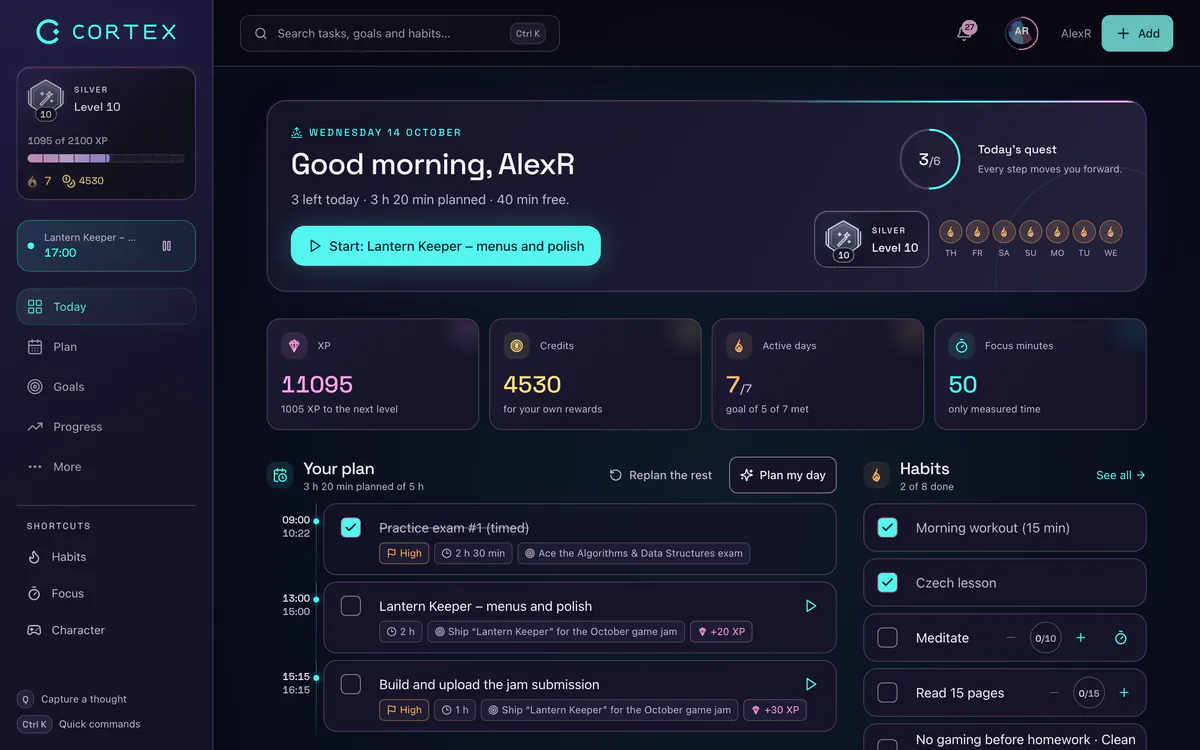
In CORTEX (free for everyone) you add it as a task for today and see it on the Today screen. Finishing earns XP and credits you can spend on your own rewards in the shop. Progress is visible right away – a healthy way to put dopamine to work.
Frequently asked questions
Does a dopamine detox work?
Not literally: you cannot drain or reset dopamine. What can help is the idea often hidden behind it – cutting back on specific habits (like your phone in bed), making them harder to reach and replacing them with something good for you.
What is a dopamine detox?
A popular trend of avoiding anything pleasant for a day or a week so the brain supposedly "resets". It is more accurate to talk about limiting specific compulsive activities and the cues that trigger them.
How long should a dopamine detox last?
There is no scientifically set length, because nothing is being "cleansed". In practice, changing one or two habits for at least a week and then reviewing what you want to keep works well.
Is dopamine the pleasure chemical?
Not really. Dopamine is linked mainly to wanting, motivation and learning from rewards; pleasure itself involves other brain systems. That is why you can strongly want something you do not actually enjoy – endless scrolling is the classic example.
How can I increase dopamine naturally?
Your brain makes dopamine all the time; the point is not to boost it but to give it good targets. Small visible goals with quick progress, movement, sleep and activities you enjoy help. Ask a doctor about medicines or supplements.
Sources and further reading
- Berridge, K. C. & Robinson, T. E. (1998). What is the role of dopamine in reward: hedonic impact, reward learning, or incentive salience? Brain Research Reviews, 28(3), 309–369
- Schultz, W., Dayan, P. & Montague, P. R. (1997). A neural substrate of prediction and reward. Science, 275(5306), 1593–1599
- Berridge, K. C. & Kringelbach, M. L. (2015). Pleasure systems in the brain. Neuron, 86(3), 646–664
- Salamone, J. D. & Correa, M. (2012). The mysterious motivational functions of mesolimbic dopamine. Neuron, 76(3), 470–485
- Grinspoon, P. (2020). Dopamine fasting: Misunderstanding science spawns a maladaptive fad. Harvard Health Blog
Level up your life
CORTEX is free for everyone. Tasks, a one-click day plan, time tracking, habits and rewards in one system – on desktop and mobile.
CREATE A FREE ACCOUNT