Gamified productivity app: a to-do list that plays like an RPG
A gamified productivity app is a task manager that adds game mechanics – points, levels, rewards, streaks or teams – so that finishing real work feels like progress in a game. CORTEX is a free one: every task you complete pays out XP and credits, your character levels up across five attributes, and you spend credits in a reward shop stocked with rewards you define yourself (a specialty coffee, a movie night, new running shoes). Below: what makes gamification work instead of feeling like a gimmick, the exact CORTEX game loop with real numbers, and a 10-minute quick start.
- CORTEX is a free gamified productivity app – tasks, a one-click day plan, time tracking and habits, with XP, levels and real-life rewards.
- In CORTEX, a finished task earns XP based on its priority and time estimate, plus credits based on priority, difficulty and estimate; credits buy rewards you create yourself.
- Your character has five attributes – STR, INT, WIS, CHR and DEX – that grow with the type of work you finish, so the character sheet shows where your effort actually goes.
- Credits cannot be bought with money, so there is no pay-to-win: the only way to a reward is finished work.
- CORTEX runs in the browser and installs as a PWA on iOS and Android; it is not in the App Store or Google Play.
What a gamified productivity app actually is
Researchers define gamification as "the use of game design elements in non-game contexts" (Deterding et al., 2011). In a productivity app that means the boring loop of write task → do task → tick box gets the feedback a game gives you: a number goes up, a bar fills, something unlocks.
Why it helps: real-life rewards for work are slow and fuzzy – the paycheck, the grade, the fitter body arrive weeks later. A game gives a visible result right now. If your brain is wired for "I need a reward now" (very common with ADHD-style attention, procrastination or plain burnout), closing that gap is the whole point.
Gamified apps fall into a few families:
- RPG task managers – tasks give XP and gold, you level a character (Habitica is the classic; CORTEX belongs here too).
- Focus games – you grow a tree or keep a pet alive while you stay off your phone (Forest).
- Points on a normal to-do list – a score and levels added to a conventional task manager (Todoist Karma).
- Habit games – streaks, badges and challenges around daily habits.
For a side-by-side look at those options, see the best gamified productivity apps compared.
Gamification that works vs. gimmicks
A meta-review of empirical studies found that gamification mostly produces positive effects, but that the results depend heavily on the context and on the people using it (Hamari, Koivisto & Sarsa, 2014). In practice, the same few design choices decide whether a game layer keeps you going for months or becomes noise after a week:
| Works | Gimmick | Why |
|---|---|---|
| Rewards scale with real effort (bigger, harder tasks pay more) | Every checkbox pays the same | Flat rewards teach you to farm tiny tasks and avoid the important one. |
| Rewards you choose yourself | Generic badges only | A badge means nothing outside the app; "movie night" does. |
| Progress you can see across weeks (levels, attributes, review) | Only a streak counter | One bad day resets a streak to zero; levels never go backwards. |
| Costs for bad behavior that are small and fair | Harsh punishment | Big penalties make people quit the app, not the bad habit. |
| No real-money shortcuts | Pay-to-win boosts | If XP can be bought, it stops meaning "I did the work". |
| Optional social layer | Forced public leaderboards | Competition motivates some people and shames others. |
There is also a well-known risk: external rewards can crowd out the enjoyment of tasks you already like (Deci, Koestner & Ryan, 1999). The practical fix is to point the game layer at the work you avoid – admin, chores, the scary email – and keep it light on things you do for fun anyway.
The CORTEX game loop, step by step
Here is the full loop in CORTEX, with the numbers the app uses at the time of writing (October 2026).
1. Task: capture it in one line
Press Q and type a sentence like Send proposal to Corner Café tomorrow @10:00 ~30m !p1 #clients. CORTEX reads the date, time, duration, priority and goal from the text. Every task can also carry a difficulty from trivial to heroic. Details are on the to-do list app page.
2. Payout: XP and credits
When you tick a task off, two currencies arrive:
| XP (levels you up) | Credits (you spend them) | |
|---|---|---|
| Base by priority | low 10 · medium 20 · high 30 · critical 50 | low 10 · medium 20 · high 35 · critical 50 |
| Time bonus | +1 XP per 2 minutes of estimate (max +240) | +1 credit per 10 minutes of estimate (max +12) |
| Difficulty | – | × 0.5 trivial · × 1 easy · × 1.5 medium · × 2 hard · × 3 heroic |
Worked example: "Homepage wireframes", critical, estimate 90 minutes, difficulty easy. XP = 50 + 45 = 95 XP. Credits = 50 × 1 + 9 = 59 credits. The same task marked hard would pay 50 × 2 + 9 = 109 credits. Completing a whole goal adds 100 XP and a credit payout set by the goal’s difficulty.
Other XP sources: good habits (+20 per check-in; bad habits cost 20), a daily log with 7–9 hours of sleep or 30+ minutes of exercise, and achievements.
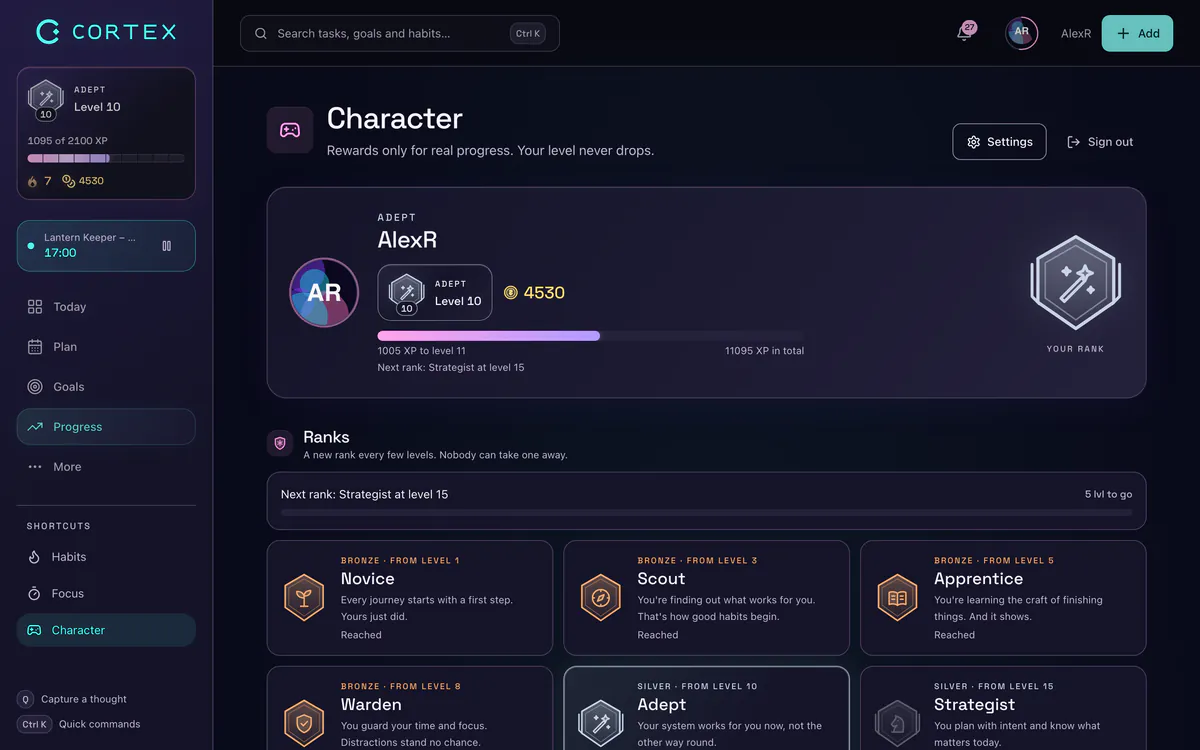
3. Level, rank and five attributes
Your level follows a curve: level = √(XP ÷ 100), rounded down. Level 2 needs 400 XP, level 3 needs 900, level 4 needs 1,600, level 5 needs 2,500 – so early levels come fast and later ones take real weeks. Each level band has a rank with its own artwork.
Separately, finished work feeds five attributes, depending on the category of the goal a task belongs to:
- STR (Vitality) – health and fitness tasks, plus logged sleep and exercise.
- INT (Intellect) – deep work and study (also the default for uncategorized work).
- WIS (Wisdom) – journaling and meditation.
- CHR (Charisma) – social and networking tasks, community posts.
- DEX (Dexterity) – quick tasks and chores; any task estimated at 15 minutes or less adds a DEX bonus.
The radar chart is honest: if INT is at level 6 and STR is stuck at 1, you know what next month needs. More on the character side on the life RPG page.
4. Reward shop: real-life loot
Credits go to the reward shop, where you create your own rewards and set their price. Consumable rewards (Basic, Common, Uncommon) are just for you; equipment (Rare, Epic, Legendary) shows on your public profile. There is a daily reward of 100 credits and a mystery box for 250 that either pays out a bundle of credits or nothing.
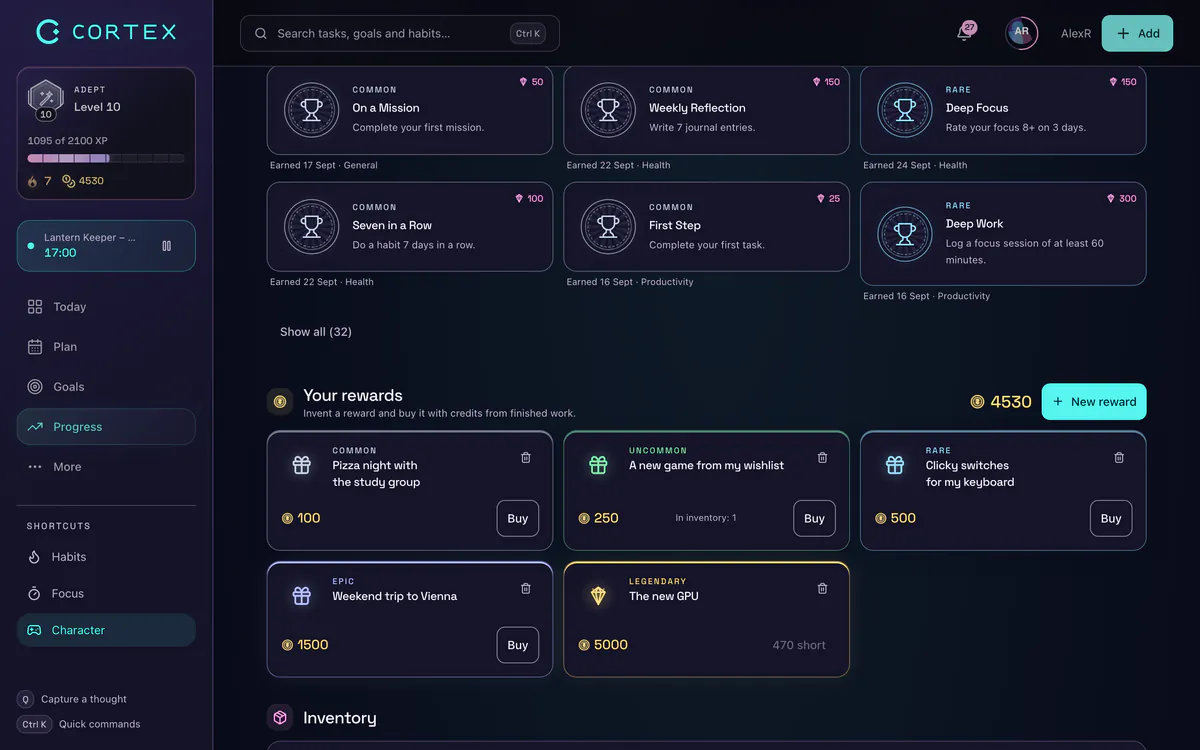
Pricing tip: anchor rewards to effort. If a normal focused day earns you roughly 150–250 credits, a 100-credit coffee is a daily treat, a 500-credit item is a weekly one and a 3,000-credit item is a month of consistent work.
5. Alliances: optional multiplayer
If you like company, join or create an alliance (the Factions tab): invite people, give them roles, chat, and take on alliance challenges where finished tasks count toward the team. There is a leaderboard, a social feed, direct messages and you can gift credits or items. Everything social is opt-in; the solo game is complete without it.
Beyond the game: the productivity tools underneath
A game layer on a weak to-do list is still a weak to-do list. These are the tools the XP sits on top of:
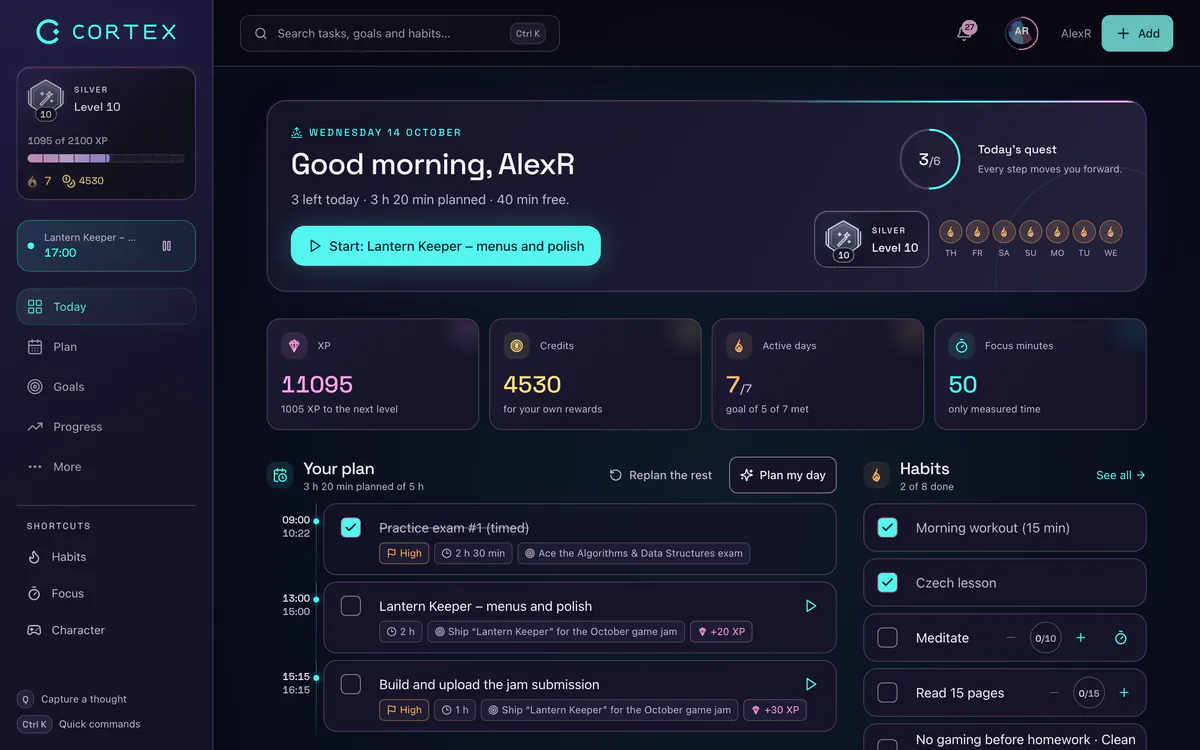
- Today screen – named work timers, your "prime directive", habits, morning brief and evening debrief.
- Plan My Day – one click turns today’s list into a time-blocked schedule.
- Focus timer – 15, 25 or 50-minute countdowns for the Pomodoro Technique.
- Time tracking – hours per project, CSV and PDF export.
- Habits – good habits (buffs) and bad ones (debuffs).
- Goals, vision board and mind map – long-term direction, shareable goals.
Quick start: your first 10 minutes
- Sign up with email, Google or Facebook. On your phone, open the site in the browser and use "Add to Home Screen" to install it like an app.
- Create one goal for this month and pick a category – that decides which attribute your tasks feed.
- Dump your tasks with quick capture (press Q). Add estimates like
~30m; they drive both XP and the day plan. - Stock the shop with three rewards: a small one (~100 credits), a medium one (~500) and a big one (~3,000).
- Click Plan My Day, apply the plan and start the first block with a 25-minute focus timer.
- Finish one task and watch the payout. Then claim your daily 100 credits.
Want the theory behind building your own system, with or without an app? Read how to gamify your life.
Who it suits – and who should pick something else
CORTEX is a good fit if you are a freelancer, student or gamer who wants tasks, a day plan, time tracking and habits in one place, and you respond to visible progress and rewards.
Pick something else if you need native App Store apps, a Kanban board, calendar sync with Google or Outlook, team workspaces, or imports from another app – CORTEX does not offer those. If you want a pure, deep RPG with a big existing community, Habitica is still the better choice; compare them on the Habitica alternatives page.
Habitica, Forest and Todoist are trademarks of their respective owners. CORTEX is not affiliated with them.
Frequently asked questions
What is a gamified productivity app?
It is a to-do list, planner or habit tracker that adds game mechanics such as XP, levels, rewards, streaks or team challenges. The goal is to give you instant, visible feedback for real work, which makes boring or scary tasks easier to start.
What is the best free gamified productivity app?
It depends on what you need. Habitica is the classic RPG habit app, Forest is great for phone-free focus, and CORTEX combines an RPG layer with a full planner, one-click day plan, time tracking and habits – free for everyone, with no ads and no paid boosts.
Is there a to-do list app with rewards?
Yes. In CORTEX every finished task earns credits based on its priority, difficulty and time estimate, and you spend them in a reward shop on rewards you define yourself, such as a coffee, a game night or new gear.
Is CORTEX really free?
Yes. All features are free for everyone, with no credit card required and no ads. Credits inside the game cannot be bought with real money.
Does gamification actually make you more productive?
Studies show mostly positive effects, but they depend on the person and on the design (Hamari et al., 2014). It works best when rewards scale with real effort, rewards are personally meaningful and the game is aimed at tasks you tend to avoid.
Is there a CORTEX app for iPhone or Android?
CORTEX is a web app you can install as a PWA: open it in your phone browser and add it to the home screen. It is not listed in the App Store or Google Play.
Sources and further reading
- Deterding, Dixon, Khaled & Nacke (2011): From game design elements to gamefulness
- Hamari, Koivisto & Sarsa (2014): Does gamification work? A literature review of empirical studies
- Deci, Koestner & Ryan (1999): A meta-analytic review of experiments examining the effects of extrinsic rewards on intrinsic motivation
- Ryan & Deci (2000): Self-determination theory and the facilitation of intrinsic motivation
Level up your life
CORTEX is free for everyone. Tasks, a one-click day plan, time tracking, habits and rewards in one system – on desktop and mobile.
CREATE A FREE ACCOUNT