The multitasking myth: why your brain switches instead – and how to switch less
In psychology, multitasking means trying to do two or more tasks at the same time – writing an email during a meeting, for example. With demanding tasks, though, the brain does not really run two tracks at once: it switches rapidly between them, and every switch costs a little time and accuracy. (In computing, multitasking means something else – several apps running at once – and that is not what this page is about.) Below: what the studies found, where the popular "40%" and "23 minutes" figures come from, what attention residue is, and six ways to switch less.
- Multitasking on demanding tasks is in practice rapid switching of attention between them.
- In experiments by Rubinstein, Meyer and Evans (2001), each switch between tasks cost time, and the cost grew with the complexity of the task rules.
- Sophie Leroy (2009) described "attention residue": after leaving an unfinished task, part of your attention stays with it and performance on the next task drops.
- The claim that multitasking costs "up to 40% of productive time" is an estimate attributed to psychologist David Meyer by the APA, not the result of one specific measurement.
- "23 minutes" is the average time people in Gloria Mark's field study took to return to an interrupted task (doing about two other things in between) – not the time needed to refocus.
Multitasking in psychology vs. in computers
The word multitasking comes from computing. A computer or phone "multitasks" when several programs run and the operating system shares processing time between them so quickly that it looks simultaneous. If you are looking for how to show two apps side by side on a tablet, check your device's help pages – this article is about people.
In psychology, multitasking means trying to attend to two or more tasks at once: talking on the phone while typing, listening to a lecture while answering messages, driving while setting up navigation. Interestingly, for tasks that need attention, the brain behaves a bit like an old computer – it does not run in parallel, it switches. Just not as fast, and not for free.
What happens in your brain when you switch
Joshua Rubinstein, David Meyer and Jeffrey Evans (2001) ran four experiments in which people either repeated the same task or alternated between two (sorting shapes by different rules, solving different kinds of arithmetic). Alternating cost time. The loss was larger when the rules were more complex and smaller when people had a clear cue about which task came next. The authors explain it as two steps: the brain first has to switch the goal ("now I am doing B") and then load the rules of the new task.
Stephen Monsell (2003), reviewing task-switching research, added an important point: even when people have time to prepare for a switch, part of the cost remains – the so-called residual switch cost. Preparation helps but does not erase it.
One switch in the lab costs fractions of a second. In real life, though, you are not switching between two simple rules but between a half-written proposal, a chat and a spreadsheet – and not once but dozens of times an hour.
Try it yourself in two minutes
Grab paper and a stopwatch. First write the letters A to T and below them the numbers 1 to 20, and time yourself. Then write the same thing alternating: A1, B2, C3… up to T20, and time it again. The second round is the same number of characters, yet it is usually noticeably slower and has more mistakes. It is a simple demonstration, not a scientific experiment – but it is exactly what happens when you answer a chat between paragraphs.
Attention residue: why unfinished work slows you down
Sophie Leroy (2009) added another layer. When you move from a task you have not finished to a different one, part of your attention stays "stuck" on the first. She calls this attention residue. In her experiments, people who moved on from unfinished work performed worse on the next task than those who had completed the previous one.
That explains a familiar feeling: you are answering an email, but in your head you are still fixing the presentation. You are fully present for neither. Leroy and Theresa Glomb (2018) later showed a simple help: before an interruption, quickly write down where you stopped and what you will do next (a ready-to-resume plan). Your head can then let the task go. More practical techniques in how to focus.
Heavy multitaskers are worse at it
Eyal Ophir, Clifford Nass and Anthony Wagner (2009) compared people who habitually use many media at once (TV, chat, web, music) with people who rarely do. The result was the opposite of what you might expect: "heavy" media multitaskers were more easily distracted by irrelevant stimuli and did worse, not better, on a task-switching test.
An important caveat: this was a correlational study. It does not show that multitasking damages your ability to focus – it could also be that people who find it harder to focus multitask more. Later studies on the topic gave mixed results. The safe conclusion is modest: multitasking a lot probably will not turn you into a skilled multitasker.
Myths and numbers that get passed around
Articles about multitasking love big numbers. Here is what is actually behind them:
| Claim | Where it comes from | Verdict |
|---|---|---|
| "Multitasking costs up to 40% of productivity" | The American Psychological Association's page on switching costs says David Meyer stated that even brief mental blocks created by switching can cost as much as 40% of productive time. It is his estimate, not a number measured in the 2001 study. | Expert estimate, not a measurement |
| "After an interruption it takes 23 minutes to refocus" | Gloria Mark told Gallup that in their field study (Mark, Gonzalez & Harris, 2005) people returned to interrupted work after 23 minutes and 15 seconds on average, doing about two other things in between. | Time to return to the task, not time to refocus |
| "Interruptions slow work down" | In a lab experiment with 48 participants, Mark, Gudith and Klocke (2008) found that interrupted people finished email tasks faster with no difference in quality – but with more stress, frustration, time pressure and effort. | More like "faster, but stressed" |
| "Women multitask better than men" | A popular claim without robust evidence. | Not supported |
| "Multitasking lowers IQ by 10 points" | Circulates from media reports; we found no peer-reviewed study showing it. | Do not use |
Research agrees that switching has a cost. How big it is depends on the tasks, how often you switch and whether you leave work unfinished. There is no single magic number.
When multitasking is fine
Doing two things at once is no problem when at least one is automatic and needs no decisions:
- walking and talking on the phone, ironing and a podcast, tidying and music,
- instrumental music during routine work (song lyrics clash more with writing),
- short mechanical work (sorting, copying) while listening to something light.
Trouble starts when both tasks need language, decisions or working memory: writing an email in a meeting, studying while chatting. And where safety is involved – a phone while driving does not belong in the "fine" category.
6 ways to switch less
- Batch email and messages. Instead of checking continuously, handle them at two to four fixed times a day. See task batching.
- One block = one task. Pick one thing for 25–50 minutes and start a countdown. How to set up blocks: the Pomodoro Technique; for longer focused work, deep work.
- Before an interruption, write where you stopped. One line – "next: finish the pricing paragraph" – reduces attention residue (Leroy & Glomb, 2018).
- Turn off notifications that are not from people. News, social media and "someone liked your post" can wait.
- One window. Close tabs that do not belong to the block. What you cannot see cannot pull you away.
- Phone out of reach. Not face down on the desk, but in another room or in your bag.
Try it now: one block, one task in CORTEX
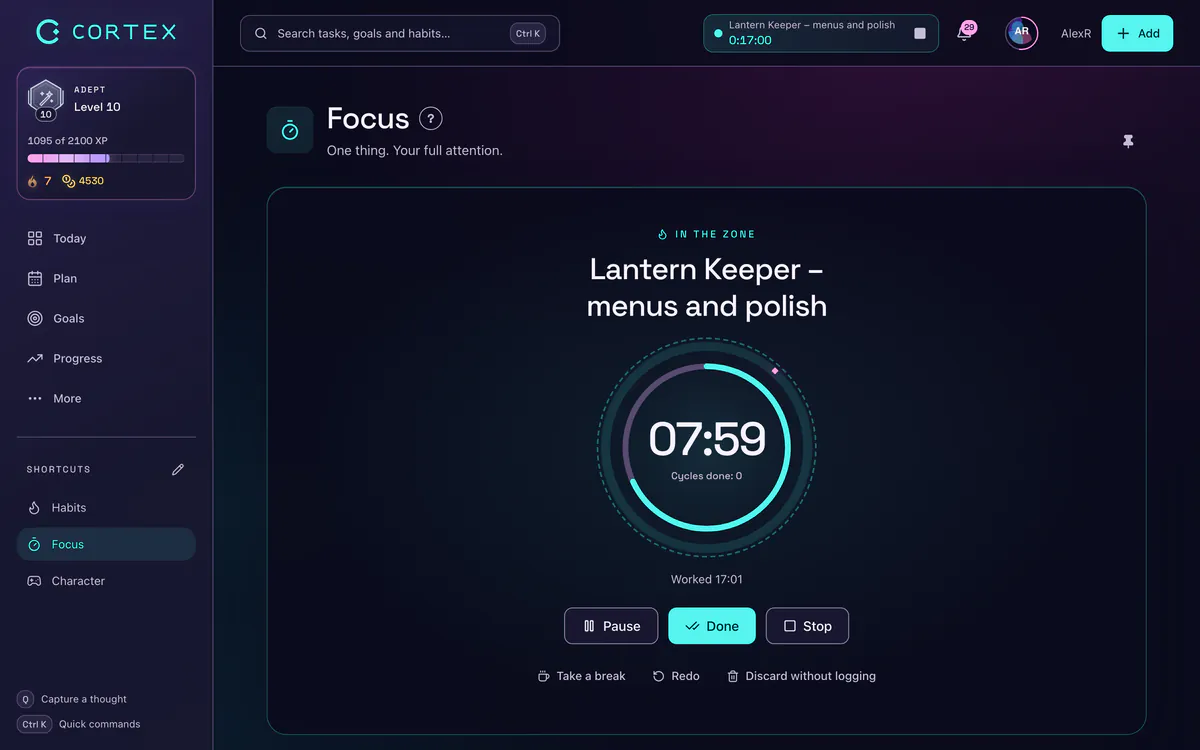
CORTEX (free for everyone) makes "one block, one task" easy: Focus with a countdown (Pomodoro 25/5, 50/10 or a custom length) runs on a single task, and quick capture (key Q) sends stray thoughts to the Inbox without leaving your block. Only one timer runs at a time, so switching to other work saves the previous time.
Frequently asked questions
Is multitasking a myth?
Partly. You can do two automatic activities at once, like walking and talking. With two demanding tasks, though, the brain switches rather than works in parallel, and task-switching research (Rubinstein et al., 2001; Monsell, 2003) shows that switching has a cost.
How much time does task switching cost?
One switch costs fractions of a second in the lab and grows with task complexity; in real work, losses add up with the number of switches. The often-quoted "40%" is an estimate attributed to psychologist David Meyer, and "23 minutes" is the average time to return to interrupted work in Gloria Mark's field study.
What is attention residue?
Attention residue is the part of your attention that stays with a previous, unfinished task after you switch to a new one. Sophie Leroy (2009) showed it lowers performance on the next task. Writing a short "next step" note before switching helps.
Are women better at multitasking?
There is no robust scientific evidence for this widespread claim. Results of individual studies differ and depend more on the type of task and practice than on gender.
How do I stop multitasking?
Work in single-task blocks with a countdown, handle email and messages in batches, turn off unnecessary notifications and keep your phone out of reach. Write stray thoughts down instead of acting on them, and note where you will continue before an interruption.
Sources and further reading
- Rubinstein, J. S., Meyer, D. E. & Evans, J. E. (2001). Executive control of cognitive processes in task switching. Journal of Experimental Psychology: Human Perception and Performance, 27(4), 763–797
- Monsell, S. (2003). Task switching. Trends in Cognitive Sciences, 7(3), 134–140
- Leroy, S. (2009). Why is it so hard to do my work? The challenge of attention residue when switching between work tasks. Organizational Behavior and Human Decision Processes, 109(2), 168–181
- Leroy, S. & Glomb, T. M. (2018). Tasks interrupted: How anticipating time pressure on resumption of an interrupted task causes attention residue and low performance on interrupting tasks and how a "ready-to-resume" plan mitigates the effects. Organization Science, 29(3), 380–397
- Ophir, E., Nass, C. & Wagner, A. D. (2009). Cognitive control in media multitaskers. PNAS, 106(37), 15583–15587
- Mark, G., Gudith, D. & Klocke, U. (2008). The cost of interrupted work: More speed and stress. CHI 2008
- Mark, G., Gonzalez, V. M. & Harris, J. (2005). No task left behind? Examining the nature of fragmented work. CHI 2005
- Gallup Business Journal (2006). Too many interruptions at work? Interview with Gloria Mark
- American Psychological Association: Multitasking: Switching costs
Level up your life
CORTEX is free for everyone. Tasks, a one-click day plan, time tracking, habits and rewards in one system – on desktop and mobile.
CREATE A FREE ACCOUNT