Implementation intentions: the one sentence that makes you follow through
An implementation intention (an if–then plan) is a specific sentence in the form "When situation X happens, I will do Y." For example: "When I finish my morning coffee, I open my essay." Instead of a vague "I'll study more", you decide in advance when, where and what exactly you will do – and your brain then responds to that situation almost automatically. A meta-analysis of 94 tests found such plans markedly increase the chance that you act on your intention (Gollwitzer & Sheeran, 2006). Below: why it works, how to write one, and fifteen examples.
- An implementation intention is a plan in the form "When X happens, I will do Y" that links a specific situation to a specific action.
- Peter Gollwitzer and Paschal Sheeran (2006) combined 94 independent tests and found a medium-to-large effect on goal attainment.
- Employees prompted to write down the date and time of their flu shot got vaccinated more often (37.1% vs 33.1%) (Milkman et al., 2011).
- A large newer meta-analysis of 642 tests confirmed the benefit of if–then plans across many areas of life (Sheeran, Listrom & Gollwitzer, 2024).
- Plans work best when the situation is clear and easy to recognise and the action is small and concrete.
What an implementation intention is
Most resolutions take the form of a goal: "I want to exercise more", "I want to study regularly". Psychologist Peter Gollwitzer (1999) described why there is often a gap between such an intention and action: at the moment you could act, you do not remember the goal, or you decide all over again – and comfort wins.
An implementation intention bridges that gap. It adds a precise plan to the goal: when, where and what. It looks like this:
The situation becomes a trigger. When it happens, you do not need to think or persuade yourself – you just keep a promise you made in advance.
What the research shows
- A strong effect across areas. Gollwitzer and Sheeran (2006) summarised 94 independent tests – from health to studying – and found a medium-to-large effect of if–then plans on whether people actually carry out their goal.
- One sentence, a real difference. Katherine Milkman and colleagues (2011) sent company employees information about flu shots. Those who got a card prompting them to write down the date and time they would go got vaccinated 37.1% of the time; the control group 33.1%.
- It works for exercise too. A meta-analysis by Bélanger-Gravel and colleagues (2013) found a smaller but consistent effect of plans on physical activity.
- Confirmed at scale. Paschal Sheeran, Olivia Listrom and Peter Gollwitzer (2024) confirmed the benefit of planning across many areas in a meta-analysis of 642 tests and described which components help most.
An if–then plan is not magic – it will not do the work for you, and it will not help if you do not really want the goal. But it is one of the best-supported and cheapest tools for getting past "I meant to, but…".
How to write a good if–then plan
- Pick one goal. Not five at once.
- Find a situation that is sure to happen. Ideally something you already do: morning coffee, getting home from work, closing your laptop, brushing your teeth.
- Make the action specific and small. "I open my maths notebook" beats "I study".
- Write it as a full sentence. "When I finish my morning coffee, I open my maths notebook and do one problem."
- Add a plan for the obstacle. "If on my way to training I think I'm not in the mood, then I tell myself: just ten minutes."
15 implementation intention examples
| Area | When… | …then |
|---|---|---|
| Study | When I get home from school and take off my shoes, | I sit at my desk and review vocabulary for 10 minutes. |
| Study | When my Monday 5 pm reminder goes off, | I open my textbook and write 3 questions. |
| Work | When I switch on my computer, | I write the 3 things I will move forward today before opening email. |
| Work | When something else pops into my head during a focus block, | I write it down in one line and go back to work. |
| Work | When it is Friday at 2 pm, | I send invoices and check payments. |
| Exercise | When I finish my morning coffee, | I change and do 10 minutes of exercises. |
| Exercise | When I am on a phone call, | I walk around the room. |
| Exercise | When it rains and I don't want to run, | I do a 15-minute workout video at home. |
| Cleaning | When I finish dinner, | I wash the dishes and wipe the table (10 minutes). |
| Sleep | When it is 10:30 pm, | I put my phone on charge outside the bedroom. |
| Phone | When I reach for my phone for no reason, | I put it down and take three deep breaths. |
| Water | When I sit down at my desk, | I fill my water bottle. |
| Procrastination | When I catch myself putting something off, | I write a two-minute first step and do it right away. |
| Relationships | When I sit down with tea on Sunday evening, | I message one person I haven't written to in a while. |
| Review | When it is Sunday at 7 pm, | I do a 20-minute weekly review. |
Common mistakes
- A vague situation. "When I have time" never comes. You need a clear moment.
- Too big an action. "Then I study for an hour" falls apart at the first sign of tiredness. Start small.
- Too many plans at once. Ten new plans drown each other out. Start with one or two.
- A plan only in your head. Write it down and keep it visible or as a reminder.
If–then plans are also at the heart of how habits form – more in how to build habits and how to get motivated to do anything.
Try it now: write your first plan
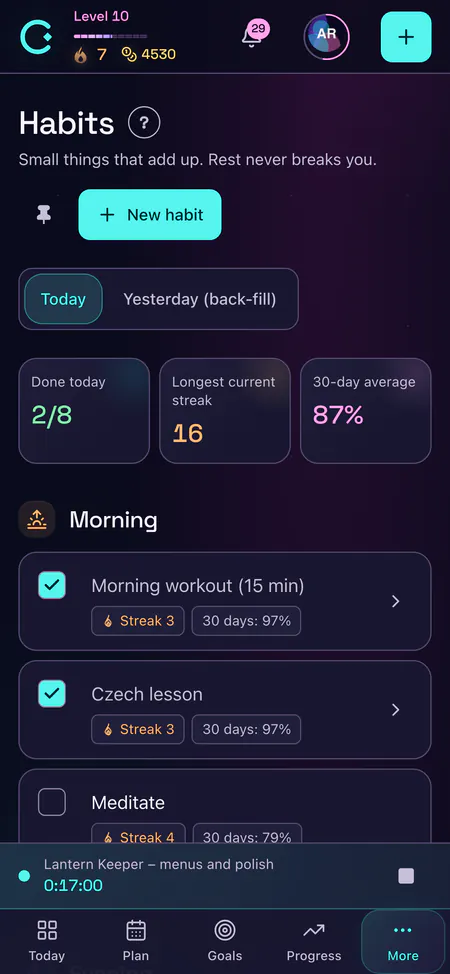
In CORTEX (free for everyone) turn the plan into a habit or a repeating task with a time: press Q and type something like "After school: vocab @16:30 ~10m *daily". The task shows up at the right time every day and earns XP when done. Put the trigger ("After school:") right in the name so you see it every time.
Frequently asked questions
What is an implementation intention?
An implementation intention is a plan in the form "When situation X happens, I will do Y". It links a specific trigger (a time, place or event) to a specific action, so you do not have to decide again in the moment.
Do implementation intentions really work?
Yes, they are among the best-supported techniques. A meta-analysis of 94 tests found a medium-to-large effect (Gollwitzer & Sheeran, 2006), and a newer meta-analysis of 642 tests confirmed benefits across many areas. They will not help if you do not really want the goal, though.
What is an example of an implementation intention?
"When I finish my morning coffee, I will do 10 minutes of exercises." Or: "When I sit down at my desk, I will write the three things I will move forward today before opening email."
What is the difference between a goal and an implementation intention?
A goal says what you want to achieve ("exercise more"). An implementation intention says when, where and how you will do it ("Monday at 7 am in the living room, 15 minutes of exercises"). They work best together.
How many if–then plans should I have?
Start with one or two. Once they become automatic, add more. Too many new plans at once drown each other out and are easy to abandon.
Sources and further reading
- Gollwitzer, P. M. (1999). Implementation intentions: Strong effects of simple plans. American Psychologist, 54(7), 493–503
- Gollwitzer, P. M. & Sheeran, P. (2006). Implementation intentions and goal achievement: A meta-analysis of effects and processes. Advances in Experimental Social Psychology, 38, 69–119
- Milkman, K. L., Beshears, J., Choi, J. J., Laibson, D. & Madrian, B. C. (2011). Using implementation intentions prompts to enhance influenza vaccination rates. PNAS, 108(26), 10415–10420
- Bélanger-Gravel, A., Godin, G. & Amireault, S. (2013). A meta-analytic review of the effect of implementation intentions on physical activity. Health Psychology Review, 7(1), 23–54
- Sheeran, P., Listrom, O. & Gollwitzer, P. M. (2024). The when and how of planning: Meta-analysis of the scope and components of implementation intentions in 642 tests. European Review of Social Psychology
Level up your life
CORTEX is free for everyone. Tasks, a one-click day plan, time tracking, habits and rewards in one system – on desktop and mobile.
CREATE A FREE ACCOUNT