To do list template (free printable) and how to write one you finish
This to do list template is a one-page daily sheet built on the 1-3-5 rule: one big task, three medium tasks and five small ones, plus a parking lot for everything that isn't for today. Print it below (A4 or US Letter), then use the seven rules on this page to write a list you can actually finish by evening.
- The 1-3-5 rule limits a daily to-do list to 9 items: 1 big task, 3 medium tasks and 5 small tasks. It was popularized by the career site The Muse and is credited to its co-founder Alex Cavoulacos.
- A finishable list has a fixed size, tasks that start with a verb, an estimate for each task and a total that fits about 70% of your available time.
- Keep two lists: a master list (everything, anytime) and a daily list (only what you commit to today). Most failed to-do lists are master lists pretending to be daily ones.
- The printable template has the 1-3-5 slots with estimate columns, a "Not today" parking lot and a "Waiting for" list, on one A4 or US Letter page.
- In CORTEX, a free gamified productivity app, you type tasks in one sentence – "Send proposal tomorrow @10:00 ~30m !p1" – and date, time, duration and priority are filled in for you.
Print the 1-3-5 to-do list template
One page, one day. The button prints only the sheet; choose "Save as PDF" in the print dialog if you want a file. Keep a small stack on your desk and fill one out the evening before or first thing in the morning.
To-do list – 1-3-5 daily template
| ✓ | Task – start with a verb, write what "done" looks like | Est. (min) |
|---|---|---|
| 1 big thing – the task that makes today a win | ||
| ☐ | ||
| 3 medium things | ||
| ☐ | ||
| ☐ | ||
| ☐ | ||
| 5 small things – quick wins, 15 minutes or less | ||
| ☐ | ||
| ☐ | ||
| ☐ | ||
| ☐ | ||
| ☐ | ||
Check: total estimate ≤ 70% of available hours? · First task tomorrow: __________________________________
How to write a to-do list you actually finish: 7 rules
- Give the list a size limit. An open-ended list grows until it's demoralizing. Nine items (1-3-5) or three items (the "big three") are both fine – the limit matters more than the number.
- Start every task with a verb. "Call dentist", "Draft intro paragraph", "Email Sam the quote". "Dentist" or "Report" are topics, not tasks, and your brain will skip them.
- Make the first step concrete. If a task needs thinking before you can start, the task is the thinking: "Outline the report in 5 bullets". David Allen calls this the next action in Getting Things Done.
- Estimate in minutes. Writing "~45" next to a task forces you to notice that eight 45-minute tasks don't fit into an afternoon.
- Plan to 70%. If you have 6 free hours, plan about 4 hours of tasks. Interruptions, email and coffee are not optional; pretending they are is why lists roll over.
- Put the big one first. Do the 1 before the 5. Small tasks expand to fill the morning if you let them.
- Close the day. Cross off what's done, move unfinished items consciously (tomorrow, a specific day, or delete), and write tomorrow's first task. A list that is never reviewed becomes a guilt archive.
The 1-3-5 rule explained
The 1-3-5 rule is credited to Alex Cavoulacos, co-founder of the career site The Muse: on any given day, assume you can get one big thing, three medium things and five small things done, and limit your daily to-do list to those nine items. The Muse explains it in the article "A Better To-Do List: The 1-3-5 Rule", and Cavoulacos and Kathryn Minshew cover their approach to work in the book The New Rules of Work (Crown Business, 2017).
| Slot | Size | Examples |
|---|---|---|
| 1 big | 2–3 hours of focused work | Write the first draft of the proposal · Finish the lab report · Build the landing page |
| 3 medium | 30–60 minutes each | Prepare slides for Thursday · Review a pull request · Study one chapter |
| 5 small | 5–15 minutes each | Pay the electricity bill · Reply to Sam · Book a haircut · Order printer ink · Send the invoice |
The numbers are a starting point, not a law. The Muse itself suggests adjusting them: on a day full of meetings, plan fewer items (say 1-2-3); if your job brings lots of unplanned requests, leave a few slots blank on purpose and fill them as work comes in. The real power of 1-3-5 is that it forces a choice – the moment you write a tenth item, you have to decide what moves to "Not today".
Struggling to choose the big one? Run your candidates through the Eisenhower matrix: important-not-urgent work usually deserves the 1 slot, because it's the first thing urgent noise pushes out.
Master list vs. daily list
Most to-do lists fail because they try to be two things at once. Split them:
| Master list | Daily list (this template) | |
|---|---|---|
| Contains | Everything you might do – ideas, errands, projects | Only what you commit to today |
| Size | Unlimited | Fixed (9 items with 1-3-5) |
| Review | Weekly | Every evening |
| Feeling | Capture: "it's out of my head" | Commitment: "this is the day" |
Every evening, pick tomorrow's 1-3-5 from the master list. Once a week, prune the master list – delete what no longer matters. If you want a weekly layer between the two, our printable weekly planner adds 3 weekly priorities and one must-do per day.
Example: a filled-in 1-3-5 list
Freelance web developer, Tuesday, 6 available hours:
- 1 big: Build the contact form and booking page for the bakery site (~150 min)
- 3 medium: Fix mobile menu bug reported by client (~45) · Write the project update email with screenshots (~30) · Review the new logo files and give feedback (~30)
- 5 small: Renew domain (~5) · Reply to the yoga studio inquiry (~10) · Back up the laptop (~5) · Book dentist (~5) · Move tomorrow's call to 14:00 (~5)
Total: 4 h 45 min – over the 70% line (4 h 12 min) for a 6-hour day. The fix: move the logo review to "Not today", which brings the plan down to 4 h 15 min – right at the line. That's the kind of decision the template makes visible before 9 a.m. instead of at 6 p.m.
The digital version: quick capture in CORTEX
Paper is perfect for the daily list. The master list is easier digitally – it needs to catch ideas when you're on the bus. CORTEX is a free gamified productivity app – tasks, a one-click day plan, time tracking and habits, with XP, levels and real-life rewards. Its to-do list is built around quick capture: press Q (or the floating button) and type a task in plain English. Tokens are parsed for you:
| Type | Meaning |
|---|---|
!p1–!p4, !high, !!, !!! | Priority (!! = high, !!! = critical) |
~30m, ~2h, ~1h30 | Estimate – the "Est." column of the template |
today, tomorrow, friday, 2026-12-24 | Date |
@15:30, @9 | Time |
*daily, *weekly, *monthly, *yearly | Repeat |
#clients | Link to a goal (matched by name) |
Example: Send proposal to Corner Café tomorrow @10:00 ~30m !p1 #clients. Tasks without a date land in the Inbox – your master list. The planner groups the rest into Overdue, Today, Tomorrow, This week and Later, and Plan My Day turns today's tasks into a time-blocked schedule with one click (rule-based, overdue first, then priority, then quick wins).
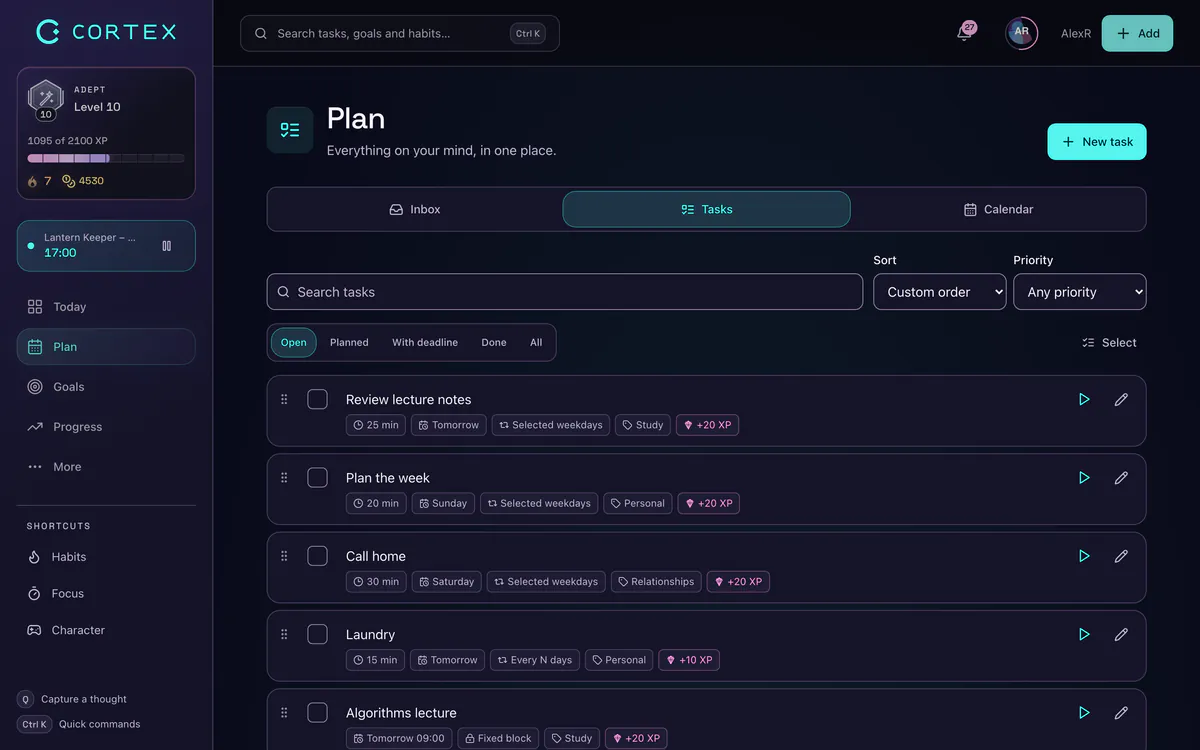
Finished tasks earn XP and credits you spend in a reward shop on rewards you define – the reason many people stick with it. More on that in the gamified productivity app overview, and if your problem is starting rather than listing, read how to stop procrastinating.
Frequently asked questions
What is the 1-3-5 rule for to-do lists?
The 1-3-5 rule says that on a typical day you can finish one big task, three medium tasks and five small tasks, so your daily to-do list should contain only those nine items. It is credited to Alex Cavoulacos, co-founder of the career site The Muse. Adjust the numbers to your day, but keep a fixed limit.
How do I write a good to-do list?
Limit its size, start each task with a verb, make the first step concrete and add a time estimate. Keep the total under about 70% of your available time, do the most important task first and review the list every evening.
How many tasks should be on a daily to-do list?
Somewhere between 3 and 9 for most people. The 1-3-5 rule caps it at nine (one big, three medium, five small); the "big three" method caps it at three. What matters is that the list fits the hours you actually have.
Is this to-do list template free?
Yes. The printable 1-3-5 template is free for personal use, with no sign-up. Print it on A4 or US Letter, or save it as a PDF from the print dialog.
Should I use a paper or digital to-do list?
Many people use both: a digital master list that catches ideas anywhere, and a short paper list for today that stays visible on the desk. If you need reminders, recurring tasks or scheduling, a free app like CORTEX handles the digital side.
Sources and further reading
Level up your life
CORTEX is free for everyone. Tasks, a one-click day plan, time tracking, habits and rewards in one system – on desktop and mobile.
CREATE A FREE ACCOUNT