How to Gamify Your Life (Without It Turning Into a Chore)
To gamify your life, you turn real goals into quests, give every finished task a visible reward (XP, levels, loot) and add just enough rules to make progress feel like a game – then keep the system small enough that running it never becomes the main quest. This guide shows which game mechanics work for daily tasks, which ones backfire, and how to set it all up on paper or in an app in about 30 minutes.
- Gamification means using game design elements – points, levels, quests, rewards – in non-game contexts like chores, study or work (Deterding et al., 2011).
- The mechanics that transfer best to daily life are quests (clear next actions), XP and levels (visible progress), streaks (consistency), loot (planned rewards) and guilds (accountability).
- The main trap is the overjustification effect: expected rewards for things you already enjoy can lower your interest in them (Lepper, Greene & Nisbett, 1973). Reward the boring stuff, not your hobbies.
- A working life RPG needs only five parts: a main quest, XP rules, a level table, a loot shop and a weekly review. Everything else is optional.
- You can run it on one sheet of paper or in a gamified app; CORTEX is a free gamified productivity app – tasks, a one-click day plan, time tracking and habits, with XP, levels and real-life rewards.
What it means to gamify your life
Researchers define gamification as "the use of game design elements in non-game contexts" (Deterding, Dixon, Khaled & Nacke, 2011). When you gamify your life, the non-game context is you: your to-do list, your study plan, your gym schedule, your inbox.
Games are good at three things real life is bad at:
- Instant feedback. In a game you see +25 XP the second you finish something. In life, the payoff for studying or invoicing arrives weeks later – if you notice it at all.
- Visible progress. A level bar shows how far you have come. Real progress is invisible until it is suddenly obvious. Teresa Amabile and Steven Kramer (2011), who studied the diaries of knowledge workers, called making progress in meaningful work the strongest everyday booster of motivation – a level bar simply makes that progress impossible to miss.
- Clear next steps. A quest log never says "work on thesis". It says "talk to the blacksmith". Specific, small, doable.
Gamifying your life is not about pretending chores are fun. It is about borrowing these three features so that the gap between "I did the thing" and "I feel good about it" shrinks from weeks to seconds. That matters most when your brain is wired for the reward now – which is why gamification is popular with gamers, students and people with ADHD-style motivation.
What gamification research says honestly: a widely cited literature review (Hamari, Koivisto & Sarsa, 2014) found that gamification can work, but results depend heavily on the context and on the people using it. Translation: there is no magic badge. You have to pick mechanics that fit you.
The game mechanics that actually work in real life
Not every game mechanic survives the trip into real life. Here are the ones that do, what they map to, and how they break.
| Mechanic | Real-life version | Why it works | How it breaks |
|---|---|---|---|
| Quests | A task written as a concrete next action ("Draft intro, 300 words") | Removes the "where do I start?" friction | Quests that are really projects ("Write thesis") |
| XP | Points per finished task, scaled by difficulty | Instant feedback for work with delayed payoff | Points for trivial tasks you would do anyway – inflation |
| Levels & ranks | XP thresholds you climb over weeks | Makes slow, cumulative progress visible | Levels that come too fast (meaningless) or too slow (demotivating) |
| Streaks | Consecutive active days | Rewards consistency, not heroics | One missed day feels like losing everything – you quit |
| Loot / rewards | Real treats bought with points: a movie night, new game, takeout | Connects effort to something you actually want | Rewards that undo the goal (a cheat day after a diet quest) |
| Boss fights | A big project with "HP" = its subtasks | Turns a scary project into a countable fight | A boss with no subtasks is just a wall |
| Daily quests | Habits: read 10 pages, drink water, no phone in bed | Small repeatable wins, every day | Too many dailies – the list itself becomes the boss |
| Guilds | A friend, partner or group that sees your progress | Accountability and a bit of friendly rivalry | Comparing yourself to the top player and giving up |
| Attributes | Stats like Strength, Intelligence, Charisma tied to task types | Shows balance – you see if you only grind one area | Too many stats to track by hand |
If you only take three mechanics from this table, take quests, XP with a level bar, and a loot shop. They cover the feedback loop – act, get points, cash them in – and are easy to run anywhere. Add streaks and guilds when the core loop feels stable.
The overjustification trap (and other ways gamification backfires)
Here is the part most "gamify your life" articles skip. Rewards are powerful, and that cuts both ways.
The overjustification effect
In a classic study, Lepper, Greene and Nisbett (1973) observed preschoolers who already liked drawing. Children who were told in advance they would get a "Good Player" certificate for drawing later showed less spontaneous interest in drawing than children who got no reward or an unexpected one. A large meta-analysis by Deci, Koestner and Ryan (1999) found the same pattern for expected, tangible rewards given for doing an interesting task, while positive feedback ("nice work") tended to increase interest.
What this means for you, carefully stated: the research is about activities people already find interesting. So the practical rule is:
Four more ways it goes wrong
- Maintenance hell. If logging your XP takes longer than the task, the system is the problem. Keep scoring rules to one line.
- Grinding for points. You start picking easy tasks because they pay fast. Fix: scale XP by difficulty and cap rewards for tiny tasks.
- Streak panic. A long streak breaks and so does your motivation. Fix: decide in advance that missing one day is fine and missing two is the real loss ("never miss twice").
- Self-sabotaging loot. Rewards that fight your goal – a shopping spree after a savings quest. Fix: pick loot that is neutral or supports the goal.
Self-determination theory (Ryan & Deci, 2000) gives a useful check: motivation holds up when you feel autonomy (you chose the rules), competence (you see yourself getting better) and relatedness (other people are in it with you). A good life game hits all three; a bad one feels like a boss tracking your every move.
How to gamify your life in 7 steps
This setup takes about 30 minutes. Do it on paper first if you are unsure – you can move it into an app later.
1. Pick one main quest
Choose the single goal that would make the next three months a win: pass the exam, land three new clients, run a 5K, ship the indie game demo. One main quest. Side quests can wait.
2. Break it into quests you can finish in one sitting
Each quest should be doable in 15–90 minutes and start with a verb. "Study biology" becomes "Make 20 flashcards for chapter 4". If you are not sure how long something takes, estimate anyway – you will calibrate. (Writing a good list is its own skill; our to-do list template walks through it.)
3. Set XP rules by difficulty
Keep it brutally simple:
| Difficulty | Example | XP |
|---|---|---|
| Trivial (<15 min) | Reply to the landlord | 5 |
| Easy (15–30 min) | Clean the desk, review notes | 10 |
| Medium (30–90 min) | Write a blog draft, gym session | 25 |
| Hard (half a day) | Finish a client deliverable | 50 |
| Heroic (dreaded) | Taxes, the phone call you avoid | 100 |
Notice that "heroic" is about dread, not just length. The task you have postponed for three weeks deserves a bigger reward than its size suggests – that is exactly where you need the extra push. (More on that in how to stop procrastinating.)
4. Build a level table
Make levels get slightly harder: Level 2 at 100 XP, Level 3 at 250, Level 4 at 450, Level 5 at 700, and so on (add 50 more each time). Aim for your first level-up within two or three days – early wins hook you; later levels should take a week or two.
5. Stock your loot shop
List 8–12 real rewards and give each a price in points. Mix cheap and expensive, and sort them by rarity like game loot:
- Common (50–100): fancy coffee, an episode of your show, 30 minutes of guilt-free gaming.
- Rare (300–500): takeout dinner, a movie night, a new book.
- Epic (1,000+): the game you have been waiting for, a concert ticket, a day trip.
Only spend points on loot – no spending on credit. The point of the shop is that the treat you would have bought anyway now feels earned.
6. Add dailies and one boss fight
Pick at most three daily quests (habits) – for example, "read 10 pages", "10-minute walk", "inbox to zero". Then turn your scariest project into a boss: write its subtasks as hit points and cross one off every time you land a blow. When the boss hits 0 HP, you get a big XP bonus and an epic item. For the habit side, see how to build habits that stick.
7. Join or form a guild, and run a weekly review
Tell one person your main quest and send them your level every Sunday. Then spend 10 minutes on "patch notes": which rules felt good, which felt like cheating, what to rebalance. Games get patched; your life game should too.
Free printable: Life RPG starter sheet
Prefer paper? Print this sheet, pin it above your desk and you have a working life game today. Fill in your main quest, keep score in the XP log and cross off loot as you buy it.
Life RPG starter sheet
| Main quest (3 months) | |
|---|---|
| Boss fight (big project) | |
| Guild (who checks in) |
XP rules
| Trivial | Easy | Medium | Hard | Heroic |
|---|---|---|---|---|
| 5 XP | 10 XP | 25 XP | 50 XP | 100 XP |
Daily quests (max 3)
| Daily quest | Mon | Tue | Wed | Thu | Fri | Sat | Sun |
|---|---|---|---|---|---|---|---|
XP log
| Date | Quest completed | XP | Total |
|---|---|---|---|
Loot shop
| Reward | Rarity | Price | Bought |
|---|---|---|---|
Levels: 2 = 100 XP · 3 = 250 · 4 = 450 · 5 = 700 · 6 = 1,000 · 7 = 1,350 · 8 = 1,750
Examples: a life game for students, freelancers and gamers
Student: "Exam season raid"
Main quest: pass the statistics final. Boss: the final itself, with 12 HP (one per chapter to review). Dailies: one focus block, 20 flashcards, bed before 1 a.m. Loot: an episode per 75 XP, a night out after the boss falls. Pair each quest with a 25-minute Pomodoro so "study" has a clear start and end.
Freelancer: "Client pipeline"
Main quest: three new retainer clients this quarter. Quests: update portfolio (medium), five personalized pitches (hard), follow-ups (easy). Heroic: raising your rates or sending the overdue invoice reminder. Guild: a freelancer friend you swap weekly scores with. Pair it with tracked hours so you see where the XP comes from – see our freelancer setup.
Gamer: "Real-life main story"
You already understand grinding, loot tables and min-maxing – use it. Attributes: STR for workouts, INT for learning, WIS for planning and reflection, CHR for social stuff, DEX for practical errands. Rule: gaming time is common loot – bought, not taken. Many gamers find that "earned" gaming time actually feels better than default gaming time. If you want stats and ranks out of the box, look at a life RPG app.
Paper or app: which should you use?
Paper is perfect for testing the rules: zero setup, no notifications, and you physically cross things off. It gets clunky once you track levels, multiple dailies and a shop for more than a few weeks.
An app does the math for you: XP is added automatically, levels update, rewards are tracked, and the system lives on your phone where your tasks already are. The downside is that some apps add so many features that you spend more time decorating your avatar than finishing tasks.
A sensible path: run the paper sheet for one or two weeks. If you are still using it on day 14, the rules work for you – move them into an app so they survive busy weeks. Compare options in our roundup of the best gamified productivity apps.
How to gamify your life with CORTEX
CORTEX is a free gamified productivity app – tasks, a one-click day plan, time tracking and habits, with XP, levels and real-life rewards. It was built around the loop described above, so you do not have to maintain the rules by hand:
- Quests and XP: every finished task earns XP based on its priority and estimate; each task has a difficulty from trivial to heroic that affects the rewards. Completing a goal is worth 100 XP, and daily logs count too.
- Levels, ranks and attributes: you level up, climb ranks and grow five attributes – STR, INT, WIS, CHR and DEX – tied to task categories, plus achievements.
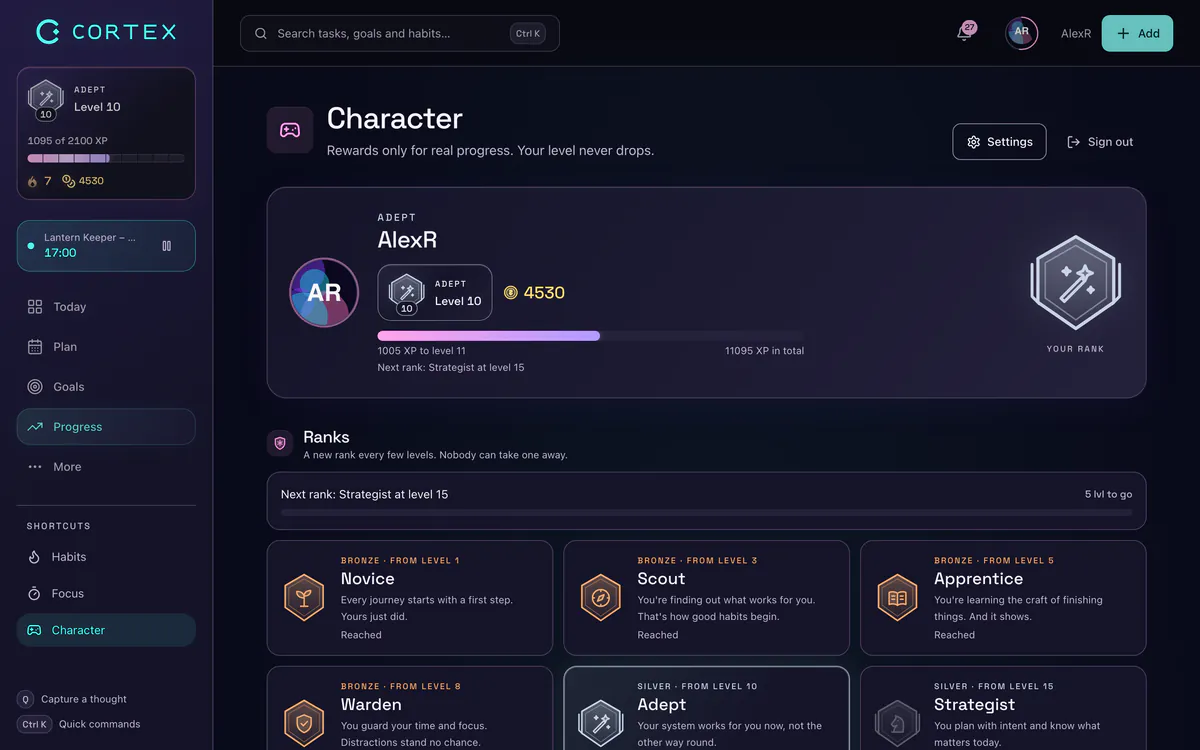
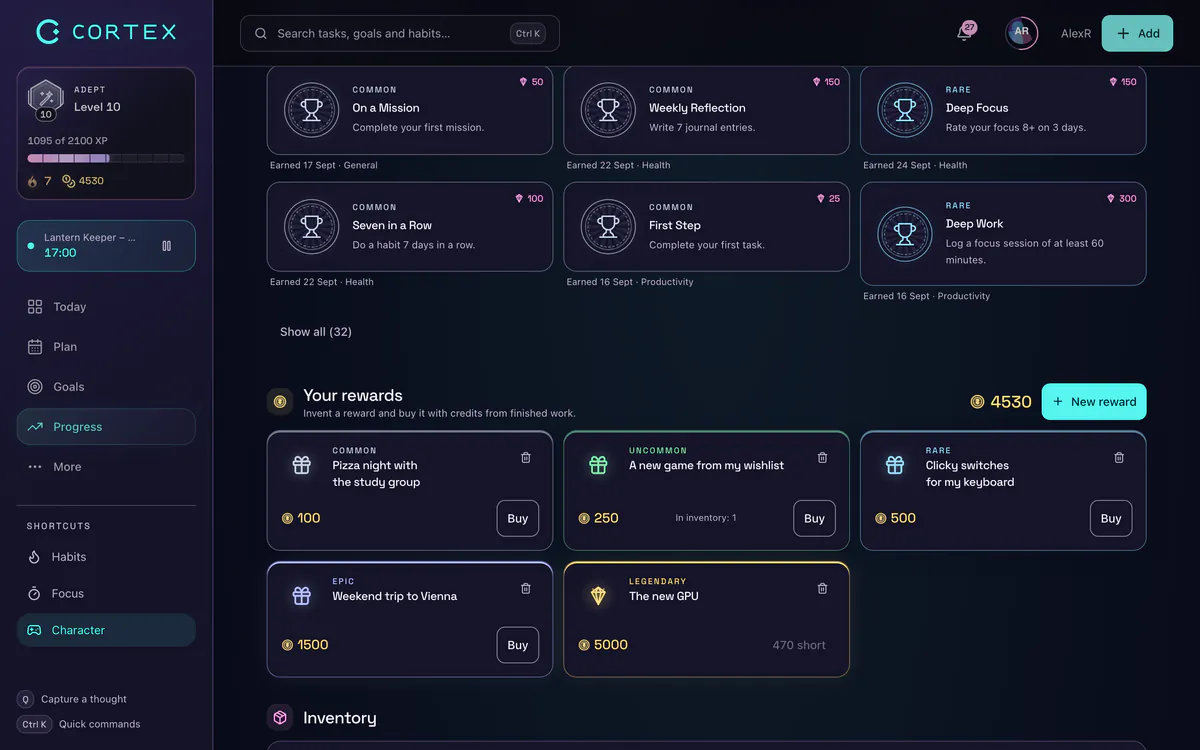
- Loot shop: finished tasks also earn credits, which you spend in a reward shop stocked with your own rewards in rarity tiers. There is a daily reward of 100 credits and a mystery box for 250. Credits cannot be bought – no pay-to-win.
- Daily quests and the boss: habits (good ones as buffs, bad ones as debuffs), an overall activity streak, goals with progress calculated from their tasks, and subtasks for breaking a boss into hit points.
- Guilds: alliances with chat, challenges and a leaderboard; shared goals if you want a real co-op quest with a partner.
- Pacts: an optional 30-day commitment contract that turns up to three pillars into tasks and habits.
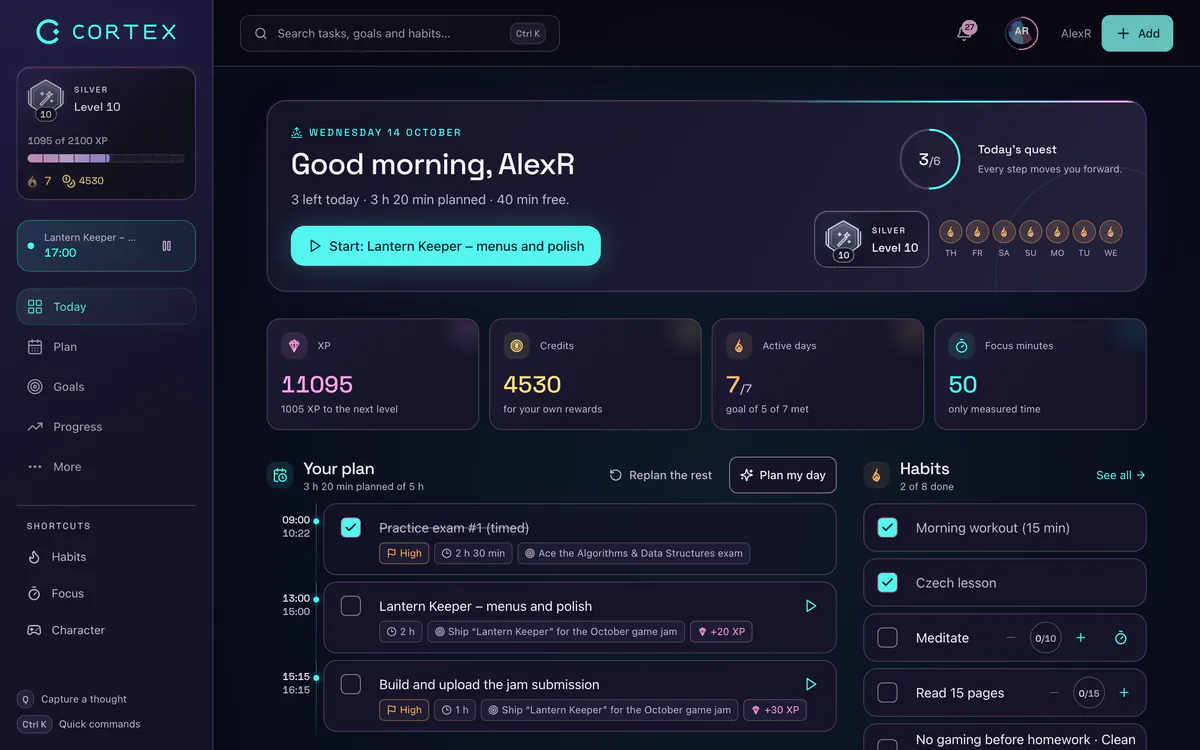
Type a quest in one line – Make 20 flashcards for chapter 4 tomorrow ~45m !p2 #Exam – and CORTEX parses the date, estimate, priority and goal. When your list is full, one click on Plan My Day fits the tasks into today's free slots. More detail on the gamified productivity app page.
Frequently asked questions
How do I gamify my life for free?
Grab a sheet of paper and define one main quest, XP points per task by difficulty, a level table and a short list of real rewards with prices. That is a complete life game. If you want the scoring done automatically, free apps like CORTEX add XP, levels and a reward shop for your own rewards.
How do you gamify daily tasks?
Write each task as a small quest with a clear verb, give it XP by difficulty, and let points buy real rewards. Add a few daily quests (habits) and a visible streak for consistency. Give the biggest rewards to the tasks you dread, not the ones you enjoy.
Does gamifying your life actually work?
It can, but it depends on the person and the setup. A literature review by Hamari, Koivisto and Sarsa (2014) found mostly positive but context-dependent effects. Systems work best when you choose the rules yourself, see your progress clearly and keep maintenance minimal.
Can rewards kill motivation?
Yes, in one specific case: expected, tangible rewards for activities you already enjoy can reduce your interest in them, known as the overjustification effect. Use rewards for boring or dreaded tasks and leave your hobbies unscored.
What is the best app to gamify your life?
It depends on what you want to gamify. Habit-focused players often like Habitica; if you want tasks, a time-blocked day plan, time tracking and habits with XP, levels and a reward shop in one place, CORTEX is a free option. See our comparison of gamified productivity apps for the details.
Is gamification good for ADHD?
Many people with ADHD-style motivation find instant feedback like points and level bars helpful, because it shortens the wait between effort and reward. It is a productivity technique, not a treatment, and CORTEX is not a medical device. Keep the system simple so it does not become another thing to manage.
Sources and further reading
- Deterding, Dixon, Khaled & Nacke (2011): From game design elements to gamefulness – defining "gamification"
- Hamari, Koivisto & Sarsa (2014): Does Gamification Work? A Literature Review of Empirical Studies on Gamification
- Lepper, Greene & Nisbett (1973): Undermining children's intrinsic interest with extrinsic reward
- Deci, Koestner & Ryan (1999): A meta-analytic review of experiments examining the effects of extrinsic rewards on intrinsic motivation
- Ryan & Deci (2000): Self-determination theory and the facilitation of intrinsic motivation
- Amabile & Kramer (2011): The Power of Small Wins, Harvard Business Review
Level up your life
CORTEX is free for everyone. Tasks, a one-click day plan, time tracking, habits and rewards in one system – on desktop and mobile.
CREATE A FREE ACCOUNT