Gamification examples: 15 real-life cases and why they work
Gamification examples are everywhere once you know the pattern: Duolingo's streaks, Apple Watch activity rings, Stack Overflow reputation, Kahoot! leaderboards and the coffee loyalty card in your wallet all borrow game mechanics – points, levels, streaks, badges, challenges – to make an ordinary activity feel like progress. Below are 15 concrete examples from everyday life, education, business and the workplace, the mechanic each one uses, and how to steal it for your own goals.
- Gamification is the use of game design elements in non-game contexts – a definition popularized by Deterding et al. (2011).
- Most real-world gamification uses a handful of mechanics: points, levels, streaks, badges, leaderboards, challenges and progress bars.
- Each mechanic works for a specific reason: streaks protect consistency, levels make long effort visible, leaderboards add social comparison, challenges add a deadline.
- A review of empirical studies (Hamari, Koivisto & Sarsa, 2014) found mostly positive effects, but they depended strongly on the context and the people involved.
- Rewards can backfire on activities you already enjoy (the overjustification effect), so gamify the boring parts, not your hobbies.
What gamification actually is (and is not)
Gamification means taking the parts of games that keep people playing – clear goals, instant feedback, visible progress, a bit of challenge and some social pressure – and adding them to something that is not a game: learning a language, paying with a loyalty card, answering questions on a forum, going for a run.
The most cited academic definition comes from Sebastian Deterding and colleagues (2011): gamification is "the use of game design elements in non-game contexts." Note what that excludes. A full educational video game is a serious game, not gamification. Gamification keeps the original activity and wraps a game layer around it – you still run 5 km, but now the run counts toward a monthly challenge.
That distinction matters when you want to use it yourself. You do not need to turn your life into a game. You just need to add the right feedback loop to the tasks that currently give you no feedback at all. If you want the full do-it-yourself system, see our guide on how to gamify your life.
Gamification examples in everyday life
These are the apps and programs most people use without thinking of them as games.
1. Duolingo streaks
Duolingo counts how many days in a row you complete at least one lesson. The number sits at the top of the app, plays an animation when it grows and sends reminders when it is at risk. A Streak Freeze lets you miss a day without losing the count – Duolingo's own blog says you can have up to two equipped. Mechanic: streak with loss aversion, softened by a safety net. The freeze is the clever part: it stops one bad day from wiping out months of progress, which is when most people quit.
2. Apple Watch activity rings
The Activity app shows three rings – Move, Exercise and Stand – and the goal is to "close your rings" every day. Mechanic: daily progress bar with a visual "complete" state. A ring that is 85% full nags you in a way a step count never does, because the gap to completion is obvious.
3. Nike Run Club challenges
Nike Run Club offers running challenges and achievements on top of guided runs and run tracking. Mechanic: time-boxed challenge plus collectible achievements. A monthly distance challenge turns "I should run more" into a finite quest with a finish line.
4. Strava segments and leaderboards
Strava splits popular routes into segments and ranks everyone who has ridden or run them; the fastest get a crown. Mechanic: leaderboard with many small arenas. Because there are thousands of segments, almost everyone can be "the best" somewhere – or at least beat their own previous time.
5. Coffee shop and airline loyalty programs
Starbucks Rewards gives you Stars for purchases that you redeem for items; airline programs add status tiers with perks. The humble paper punch card ("buy nine, get the tenth free") is the analog version. Mechanic: points currency plus tiers. Tiers are powerful because losing a status you have earned feels worse than never having it.
6. Forest-style focus apps
Focus apps such as Forest grow a virtual tree while you leave your phone alone and let it wither if you leave the app. Mechanic: avatar or object that reflects your behavior. You are not protecting your focus in the abstract; you are protecting a specific little tree. A plain Pomodoro timer with a tally of finished blocks gives you a low-tech version of the same loop.
Gamification examples in education
7. Kahoot!
Kahoot! turns a classroom quiz into a live game show: questions appear on a shared screen, students answer on their own devices, and a leaderboard appears between questions. Mechanic: points for correct (and fast) answers, a visible leaderboard and a podium at the end. Review sessions that used to be dead time suddenly have stakes.
8. Duolingo leagues
Beyond streaks, Duolingo groups learners into weekly leagues where XP earned that week decides who moves up a division. Mechanic: weekly reset leaderboard. The reset is key – a new week means a new chance, so latecomers are not permanently stuck at the bottom.
9. Khan Academy energy points and mastery
Khan Academy awards points and badges for practice and tracks skill mastery levels. Mechanic: points plus a mastery progress bar. The mastery bar works better than points alone because it shows what you have learned, not just how much you clicked.
10. Classroom point systems
Many teachers use point systems (digital tools like ClassDojo or a simple chart on the wall) where students or teams earn points for participation and behavior. Mechanic: team points and shared goals. Team-based points add cooperation, not just competition, which keeps weaker students engaged.
Gamification examples in business and the workplace
11. Stack Overflow reputation and privileges
On Stack Overflow, upvotes on your questions and answers earn reputation, and reputation unlocks privileges – from commenting to editing and moderation tools. Badges reward specific behaviors. Mechanic: reputation that unlocks abilities. This is one of the best-designed examples anywhere: the reward for contributing well is the power to contribute more, which aligns the points with the real goal of the community.
12. Salesforce Trailhead
Trailhead, Salesforce's free learning platform, uses badges, points and ranks for completed modules and hands-on challenges. Mechanic: badges as proof of skill. Badges here double as credentials you can show on a profile, so they carry meaning outside the game.
13. Sales leaderboards and contests
The classic workplace gamification: a board showing who closed the most deals this month, often with a prize. Mechanic: public leaderboard plus reward. It works for top performers and can demotivate everyone else – a reason many teams now rank against personal targets or run team-vs-team contests instead.
14. Google Maps Local Guides
Google rewards people who add reviews, photos and corrections with points and levels as a Local Guide. Mechanic: points and levels for user-generated content. A company gets free data; contributors get visible status for helping others.
15. Onboarding progress bars
"Your profile is 70% complete." LinkedIn's profile strength meter is a well-known example, and countless apps use the same idea in onboarding checklists. Mechanic: progress bar near completion. People have a strong urge to finish something that is visibly almost done.
Mechanic → example → why it works
Strip away the branding and the same seven mechanics show up again and again.
| Mechanic | Real example | Why it works | Watch out for |
|---|---|---|---|
| Streak | Duolingo daily streak | Makes consistency visible; breaking the chain feels like a loss | Anxiety and all-or-nothing quitting after a break |
| Progress bar / rings | Apple Watch activity rings, profile completeness | Shows the exact gap to "done"; nearly finished things pull you in | Bars that never fill feel discouraging |
| Points & currency | Starbucks Stars, Khan Academy points | Instant feedback for small actions; can be saved up | Points for volume instead of value |
| Levels & tiers | Airline status, Local Guides levels | Turn long-term effort into visible milestones | Grind without meaning |
| Badges & achievements | Trailhead badges, Nike Run Club achievements | Recognize specific behaviors; collectible | Badge inflation – if everything earns one, nothing matters |
| Leaderboard | Strava segments, Kahoot!, Duolingo leagues | Social comparison and friendly competition | Demotivates the bottom half; use small groups or resets |
| Challenge / quest | Nike Run Club monthly challenges | A clear finish line and a deadline | Too hard = ignored, too easy = boring |
| Unlocks | Stack Overflow privileges | The reward is more ability, not just a number | Gatekeeping newcomers |
A useful rule: pick the mechanic that matches your problem. If you start strong and fade, you need a streak. If a goal feels endless, you need a progress bar or levels. If you lack a deadline, you need a challenge. If you are bored alone, add a leaderboard or a partner.
When gamification backfires
Gamification is not magic. A literature review of empirical studies by Hamari, Koivisto and Sarsa (2014) found that gamification mostly produced positive effects, but the results depended heavily on the context and on the users. In practice, three failure modes come up again and again:
- The overjustification effect. In a classic study by Lepper, Greene and Nisbett (1973), preschoolers who already liked drawing and were promised a certificate for it later drew less in free play than children who were not promised a reward. The lesson is narrow but important: adding external rewards to something you already enjoy can shift your reason for doing it. Gamify the boring chores, not your hobbies.
- Chasing the metric. If points reward activity rather than results, people optimize the points. Ten trivial tasks should not beat one important one.
- Streak fragility. A long streak can turn into pressure. When it breaks, some people drop the habit entirely. Build in a safety net – Duolingo's freeze, or a simple "never miss twice" rule.
How to apply these examples to your own life
You can copy every mechanic above with paper and a pen. Here is a translation table for personal goals:
- Streak (Duolingo): mark an X on a calendar for every day you do your one key habit. Allow one "freeze" per week. Our free printable habit tracker works for this.
- Rings (Apple Watch): define three daily minimums – for example, one focused work block, 20 minutes of movement and 10 pages of reading – and "close" them.
- Challenge (Nike Run Club): run a 30-day challenge with one clear finish line. A written commitment contract makes it feel official.
- Points and shop (loyalty cards): give yourself points for finished tasks and a menu of real rewards you can "buy" – an episode, a takeout meal, a new game.
- Levels (airline tiers): every 10 finished weekly goals = one level. Write your level somewhere you see it – or let a life RPG app do the math.
- Leaderboard (Strava): pair up with a friend and compare weekly scores, or compete against your own last week.
- Unlocks (Stack Overflow): make bigger rewards available only after consistent effort – the new keyboard unlocks after four weeks of hitting your writing target.
Start with two mechanics, not seven. A streak plus a reward shop is enough for most people for the first month.
Gamification in a productivity app: how CORTEX does it
If you would rather not run the bookkeeping by hand, CORTEX is a free gamified productivity app – tasks, a one-click day plan, time tracking and habits, with XP, levels and real-life rewards. It combines several of the mechanics above in one place:
- Points: finished tasks earn XP (more for higher priority and longer estimates) and credits.
- Levels and ranks: XP raises your level and rank; five attributes (STR, INT, WIS, CHR, DEX) grow with the kind of tasks you finish.
- Shop: credits buy rewards you define yourself in a reward shop – the loyalty-card idea applied to your own life. Credits cannot be bought with money.
- Streak: one overall activity streak (current and best), not one per habit, which keeps the pressure lower.
- Leaderboard: optional alliances, challenges and a leaderboard if you want social pressure.
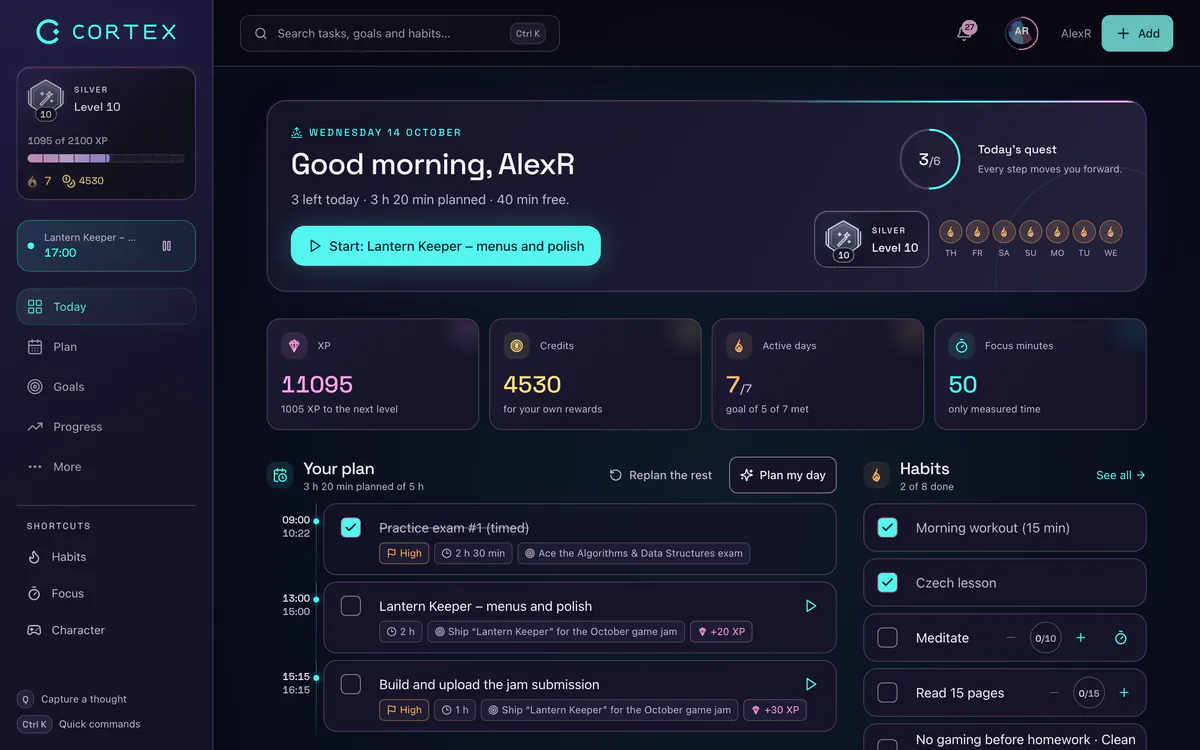
See the full list of game features on the gamified productivity app page, or compare options in the best gamified productivity apps. If you already use Habitica, our Habitica alternatives comparison explains where each app fits.
Frequently asked questions
What are some examples of gamification in real life?
Common real-life examples are Duolingo's daily streaks, Apple Watch activity rings, coffee shop loyalty programs, airline status tiers, Strava segment leaderboards and Nike Run Club challenges. Each one adds a game mechanic – a streak, a progress ring, points, tiers or a leaderboard – to an ordinary activity.
What are examples of gamification in education?
Kahoot! quizzes with live leaderboards, Duolingo's weekly leagues, Khan Academy's points and mastery levels, and classroom point systems such as ClassDojo are well-known examples. They work best when points reward learning progress rather than just speed or volume.
What is an example of gamification in the workplace?
Sales leaderboards and contests are the classic example. Others include learning platforms with badges and ranks, such as Salesforce Trailhead, and community reputation systems like Stack Overflow, where reputation unlocks privileges. Team-based or personal-best goals tend to motivate more people than a single public ranking.
What are the most common gamification mechanics?
Points, levels, badges, leaderboards, streaks, progress bars and challenges. Many products also use unlocks, where effort grants new abilities, and virtual currencies you can spend on rewards.
Can gamification backfire?
Yes. Rewards for activities you already enjoy can lower your intrinsic interest (the overjustification effect, Lepper et al., 1973), points can push people to optimize the metric instead of the goal, and long streaks can create pressure. Use gamification for tasks that feel boring or endless, and reward meaningful results.
How can I use gamification in my everyday life?
Pick one or two mechanics that match your problem: a streak for consistency, a progress bar for long goals, a challenge for a deadline, or a reward shop for motivation. You can do it on paper or use a gamified app such as CORTEX that tracks XP, levels and rewards for you.
Sources and further reading
- Deterding et al. (2011): From game design elements to gamefulness – defining "gamification"
- Hamari, Koivisto & Sarsa (2014): Does Gamification Work? – A Literature Review of Empirical Studies on Gamification
- Lepper, Greene & Nisbett (1973): Undermining children's intrinsic interest with extrinsic reward
- Duolingo blog: How the Duolingo streak builds habits
- Apple: Close Your Rings
- Stack Overflow Help Center: Privileges
- Kahoot!
- Nike Run Club app
- Starbucks Rewards
Level up your life
CORTEX is free for everyone. Tasks, a one-click day plan, time tracking, habits and rewards in one system – on desktop and mobile.
CREATE A FREE ACCOUNT