The two-minute rule: do small things now, and start new habits tiny
The two-minute rule comes in two versions. In David Allen's Getting Things Done it says: if something takes less than two minutes, do it now, because tracking it and reviewing it later would take longer than doing it. James Clear popularized a habit version: start every new habit with a version that takes two minutes or less ("put on your running shoes" instead of "run 5K"). Both solve the same problem – lowering the barrier to starting.
- GTD version: when you process new inputs and hit an action that takes under two minutes, do it immediately; anything longer gets captured, delegated or scheduled.
- Habit version: shrink a new habit to a two-minute version and let it grow once it is stable.
- The rule is meant for the moment you process new stuff – not for chasing small tasks all day.
- In Lally et al. (2009), habit automaticity built up through repetition over a median of 66 days; missing a single day did not derail it.
- The two-minute version is a starting point, not the goal: it only works if it leads to the full habit.
The two-minute rule in GTD
In Getting Things Done, David Allen recommends: when you process your inboxes – email, paper, notes – and find an action that takes less than two minutes, do it right then. The reason is purely practical: writing it down, filing it, finding it again and rereading it would take longer than the work itself.
Examples: replying "yes, Thursday works", forwarding an invoice to your accountant, confirming an order, paying a bill, sending back a signed document.
Allen also says the rule is not dogma: two minutes is a rough line, and you can always choose to do something longer if it is the most important thing right now. The whole method is in our Getting Things Done guide.
When the two-minute rule backfires
The most common mistake is doing "quick ones" all day, whenever they appear. Two-minute tasks then turn into an hour of interruptions and the important work never starts. The rule makes sense:
- while processing new inputs – morning, noon and evening, or in an email block;
- when the task is already in front of you – not when you go looking for it;
- outside your focus blocks – during deep work, just jot the small thing down.
Every switch between tasks has a price: Monsell (2003) sums up research showing a measurable "switch cost" that remains even when people can prepare. That is why small tasks are better grouped – see task batching.
The two-minute rule for habits
James Clear applied the rule to habits: when you start a new habit, it should take less than two minutes. "Read every night" becomes "read one page", "do yoga" becomes "roll out the mat", "study German" becomes "open the textbook".
Why it works: a habit forms through repetition in the same situation, not through the length of each session. In Lally and colleagues' 2009 study, automaticity for new habits built up gradually over a median of 66 days (with a wide range of 18–254 days), and missing a single opportunity did not materially affect the process. A tiny version carries you through the period when willpower has nothing to lean on yet.
The key is that the two-minute version is the start of the real habit, not a replacement for it. Once you have done it effortlessly for two weeks, add the next step: one page → ten pages → twenty minutes of reading. More in how to build habits that stick.
Two-minute versions of common habits
| Target habit | Two-minute version | Next step |
|---|---|---|
| Run three times a week | Put on running clothes and step outside | Ten minutes of walk–jog |
| Read every day | Read one page | Ten pages before bed |
| Keep a journal | Write one sentence about the day | Three questions about the day |
| A clean kitchen | Load the dishwasher | Wipe the counter |
| Learn a language | Open the book at today's lesson | A fifteen-minute lesson |
| Less phone at night | Charge the phone outside the bedroom | Phone away from 9 p.m. |
Using both versions together
- Set two processing blocks a day (email, messages, paper). Do anything under two minutes on the spot, capture the rest.
- During focused work, only capture small things. Handle them in the next block.
- Pick one new habit and write down its two-minute version.
- Attach it to an existing moment: "After my morning coffee, I open the textbook." If-then plans make the action more likely (Gollwitzer & Sheeran, 2006).
- After two weeks, add the next step if the two-minute version happens without negotiating with yourself.
The two-minute rule in CORTEX
- Quick capture – anything you can't do right now goes in within seconds (press Q) and lands in the Inbox or straight on a date.
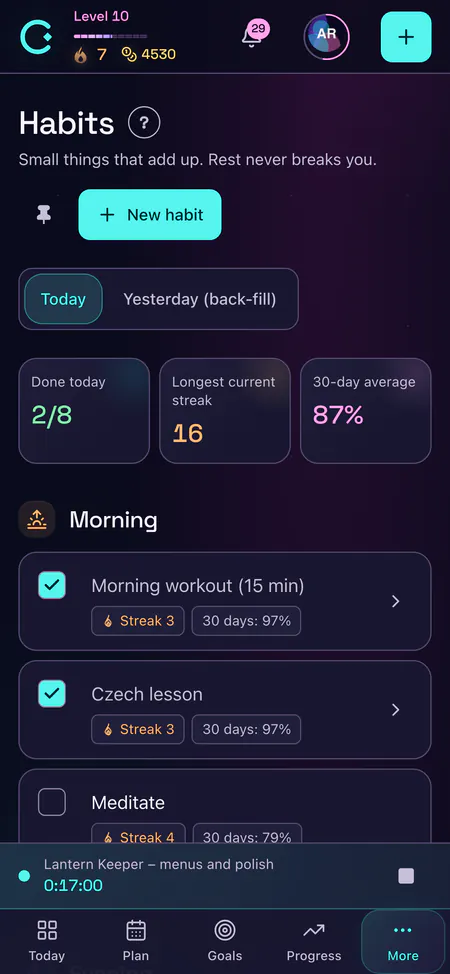
- Habits with a daily target – set the two-minute version as a yes/no habit ("one page") and later change it to a number ("10 pages") or minutes.
- A streak and heatmap per habit show when it is time for the next step; a pause or a frozen day keeps the streak when you are ill.
- XP for every completed day – small steps count, and that is exactly the point at the start. See the habit tracker.
Frequently asked questions
What is the two-minute rule?
A rule from David Allen's Getting Things Done: if something takes less than two minutes, do it now, because tracking and reviewing it later would take longer. James Clear applied it to habits: start every new habit with a version that takes two minutes or less.
When should I not use the two-minute rule?
During focused work and whenever a small task would interrupt something important. The rule belongs mainly in the moments when you process new email, messages and notes.
How does the two-minute rule help build habits?
It lowers the barrier to starting. Habits form through repetition, not session length, so a tiny version carries you through the period before the habit is automatic. Once it is stable, make it longer step by step.
Isn't a two-minute habit too small?
Not at the start – the point is repetition in the same situation. The problem is staying at the two-minute version and never adding the next step.
How long does it take to form a habit?
In Lally and colleagues' 2009 study, a median of 66 days, ranging from 18 to 254 days depending on the person and the habit. Missing one day did not materially affect the process.
Sources and further reading
- Getting Things Done: The Two-Minute Rule (David Allen, podcast episode 79)
- Getting Things Done: When to use GTD's Two-Minute Rule
- James Clear: How to Stop Procrastinating by Using the "2-Minute Rule"
- Lally et al. (2009): How are habits formed, European Journal of Social Psychology
- Monsell (2003): Task switching, Trends in Cognitive Sciences
- Gollwitzer & Sheeran (2006): Implementation intentions and goal achievement – a meta-analysis
Level up your life
CORTEX is free for everyone. Tasks, a one-click day plan, time tracking, habits and rewards in one system – on desktop and mobile.
CREATE A FREE ACCOUNT