Small wins: why visible progress motivates you more than big goals
Small wins are minor but visible steps forward in work you care about – and they are among the strongest sources of motivation on ordinary days. Researchers Teresa Amabile and Steven Kramer call this the progress principle: on days when people felt they had moved forward on something meaningful, they were in a better mood and more engaged with their work. The progress doesn’t have to be big, it just has to be visible. Below: what the research says, why it helps to write progress down and how to do a short weekly review of what you got done.
- The progress principle: of everything that made people’s workdays better, the most common was a sense of progress in meaningful work (Amabile & Kramer, 2011).
- Monitoring progress towards a goal increases the chance of reaching it, more so when progress is physically recorded or shared (Harkin et al., 2016; 138 studies).
- Early on, looking at what is already done motivates more; close to the goal, looking at what remains does (Koo & Fishbach, 2012).
- Psychologist Karl Weick (1984) recommended breaking big problems into “small wins” because a manageable step reduces stress and attracts further effort.
- A note on evidence: the core data behind the progress principle come from diaries (correlations), so they can’t prove what causes what.
What small wins and the progress principle are
A small win is a concrete, completed step that moves you towards something important: a first draft sent, a bug fixed, a chapter learned, the first kilometre without stopping. It is not “cleared 30 emails” unless those emails matter to you.
Teresa Amabile and Steven Kramer (2011) analysed nearly 12,000 diary entries from 238 people in 26 teams. Each day people described what happened at work and how they felt. The most common trigger of a good day was progress in meaningful work – even a small one. The worst days, by contrast, brought setbacks and being stuck. They called this the progress principle.
An honest note: this is a descriptive diary study. It shows a strong link between progress and mood but does not by itself prove the cause. The experimental research below fits the picture well, though.
Why progress works: what experiments show
- Tracking progress helps. Benjamin Harkin and colleagues (2016) combined 138 experiments with almost 20,000 people. When people regularly monitored their progress, they reached their goal more often. The effect was larger when progress was written down or shared.
- Look back at the start, look ahead near the end. Minjung Koo and Ayelet Fishbach (2012) found that early on, people are pulled more by what they have done (“20% complete”), and near the goal by what remains (“only 20% left”).
- A close goal speeds you up. Ran Kivetz and colleagues (2006) described the goal-gradient effect: the closer people are to a reward, the more effort they put in. Visible progress makes a goal feel closer.
- Small steps reduce stress. Karl Weick (1984) wrote that a problem framed as huge paralyses, whereas a series of small wins is manageable and draws in more effort and allies.
How to create small wins
- Break work into steps you can finish in a day. “Write the thesis” is not a win. “Write the intro to chapter 2” is. See how to break down a big task.
- Pick one win for the day in the morning. One thing that makes the day a success if you finish it, whatever else happens.
- Do it before the day falls apart. Ideally in your first focus block (eat the frog).
- Write down what you finished. A short “what I moved forward today” list is proof for your brain that effort leads to results.
- Remove blockers. Amabile and Kramer stress that setbacks demotivate more strongly than wins motivate. If something is blocking you, it is task number one.
The weekly review: where small wins add up
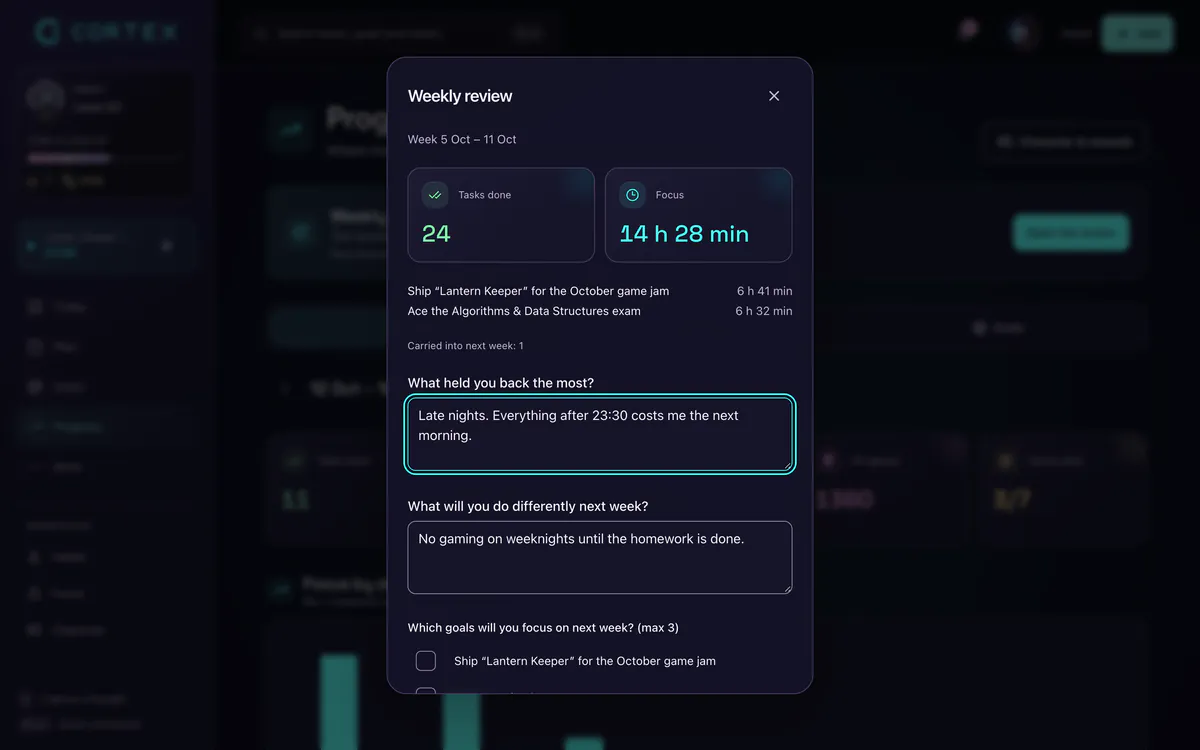
Individual wins get lost in a busy week. It helps to stop once a week and look at what went well. A weekly review has three parts:
- What went well – three to five concrete wins, small ones included.
- What got in the way – one blocker you will remove next week.
- What I will focus on – no more than three goals for the coming week.
Common mistakes
- Wins made only of trivia. Cleared emails are nice, but if the important work isn’t moving, the good feeling won’t last.
- Overlooking progress. Many people remember mostly what they didn’t get done. Without writing it down, progress stays invisible.
- Steps that are too big. If a step takes a week, a win comes once a week – not enough for motivation.
- Comparing yourself to others. A small win is progress compared with your yesterday, not with someone else.
If you can’t get started at all, see how to get motivated to do anything or no motivation to do anything.
Try it now in CORTEX
In CORTEX (free for everyone) progress adds up by itself: finished tasks, time in Focus and the week’s “light trail” of focus blocks. In Progress, a Weekly review waits for you every week – two questions, three minutes: what worked and where next, plus picking up to three goals for the coming week. The “Weekly review” template (More → Templates) turns it into a regular ritual. If you have an account, open the Weekly review template.
Frequently asked questions
What is the progress principle?
The progress principle is a finding by Teresa Amabile and Steven Kramer (2011): of all the events that improved people’s workdays, the most common was a sense of progress in meaningful work, even a small one. It is based on almost 12,000 diary entries.
Why are small wins important?
Because motivation grows from visible progress. Small wins come often, show your brain that effort leads to results and reduce the stress of big tasks. Experiments show that tracking progress increases the chance of reaching a goal.
How should I track my progress?
The simplest way is a daily “what I moved forward” list and a short weekly review: what went well, what got in the way and what to focus on. According to a meta-analysis, recording progress physically or sharing it has a stronger effect than tracking it in your head.
Is it better to focus on what’s done or what’s left?
It depends on the stage. At the start, looking at what is already done motivates more. Near the goal, looking at how much is left does. That is what Koo and Fishbach (2012) found.
What if I feel like I’m not making any progress?
Try making your steps smaller so a win comes at least once a day, and remove the biggest blocker. If the sense of being stuck comes with lasting sadness or loss of interest, talk to a doctor or psychologist.
Sources and further reading
- Amabile, T. M. & Kramer, S. J. (2011): The Power of Small Wins – Harvard Business Review
- Harkin, B. et al. (2016): Does monitoring goal progress promote goal attainment? A meta-analysis of the experimental evidence – Psychological Bulletin
- Koo, M. & Fishbach, A. (2012): The small-area hypothesis: Effects of progress monitoring on goal adherence – Journal of Consumer Research
- Kivetz, R., Urminsky, O. & Zheng, Y. (2006): The goal-gradient hypothesis resurrected – Journal of Marketing Research
- Weick, K. E. (1984): Small wins: Redefining the scale of social problems – American Psychologist
Level up your life
CORTEX is free for everyone. Tasks, a one-click day plan, time tracking, habits and rewards in one system – on desktop and mobile.
CREATE A FREE ACCOUNT