How many hours of focused work a day is realistic – and how to find your number
Most people can do roughly 2–4 hours of truly focused work a day; the rest of the workday goes to communication, routine and transitions. The research backs this up: the top violinists in a classic study practised deliberately for about four hours a day, in blocks with breaks, and output in very long work weeks stopped rising in step with the hours. Your own number is best found by measuring – here is how.
- Deep, fully focused work can only be sustained for a limited time each day; for most people, realistically 2–4 hours.
- Ericsson, Krampe and Tesch-Römer (1993): the best violinists spent about four hours a day on deliberate practice, split into sessions with breaks.
- Pencavel (2014): munitions workers' output rose in proportion to hours only up to a point; in very long weeks, extra hours added almost nothing.
- The rest of the day isn't wasted: communication, admin and lighter tasks belong in less demanding blocks.
- Find your number by tracking focused time and rating the quality of your output for two weeks.
What "focused work" means here
By focused (deep) work we mean tasks that need your full attention and where mistakes hurt: writing, analysis, programming, design, learning new material. Email, meetings, routine admin and "working with one eye on the phone" don't count.
The distinction matters: eight hours at work is not eight hours of deep work. Planning eight hours of deep focus a day is planning to fail. More on protecting it in deep work.
What the research says
Four hours of deliberate practice
Ericsson, Krampe and Tesch-Römer (1993) studied violinists at a music academy. The best of them spent about four hours a day on deliberate, effortful practice – not in one stretch, but in sessions of around an hour with breaks – and slept a lot, including afternoon naps. The authors argue that this kind of practice is so demanding that it can't be sustained much longer without losing quality.
Long weeks, diminishing returns
Pencavel (2014) analysed data on British munitions workers from the First World War. Output rose in proportion to hours only up to a point; beyond it, each additional hour added less, and in very long weeks total output was barely higher than in shorter ones. It is manual work and historical data, but the direction matches many people's experience of knowledge work.
Rest is part of performance
Sonnentag (2012) reviews research linking psychological detachment from work during leisure time with better well-being and less exhaustion. In other words, "extra" hours in the evening often cost you capacity the next day.
Find your number: a two-week measurement
- Define deep work for yourself – which tasks count.
- Time every block with a timer: start, end, any interruptions.
- Rate the quality from 1 to 5 right after each block: was I really focused? Is the output good?
- Note your energy during the day – when it peaks.
- Review after two weeks: after how many hours does quality drop? Which part of the day has your best blocks?
A typical result: "Two 90-minute blocks in the morning score 4–5; a third block in the afternoon scores 2–3." That is your capacity – plan around it. To find your best hours, see chronotype and productivity.
Plan your day around your capacity
| Type of work | How much per day | When |
|---|---|---|
| Deep work | 2–4 h in 2–3 blocks | Your best hours |
| Lighter work (fixes, prep, routine learning) | 1–3 h | Between blocks |
| Communication and admin | 1–2 h in batches | Outside your best hours – see task batching |
| Buffer | 20–30% of the day | Spread out, not just in the evening |
If you only manage one hour of deep work a day, that is not failure – it is a realistic starting point. Protect it and extend it gradually.
Common misconceptions
- "I work 10 hours, so I'm productive." Length isn't quality. Measure results and focused blocks, not time at the desk.
- Deep work in the afternoon after meetings. Give your drained hours lighter work.
- Blocks without breaks. Even four hours is only sustainable with breaks.
- The same number every day. A day after bad sleep or full of meetings has less capacity – and that's fine.
Measuring focused work in CORTEX
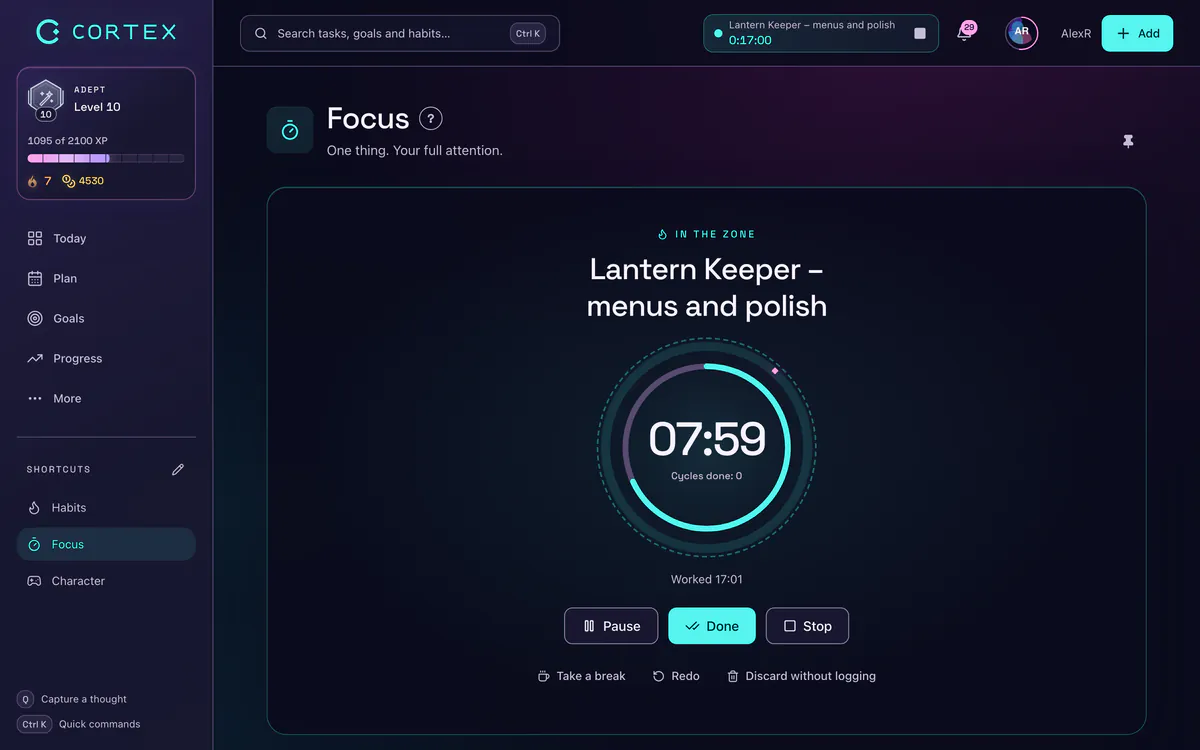
- Focus on a task – a free timer or Pomodoro (25/5, 50/10, 90/15 or custom); the time is recorded for you.
- Reports – time per goal and category, compared with the previous period, with CSV or PDF export. See the time tracking app.
- Energy log – energy and focus on a scale, so you can compare when you work best.
- Day capacity – in planning settings you set how much focused work fits into a day, and Plan My Day plans accordingly.
Frequently asked questions
How many hours of focused work can you do a day?
For most people, realistically 2 to 4 hours of deep work a day, split into blocks with breaks. The rest of the workday goes to communication, routine and lighter tasks. Measure to find your exact number.
Where does the "four hours" figure come from?
Mainly from Ericsson, Krampe and Tesch-Römer's 1993 study: the best violinists spent about four hours a day on deliberate practice, in sessions with breaks. It is a rough guide, not a rule for every kind of work.
Is working 10 hours a day effective?
In long weeks, each extra hour adds less – Pencavel's 2014 analysis of historical data shows output barely rising beyond a certain number of hours. Long days also reduce your capacity the next day.
How long should one focus block be?
It depends on you and the task: from 25-minute Pomodoro blocks to 60–90 minutes. Try both and rate the quality of your output.
What should I do with the rest of the workday?
Lighter work, communication and admin in batches, planning and rest. That is work too – it just doesn't need full focus.
Sources and further reading
- Ericsson, Krampe & Tesch-Römer (1993): The role of deliberate practice in the acquisition of expert performance, Psychological Review
- Pencavel (2014): The Productivity of Working Hours, The Economic Journal
- Sonnentag (2012): Psychological Detachment From Work During Leisure Time, Current Directions in Psychological Science
Level up your life
CORTEX is free for everyone. Tasks, a one-click day plan, time tracking, habits and rewards in one system – on desktop and mobile.
CREATE A FREE ACCOUNT