How to fall asleep fast: tips backed by research
You fall asleep faster when you calm both mind and body in the evening: five minutes before bed you write a specific to-do list for tomorrow, one to two hours before bed you take a warm shower, in bed you imagine something calm in detail, and if you haven’t fallen asleep after about twenty minutes you get up and come back when you feel sleepy. A consistent wake-up time and less screen light in the evening help too. Tricks like “fall asleep in two minutes” or 4-7-8 breathing have weak evidence. If you have slept badly for weeks, that’s a matter for a doctor, not for tips.
- People who spent five minutes before bed writing a specific to-do list for the coming days fell asleep faster than those who wrote about completed tasks (Scullin et al., 2018).
- A warm shower or bath (40–42.5 °C) 1–2 hours before bed shortened the time to fall asleep in a meta-analysis, even when it lasted only 10 minutes (Haghayegh et al., 2019).
- Detailed calm imagery helped people with insomnia fall asleep sooner than a general “think about something else” (Harvey & Payne, 2002).
- Reading on a light-emitting screen before bed made it take longer to fall asleep and shifted the body clock compared with a printed book (Chang et al., 2015).
- For long-term insomnia, the first-choice treatment is cognitive behavioural therapy for insomnia, not pills or tricks (Edinger et al., 2021; Riemann et al., 2017).
Why you can’t fall asleep
The most common reasons it takes a long time to fall asleep are fairly ordinary: your mind is still processing the day, your body is “revved up” (stress, late exercise, caffeine), your body clock is shifted (different wake-up times, light from screens) or you go to bed before you feel sleepy. Sometimes a fear of not falling asleep again joins in – and that slows sleep down even more.
If it happens only now and then, the tips below usually help. If you sleep badly most nights for several weeks, read the section on when to see a doctor.
8 tips to fall asleep faster
- A list for tomorrow (5 minutes). In a sleep lab, Michael Scullin and colleagues (2018) had people spend five minutes before bed writing either a list of tasks for the coming days or a list of what they had already done. The to-do list group fell asleep faster – and the more specific the list, the faster.
- A warm shower 1–2 hours before bed. A meta-analysis by Shahab Haghayegh and colleagues (2019) found that a warm shower or bath at that time shortened the time to fall asleep, even if it lasted only ten minutes. The body then cools down faster, which helps sleep.
- Calm, concrete imagery. Allison Harvey and Suzanna Payne (2002) showed that imagining something interesting and calm in detail (such as a walk through a favourite place) helped people with insomnia more than the general advice to “think about something else”.
- If you’re awake for about 20 minutes, get up. Go to another room, do something calm in dim light and come back when you feel sleepy. This is part of what is called stimulus control, which professional guidelines on insomnia include (Edinger et al., 2021). Your bed then becomes linked with sleep, not with tossing and turning.
- The same wake-up time. Even at weekends, within about an hour. A regular wake-up time anchors your body clock more than a regular bedtime.
- Less screen time in the evening. Anne-Marie Chang and colleagues (2015) found that reading on a light-emitting device before bed made it take longer to fall asleep and shifted the body clock compared with a paper book. Charge your phone outside the bedroom.
- Caffeine and alcohol with care. Caffeine works for hours; an afternoon coffee can still interfere in the evening. Alcohol may help you fall asleep but worsens sleep quality in the second half of the night.
- A cool, dark, quiet bedroom. Curtains, an eye mask or earplugs help.
“Fall asleep in 2 minutes” tricks: what we know
| Trick | What it is | Evidence |
|---|---|---|
| The “military method” | Gradually relax your face, shoulders, arms and legs and think of a calm image | It comes from a book on relaxation for athletes, not from controlled studies. Body relaxation and calm imagery are sensible in themselves, though. |
| 4-7-8 breathing | Breathe in for 4, hold for 7, breathe out for 8 | There are few direct studies on falling asleep. Slow breathing is generally calming; if holding your breath stresses you, skip it. |
| Progressive muscle relaxation | Tense and release muscle groups one by one | Relaxation techniques are among the methods insomnia guidelines mention as an add-on. |
| White noise | Constant background sound | Can mask disruptive sounds; clear evidence for faster sleep onset is lacking. |
If one of these tricks works for you, by all means use it. Just don’t expect a miracle every night.
When thoughts keep you awake
Racing thoughts are one of the most common reasons for lying awake. Besides a list for tomorrow, it helps to give worries their time in the afternoon or early evening – not in bed. More in how to stop overthinking and shutdown ritual. And if you go to bed late because the evening is your “me time”, read bedtime procrastination.
When to see a doctor
See your doctor when:
- you have trouble falling or staying asleep at least three nights a week for several weeks,
- you are noticeably tired, sleepy or irritable during the day,
- you snore and stop breathing during sleep, or wake up with headaches,
- poor sleep comes with sadness, anxiety or pain.
For long-term insomnia, both American and European guidelines recommend cognitive behavioural therapy for insomnia (CBT-I) as the first choice (Edinger et al., 2021; Riemann et al., 2017). Don’t take sleeping pills or supplements without talking to a doctor.
Try it now in CORTEX
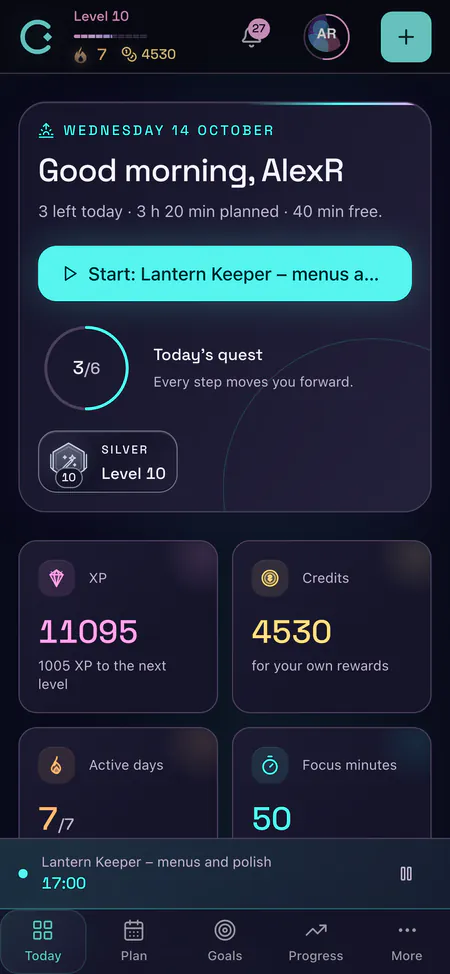
In CORTEX (free for everyone) there is a “Better sleep” template for this (More → Templates): for four weeks it sets up an evening wind-down as a routine, the same wake-up time even at weekends, and morning light. You write tomorrow’s list with the Q key in a minute, and in the morning it is already in your plan. With the Energy and health module you can also log your sleep and energy and see after a few weeks what helps you. If you have an account, open the Better sleep template.
Frequently asked questions
How can I fall asleep fast when I can’t?
Don’t try to force sleep. If you are awake for about 20 minutes, get up, go to another room and do something calm in dim light until you feel sleepy. Calm, concrete imagery and a to-do list for tomorrow written before bed also help.
How do I fall asleep in 5 minutes?
There is no reliable trick for falling asleep in five minutes. A regular wake-up time, a warm shower 1–2 hours before bed, less screen time in the evening and a list of tomorrow’s tasks help you fall asleep faster. If a breathing exercise or relaxation works for you, use it.
Does 4-7-8 breathing help you fall asleep?
There are few direct studies. Slow breathing with a long exhale generally calms the body, so it may help. If holding your breath makes you uneasy, just breathe slowly without holding.
Why can’t I fall asleep even when I’m tired?
Your body may be tired but your mind still on alert: stress, racing thoughts, caffeine, screen light or a shifted body clock. It helps to slow down in the evening, write your thoughts down and go to bed only once you feel sleepy.
When should I see a doctor about insomnia?
When you sleep badly at least three nights a week for several weeks, feel very tired during the day, snore with pauses in breathing or poor sleep comes with sadness or anxiety. The first-choice treatment for long-term insomnia is cognitive behavioural therapy.
Sources and further reading
- Scullin, M. K. et al. (2018): The effects of bedtime writing on difficulty falling asleep: A polysomnographic study comparing to-do lists and completed activity lists – Journal of Experimental Psychology: General
- Haghayegh, S. et al. (2019): Before-bedtime passive body heating by warm shower or bath to improve sleep: A systematic review and meta-analysis – Sleep Medicine Reviews
- Harvey, A. G. & Payne, S. (2002): The management of unwanted pre-sleep thoughts in insomnia: distraction with imagery versus general distraction – Behaviour Research and Therapy
- Chang, A.-M. et al. (2015): Evening use of light-emitting eReaders negatively affects sleep, circadian timing, and next-morning alertness – PNAS
- Edinger, J. D. et al. (2021): Behavioral and psychological treatments for chronic insomnia disorder in adults: an American Academy of Sleep Medicine clinical practice guideline – Journal of Clinical Sleep Medicine
- Riemann, D. et al. (2017): European guideline for the diagnosis and treatment of insomnia – Journal of Sleep Research
Level up your life
CORTEX is free for everyone. Tasks, a one-click day plan, time tracking, habits and rewards in one system – on desktop and mobile.
CREATE A FREE ACCOUNT