How to get motivated to work when you don't feel like it
To get motivated to work, start the day with a small win within 15 minutes – a task you can finish right away – then give your most important work one focus block without notifications, and decide in advance when your workday ends. What fuels motivation at work most is a sense of progress, a clear next step and knowing why the work matters. Below: a 15-minute morning start, how to work in blocks, what to do with boring or vague tasks, and how to make it all work from home.
- The strongest everyday motivator at work is a sense of progress on something meaningful, even small progress (Amabile & Kramer, 2011).
- A quick first win gets the day moving; the hardest task then goes into the first big focus block.
- Frequent interruptions did not slow people down in an experiment, but raised their stress, frustration and time pressure (Mark, Gudith & Klocke, 2008).
- A specific "when and where" plan makes it more likely you actually do the task (Gollwitzer & Sheeran, 2006).
- A clear end to the workday is not laziness: it protects the rest that tomorrow's motivation runs on.
Why you don't feel like working
Not wanting to work usually has a specific cause, not a character one:
- A vague task. "Prepare the strategy" cannot be started. "Write three bullet points for slide one" can.
- No visible progress. You spend the day fighting email and by evening cannot say what you did.
- Constant interruptions. Chat, notifications, "got a minute?".
- Boredom or missing meaning. A task where you do not know what it is for.
- Tiredness. Late nights and endless workdays come back as morning reluctance.
If it is a general lack of drive, not just about work, see no motivation to do anything. If it is one task you keep avoiding, read why do I procrastinate.
A 15-minute morning start
- Before opening email, write down three things you will move forward today. One of them is the most important.
- Get one quick win. A 5–15 minute task you can finish now: reply to an important message, send a document, fix a small thing.
- Schedule the first focus block. Specifically: "9:30–10:20 presentation outline". A "when and where" plan like this makes it more likely you actually get to it (Gollwitzer & Sheeran, 2006).
Work in blocks, not in a stream of interruptions
Gloria Mark, Daniela Gudith and Ulrich Klocke (2008) found that people whose work was frequently interrupted actually finished faster – but with more stress, frustration and time pressure. Over time that is a recipe for exhaustion. So:
- One 25–50 minute block per task, with a countdown. Details in the Pomodoro Technique or deep work.
- Notifications off during the block, phone out of reach, one window.
- Messages and email in batches two to four times a day – see task batching.
- Before an interruption, note where you stopped so you get back faster (see the multitasking myth).
Boring or vague work
| Situation | What helps |
|---|---|
| The task is vague | Send a two-line question to whoever assigned it; meanwhile write a rough version of what you know |
| The task is boring | A short time box, instrumental music, a reward right after the block |
| The task is huge | Split it into 15–60 minute steps (how to break down a big task) |
| You see no point | Write one sentence about who the task helps; if you do not know, ask |
| You fear it won't be good | A deliberately rough first version in 15 minutes (perfectionism and procrastination) |
Progress you can see
Teresa Amabile and Steven Kramer (2011) analysed nearly 12,000 daily diary entries from people at work, and the best workdays shared one thing: progress on something meaningful. So make it visible:
- at the end of the day, write three things that moved forward (even small ones),
- for big projects, track the share of steps done,
- once a week, look back – a weekly review shows how much actually happened.
Working from home: boundaries instead of willpower
- A fixed start and end. The same hours as at the office, a short ritual at the start (coffee, plan) and at the end (write tomorrow's first step, close the laptop).
- A workspace. Ideally used only for work; if not, "switch it on and off" by clearing the desk.
- Work "next to" someone. A video call with a colleague where you both work quietly helps many people.
- A clear end to the day. Rest is not a reward for performance but fuel for tomorrow. More in how many hours of focused work a day.
Try it now: a first win and a first block
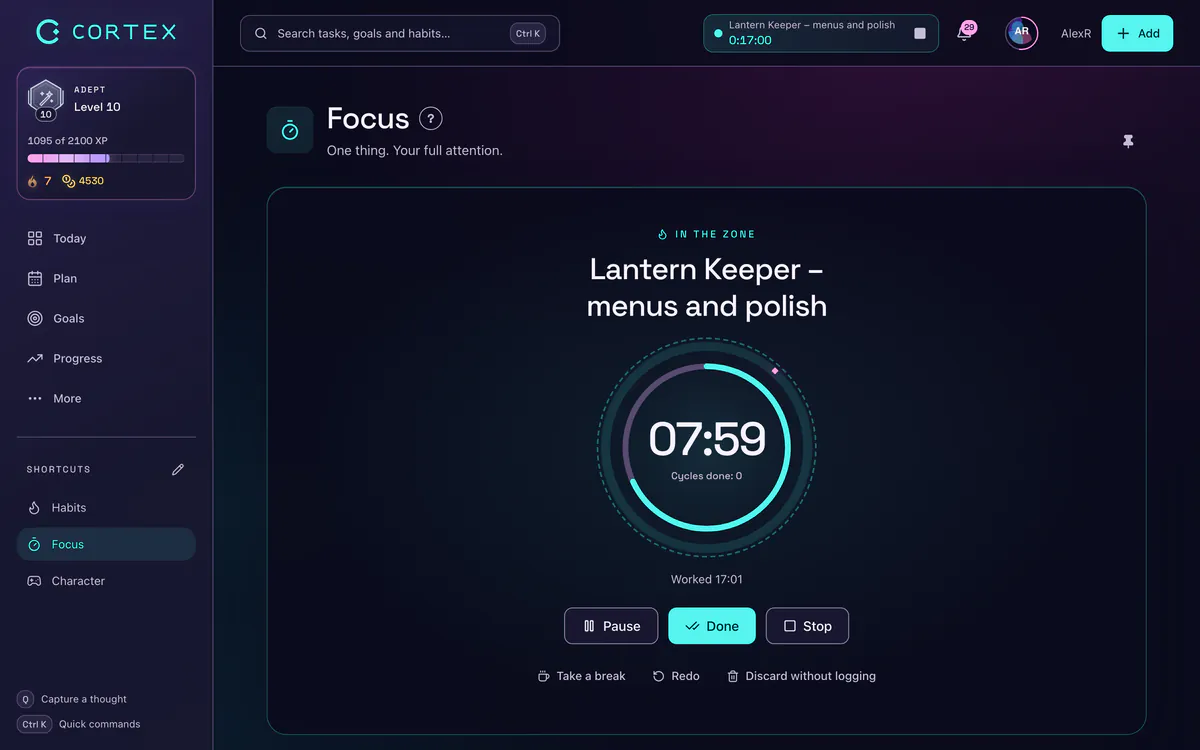
In CORTEX (free for everyone) you capture tasks in one sentence (key Q), fit them into free slots around meetings with a buffer using Plan my day, and start a Focus session on the most important one. Finished tasks show up on the Today screen and each earns XP – progress stays visible even on days full of email.
Frequently asked questions
How do I get motivated to work when I don't feel like it?
Start with a small win under 15 minutes, then schedule a focus block for the most important task with a specific time and notifications off. Keep a record of progress and decide in advance when your workday ends.
How do I motivate myself to work from home?
Keep a fixed start and end, have a workspace you "switch on" in the morning and "off" in the evening, and work in blocks with a countdown. A quiet co-working call with a colleague or friend helps too.
What if I find my work boring?
Put boring tasks in short time boxes with a small reward, clarify vague ones with a two-line question, and write down who each task helps. If you find the whole job dull for a long time, it is worth talking it through with someone you trust.
Should I start with the hardest task or the easiest one?
Both can work. A quick win in the morning helps you get going, but the hardest task should come in the first big focus block while your energy is highest – not late in the afternoon.
Why am I always tired and unmotivated at work?
Common causes are too little sleep, endless workdays and constant interruptions. If tiredness and reluctance last for weeks and rest does not help, talk to a doctor – it could be burnout or another health issue.
Sources and further reading
- Amabile, T. M. & Kramer, S. J. (2011). The power of small wins. Harvard Business Review
- Mark, G., Gudith, D. & Klocke, U. (2008). The cost of interrupted work: More speed and stress. Proceedings of CHI 2008
- Gollwitzer, P. M. & Sheeran, P. (2006). Implementation intentions and goal achievement: A meta-analysis of effects and processes. Advances in Experimental Social Psychology, 38, 69–119
Level up your life
CORTEX is free for everyone. Tasks, a one-click day plan, time tracking, habits and rewards in one system – on desktop and mobile.
CREATE A FREE ACCOUNT