How to focus better: a practical guide for work, study and long sessions
To focus better, remove the phone from the room, write down one specific task, work in timed blocks of 25–50 minutes and plan your breaks before you start – these four changes beat any "focus hack". This guide goes further: which technique fits which situation, what the research actually says about music and background noise, how to build up to focusing for hours, and a 4-week training plan.
- The biggest focus wins are environmental: phone out of sight, notifications off, one clearly written task and a timer.
- Background music has no consistent overall effect on performance, but music with lyrics tends to hurt reading and memory tasks (Kämpfe et al., 2011; Perham & Currie, 2014).
- Moderate background noise (about 70 dB, like a busy café) improved creative thinking compared with a quiet room in one study, while loud noise (85 dB) hurt it (Mehta et al., 2012).
- Focus is trainable: start with 25-minute blocks and add 5–10 minutes per week; Cal Newport estimates about four hours of deep focus a day as a realistic ceiling for experienced people.
- For studying, how you study matters as much as focus: practice testing and spaced practice are among the most effective techniques (Dunlosky et al., 2013).
Why you can't focus: a 60-second diagnosis
"I can't focus" has different causes, and each needs a different fix. Find your row:
| What it feels like | Likely cause | Try this first |
|---|---|---|
| You keep picking up your phone | Easy rewards within reach | Phone in another room, not just face-down |
| You open the file, then wander off | Task is vague or too big | Rewrite it as a 25-minute next step: "outline section 2", not "write report" |
| You read the same paragraph three times | Tired or passive reading | Take notes in your own words, or switch to a lower-effort task and come back |
| Your mind keeps jumping to other to-dos | Open loops | 2-minute brain dump on paper, then return |
| You feel restless and fidgety | Been sitting too long, low energy | Walk for 5 minutes, drink water, eat something real |
| It is fine at night but impossible at 3 pm | Energy rhythm | Move hard work to your best hours, shallow work to the slump |
If you cannot even start, that is usually procrastination rather than focus – see how to stop procrastinating. If long-standing attention problems affect your work or studies, talking to a doctor is worth it; nothing here is medical advice.
Focus techniques for every situation
| Situation | Best technique | Setup |
|---|---|---|
| Hard work task (writing, coding) | One 50–90-minute block | Single target written down, chat closed, block at your best time of day |
| Studying for an exam | Pomodoro + practice questions | 25/5 rounds, test yourself instead of rereading |
| Reading long texts | Read with a pen | One-sentence summary per section, 30-minute rounds |
| Boring admin | Batching + timer | All emails and forms in one 45-minute block, reward at the end |
| Working from home | Start ritual | Same place, same start time, a "commute" walk before you begin |
| Noisy office or café | Headphones + steady sound | Instrumental music or steady noise, see below |
| Restless brain that needs novelty | Short sprints + visible rewards | 15-minute rounds, tick a box after each, switch tasks between rounds |
The Pomodoro Technique deserves a special mention because it solves two problems at once: it makes starting easy ("just 25 minutes") and it forces breaks before your focus collapses. You can run it with our free online Pomodoro timer.
Set up your environment and phone
Willpower is a weak tool against a device built to grab attention. Change the environment instead:
- Phone out of the room during focus blocks. Ward et al. (2017) reported that even the presence of your own phone reduced available cognitive capacity. Later direct replications did not find the same effect, so treat it as unsettled – but distance still removes the easiest distraction there is.
- Notifications off on your computer during the block. Use focus or "do not disturb" modes.
- One window: only the files and tabs for this task. Close the inbox.
- A paper notepad next to you for every "I should…" thought.
- Water and a snack within reach so you do not "just go grab something".
- Light and temperature comfortable enough to forget about.
The best music and noise to focus (what research says)
This is the most-searched focus question, and the honest answer is: it depends on the task and on you. Here is what the evidence suggests:
- Music overall: a meta-analysis by Kämpfe, Sedlmeier and Renkewitz (2011) found background music had no consistent overall effect on adult performance, but small negative effects on reading and memory tasks.
- Lyrics: Perham and Currie (2014) found reading comprehension was worse with music that had lyrics – whether people liked the music or not – than in quiet.
- Moderate noise and creativity: Mehta, Zhu and Cheema (2012) found a moderate level of ambient noise (around 70 dB, like a busy café) improved creative thinking compared with a quiet 50 dB room, while loud noise (85 dB) hurt it.
- White noise and attention: a small study by Söderlund and colleagues (2007) found white noise improved memory performance in inattentive children, but slightly worsened it for children without attention problems. Brown and pink noise are popular for focus, but strong direct evidence is limited.
Practical rules:
| Task | Best bet | Avoid |
|---|---|---|
| Reading, memorizing, writing | Silence or steady noise at low volume | Songs with lyrics |
| Creative or brainstorming work | Café-level ambient sound | Very loud music |
| Repetitive tasks (admin, data entry) | Music you like, lyrics are fine | Nothing in particular |
| Noisy environment | Headphones with instrumental music, lofi or nature sounds | Switching playlists every few minutes |
Try one option for a full week and compare how much you got done. The playlist that "feels" productive is not always the one that is.
How to focus for hours (without burning out)
Nobody focuses for eight hours straight. People who "focus for hours" stack several good blocks with real breaks. Cal Newport, author of Deep Work, estimates that around four hours of deep focus per day is a realistic upper limit even for experienced people. A sustainable structure:
- Block 1 (50–90 min): your hardest task, ideally early in the day.
- Break (10–15 min): stand up, move, look at something far away, no feeds.
- Block 2 (50–90 min): the second-hardest task or a continuation.
- Long break (30–60 min): food and something offline.
- Block 3 (50 min): lighter deep work: editing, review, practice.
- Shallow work and admin fill the rest.
Breaks matter as much as blocks. Scrolling social media is not a break for your attention; walking, stretching or making tea is. For the full method, read our guide to deep work, and to give each block a fixed slot in your calendar, use time blocking.
How to focus on studying
Students often blame focus when the real problem is the method. A big review of learning techniques by Dunlosky and colleagues (2013) rated practice testing (quizzing yourself) and distributed practice (spreading study over days) as the most useful techniques, and highlighting and rereading as low-utility. Active techniques also happen to be easier to focus on, because they give you something to do.
- Before each session, write the goal: "Answer 20 chapter-5 questions" – not "study biology".
- Phone in another room, laptop with only the course material open.
- Run 25/5 Pomodoros. After four rounds, take a 20–30-minute break.
- Close the book and test yourself: flashcards, past papers, explaining it aloud.
- Spread it out: three 45-minute sessions across a week beat one 3-hour cram.
- Protect sleep before exams – see the evening routine guide for a simple wind-down.
The 2-minute reset (when you lose focus mid-block)
You will drift. The goal is not to never lose focus, it is to come back fast. When you notice you have wandered:
- Notice it without drama. "Drifted. Fine."
- Write down whatever pulled you away so it stops nagging.
- Take three slow breaths and roll your shoulders.
- Reread your one-line target for this block.
- Do the smallest next step – one sentence, one line of code, one question.
If you need the reset more than three times in one block, the task is probably unclear or too big. Stop, split it, and restart the timer.
A 4-week focus training plan
| Week | Daily focus target | Focus habit to add |
|---|---|---|
| 1 | 2 × 25 min | Phone out of the room during blocks |
| 2 | 3 × 25 min or 2 × 40 min | Write the one-line target before each block |
| 3 | 2 × 50 min | Check email and chat only at 3 set times a day |
| 4 | 2–3 × 50 min, or 1 × 90 min + 1 × 50 min | End-of-day shutdown: plan tomorrow's first block |
Track blocks, not feelings. A simple tally each day is enough – what you measure, you protect. If you want this to become automatic, the same rules apply as for any habit: start small, keep it daily and make the progress visible (more in how to build habits).
Using the CORTEX focus timer with ambient sounds
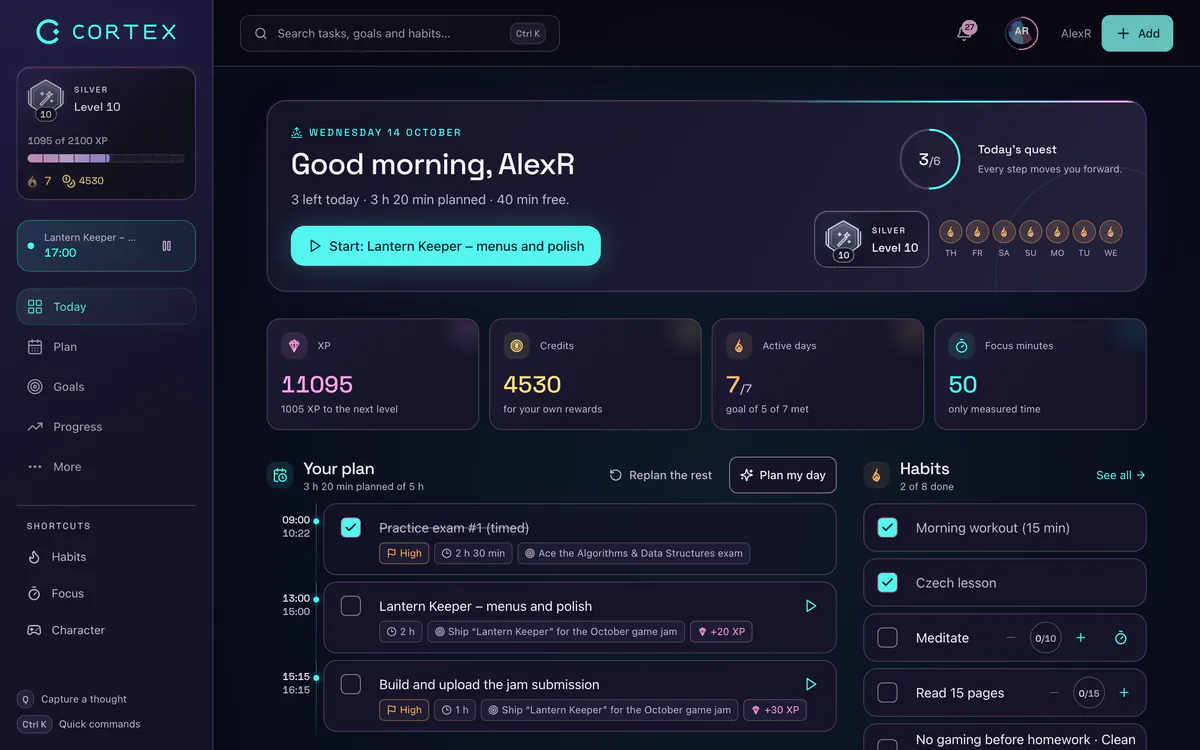
CORTEX is a free gamified productivity app – tasks, a one-click day plan, time tracking and habits, with XP, levels and real-life rewards. Its focus tools fit the routine above:
- Focus timer in the top bar: 15, 25 or 50-minute countdown with a progress bar and a "done" notification in the app.
- Ambient sounds built in: Lofi, Synth, Bio (nature), Zen and Wave (alpha). Pick one and keep it for a week, per the music rules above.
- Named work timers on the Today screen log your actual focus minutes to reports. (The countdown itself is not logged – start a work timer such as "Study – biology" alongside it.)
- XP and credits for finished tasks, which you spend on rewards you set yourself – a handy carrot for brains that want a reward now. If that is you, see the ADHD planner page.
Frequently asked questions
How can I focus better?
Put your phone in another room, turn off notifications, write one specific task, and work in timed blocks of 25–50 minutes with short breaks. Start with your hardest task at your best time of day. These environmental changes help more than any supplement or hack.
How do I focus for hours?
Stack two or three 50–90-minute blocks with real breaks between them instead of trying to focus all day. Build up gradually by adding 5–10 minutes per week. Around four hours of deep focus a day is a realistic ceiling for most people.
What is the best music to focus?
For reading and memorizing, silence or steady low-volume noise usually works best, and songs with lyrics tend to hurt. For creative work, café-level ambient sound may help. For repetitive tasks, any music you enjoy is fine. Test one option for a week.
Does white noise or brown noise help you focus?
It can, especially in noisy places, because it masks unpredictable sounds. A small study found white noise helped inattentive children but not others, and direct evidence for brown noise is limited. If it helps you, use it at a low, comfortable volume.
How do I focus on studying when I keep getting distracted?
Use short Pomodoro rounds, keep your phone out of the room and switch to active techniques like self-testing and past papers. A clear goal per session ("answer 20 questions") makes it easier to stay on track than "study chapter 5".
Why can't I focus on anything?
Common causes are poor sleep, a vague or overwhelming task, constant phone checks and too many open loops in your head. Fix the easy ones first. If difficulty focusing is persistent and affects your daily life, talk to a doctor.
Sources and further reading
- Kämpfe, J., Sedlmeier, P. & Renkewitz, F. (2011). The impact of background music on adult listeners: A meta-analysis. Psychology of Music
- Perham, N. & Currie, H. (2014). Does listening to preferred music improve reading comprehension performance? Applied Cognitive Psychology
- Mehta, R., Zhu, R. & Cheema, A. (2012). Is noise always bad? Exploring the effects of ambient noise on creative cognition. Journal of Consumer Research
- Söderlund, G., Sikström, S. & Smart, A. (2007). Listen to the noise: noise is beneficial for cognitive performance in ADHD. J. Child Psychology and Psychiatry
- Ward, A. F. et al. (2017). Brain Drain: The mere presence of one's own smartphone reduces available cognitive capacity. JACR
- BPS Research Digest – Revisiting the "brain drain" effect (replications)
- Dunlosky, J. et al. (2013). Improving students' learning with effective learning techniques. Psychological Science in the Public Interest
Level up your life
CORTEX is free for everyone. Tasks, a one-click day plan, time tracking, habits and rewards in one system – on desktop and mobile.
CREATE A FREE ACCOUNT