Chronotype and productivity: plan your day around being a lark or a night owl
Your chronotype is your natural timing for sleep and alertness – whether you wake easily and do your best work in the morning (a lark, or morning type) or come alive in the afternoon and evening (a night owl, or evening type). Most people sit somewhere in between. It matters for productivity because the same task can go better or worse depending on whether it lands in your best window. Below: a quick way to estimate your chronotype, what the studies actually show, and a schedule you can adapt.
- A chronotype is your individual timing of sleep and wakefulness; across the population it forms a continuous spectrum from strong morning types to strong evening types.
- A simple marker is the midpoint of your sleep on free days, when no alarm wakes you – the approach behind the Munich ChronoType Questionnaire (Roenneberg et al., 2003).
- Chronotype shifts with age: it gets later through adolescence, is latest around age 20 and then moves earlier again (Roenneberg et al., 2004).
- Analytical tasks tend to go better at your optimal time of day (May et al., 1993), while in Wieth and Zacks (2011) insight problems were solved more often at the non-optimal time.
- In practice: put your hardest focused work in your best window, routine work in the dip, and brainstorming wherever you feel a bit less sharp.
What a chronotype is
Everyone runs on an internal (circadian) clock that times sleep, body temperature and hormones over roughly 24 hours. Your chronotype describes how that clock is set relative to the sun and to everyone else: morning types fall asleep and wake earlier, evening types later.
It is not two boxes. Till Roenneberg and colleagues, who collected sleep data from tens of thousands of people, found a smooth distribution: strong larks and strong owls are the minority and most people are somewhere in the middle. There is a genetic component too – a study of nearly 700,000 people by Jones et al. (2019) found 351 locations in the genome associated with being a morning person.
A chronotype is not a character trait. An owl who can't focus at 7 a.m. isn't lazy; they are working against their clock. You may not be able to change your chronotype much, but you can plan around it.
How to find your chronotype in a week
The easiest estimate follows the logic of the Munich ChronoType Questionnaire (MCTQ, Roenneberg et al., 2003): look at when you sleep on free days, without an alarm, and work out the midpoint.
- For a few free days, note when you fall asleep and when you wake up on your own.
- Work out the midpoint: sleep onset plus half your sleep duration. Example: asleep at 12:30 a.m., awake at 8:30 a.m., 8 hours, midpoint 4:30 a.m.
- Compare with the table. The cut-offs are our rough simplification, not an official MCTQ scale – it is a spectrum, not a diagnosis.
| Sleep midpoint on free days | Roughly | Typical best focus window |
|---|---|---|
| Before 3:00 a.m. | Morning type (lark) | Morning |
| 3:00–5:00 a.m. | Intermediate | Late morning to early afternoon |
| After 5:00 a.m. | Evening type (owl) | Afternoon and early evening |
Two caveats. If you catch up on sleep debt at the weekend, your midpoint will look later than your real chronotype. And light shifts the result: long evenings in front of screens and little morning daylight push you later.
What the research says about performance across the day
The synchrony effect
May, Hasher and Stoltzfus (1993) tested memory in younger and older adults in the morning and the afternoon. Older participants, mostly morning types, remembered more in the morning; younger participants, more often evening types, did better later in the day. Performance depends partly on whether the task matches your optimal time – the synchrony effect.
Insight at your "worst" time
Wieth and Zacks (2011) gave people analytic problems and insight problems (the kind where the answer suddenly clicks). On insight problems, participants did better at their non-optimal time of day. The authors' explanation: when you are less alert you filter out "irrelevant" thoughts less, which can help with unusual solutions. Analytic problems showed no large difference.
Age moves the clock
Roenneberg et al. (2004) showed that chronotype gets later during adolescence, peaks around age 20 and then gradually moves earlier. Late-rising students are not simply short on willpower.
Sleep comes first
No schedule makes up for too little sleep. The American Academy of Sleep Medicine and the Sleep Research Society recommend that adults regularly sleep 7 or more hours (Watson et al., 2015). If you are consistently below that, start there.
A daily schedule for larks, owls and everyone between
The principle: hardest focused work in your best window, routine work in the dip, idea work wherever you feel slightly less sharp. Here is what an eight-hour workday can look like:
| Lark | Intermediate | Owl | |
|---|---|---|---|
| Deep work (analysis, writing, coding) | 7:30–10:30 | 9:00–12:00 | 1:00–4:00 p.m. |
| Meetings, email, admin | 1:00–3:00 p.m. | 1:30–3:30 p.m. | 10:00 a.m.–12:00 |
| Brainstorming and creative tasks | Afternoon | Late afternoon | Morning |
| Exercise and recovery | Late afternoon | After work | Morning, outdoors in daylight |
Treat the times as a starting point. Shift them to your own window, then adjust after a couple of weeks of notes. For the mechanics of planning in blocks, see time blocking; for protecting focus, deep work.
When you can't choose your hours
- Protect one block in your better window – even 90 minutes a week for your most important task counts.
- Early meetings for owls: prepare the material the day before so the morning is execution, not thinking.
- Late slump for larks: no decisions after 4 p.m.; use the time for routine and tomorrow's plan.
- Morning light, dim evenings. Light is the main signal that sets the internal clock (Roenneberg et al., 2003): daylight early and fewer screens late help shift it earlier – useful for owls with early starts.
Run a two-week chronotype experiment
- Week 1 – measure. Three times a day (morning, after lunch, early evening), rate energy and focus from 1 to 10, and note your sleep.
- Find your window. When is focus repeatedly highest?
- Week 2 – test. Put the hardest task of each day in that window. Move routine work out of it.
- Compare. How many hard tasks did you finish in week 2 versus week 1, and how did you feel?
You end up with your own data instead of a personality label – and "intermediate with a 10 a.m. peak" is just as useful a result as "night owl".
Planning by chronotype in CORTEX
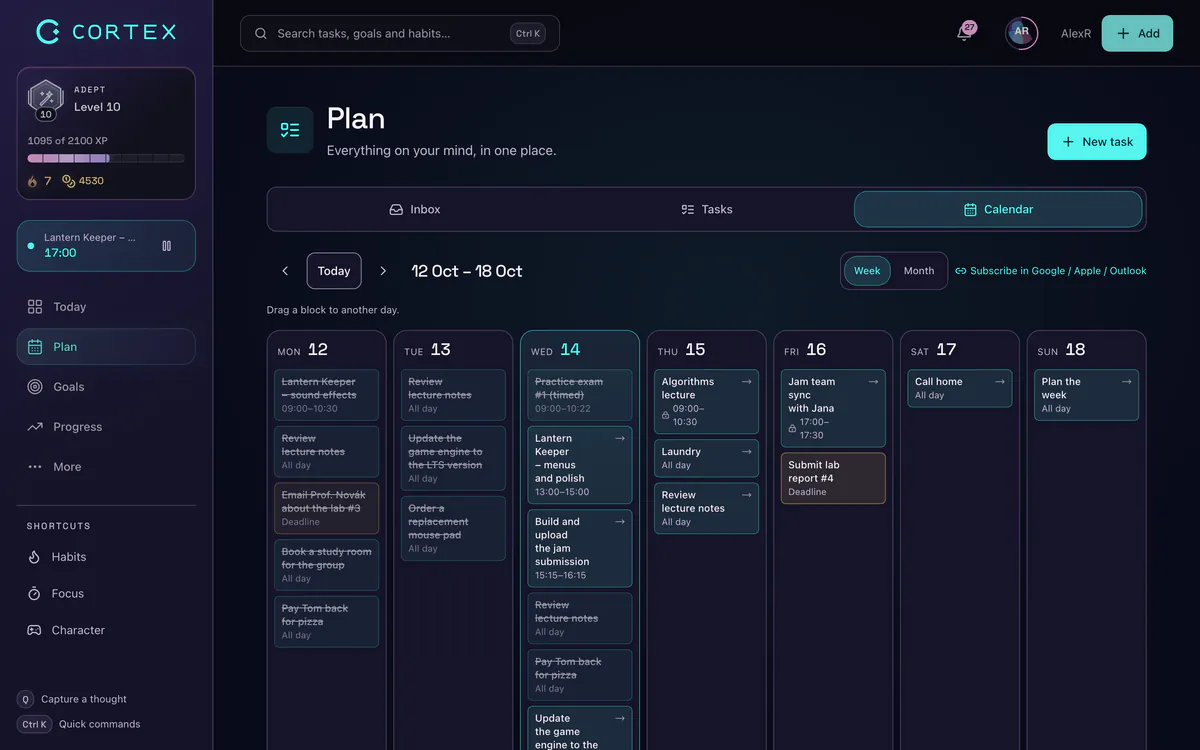
CORTEX is a free gamified productivity app – tasks, a one-click day plan, time tracking and habits, with XP, levels and real-life rewards. It doesn't score your chronotype, but it gives you the controls to plan around it:
- Your own day start and end. In planning settings you set when your workday starts and ends, how much focused work fits and how much buffer to keep. An owl can start the day at 10.
- Plan My Day. Plan My Day fits tasks into the free slots between fixed appointments; drag your hardest task into your best window in the calendar.
- Energy log. The daily log records energy, focus and sleep, so the experiment above lives in one app.
- Focus and time. A focus session on a task records how much focused work you actually do, and when – see the time tracking app.
This article is for information only and is not medical advice. If you have long-term sleep problems or daytime sleepiness, talk to a doctor.
Frequently asked questions
What is a chronotype?
A chronotype is your natural timing of sleep and alertness. Morning types (larks) sleep and wake earlier and do their best work in the morning; evening types (night owls) peak later. Chronotypes form a continuous spectrum, and most people are in between.
How do I know if I am a morning person or a night owl?
Work out the midpoint of your sleep on free days without an alarm: sleep onset plus half your sleep duration. As a rough guide, a midpoint before 3 a.m. suggests a morning type, 3–5 a.m. an intermediate type and after 5 a.m. an evening type. The Munich ChronoType Questionnaire gives a more detailed picture.
Can you change your chronotype?
Partly. It has a genetic component and changes with age, but light matters: daylight in the morning and less screen light at night help shift your clock earlier. You are unlikely to turn a strong owl into a lark, but you can shape your schedule.
When is the best time for focused work?
In your optimal window – usually the morning for larks and the afternoon for owls. Research on the synchrony effect shows the same task can go better at your optimal time, while creative insight can come at a less optimal time.
What is social jetlag?
The gap between when you sleep on workdays and on free days. The term was introduced by Wittmann et al. (2006). The bigger the gap, the more your body runs on a different schedule from your calendar; it affects evening types most.
Are night owls less productive?
No. Night owls are most productive later in the day. The trouble starts when they have to perform at times that don't suit their clock, which is why scheduling hard work in their better window helps.
Sources and further reading
- Roenneberg, Wirz-Justice & Merrow (2003): Life between Clocks: Daily Temporal Patterns of Human Chronotypes, Journal of Biological Rhythms
- Roenneberg et al. (2004): A marker for the end of adolescence, Current Biology
- Wittmann, Dinich, Merrow & Roenneberg (2006): Social jetlag: misalignment of biological and social time, Chronobiology International
- May, Hasher & Stoltzfus (1993): Optimal Time of Day and the Magnitude of Age Differences in Memory, Psychological Science
- Wieth & Zacks (2011): Time of day effects on problem solving: When the non-optimal is optimal, Thinking & Reasoning
- Jones et al. (2019): Genome-wide association analyses of chronotype in 697,828 individuals, Nature Communications
- Watson et al. (2015): Recommended Amount of Sleep for a Healthy Adult (AASM and SRS), SLEEP
Level up your life
CORTEX is free for everyone. Tasks, a one-click day plan, time tracking, habits and rewards in one system – on desktop and mobile.
CREATE A FREE ACCOUNT