How to gamify studying: a complete XP system for exam season
To gamify studying, give every study task points (XP), turn each exam into a "boss fight" with prep quests, and trade points for small real rewards. The trick is to give the most XP to the study methods that actually work, like practice tests and spaced review, and to use rewards to get you started, not as the only reason you study. This guide gives you a ready-made XP table, a boss fight plan, a printable quest log and the research on when rewards help and when they backfire.
- A 2020 meta-analysis found small positive effects of gamification on learning: g = 0.49 for cognitive, 0.36 for motivational and 0.25 for behavioral outcomes (Sailer & Homner). Only the cognitive effect held up in the most rigorous studies.
- Expected, tangible rewards can lower your interest in a task you already enjoy, while positive feedback tends to increase it (Deci, Koestner & Ryan, 1999).
- Give the most XP to practice testing and spaced review, the two techniques rated most useful in a major review of study methods (Dunlosky et al., 2013).
- An exam works well as a boss: its HP is the number of topics, prep quests are spaced reviews, and the final attack is a timed mock exam.
- Gamification is a starter motor, not an engine. It helps you begin and keep going; understanding why the subject matters keeps you going longer.
Does gamifying studying actually work?
Short answer: a little, on average, and more when it is designed well. Here is what the research says.
- Small but real effects. Sailer and Homner (2020) pooled studies on gamified learning and found small positive effects on cognitive outcomes like test scores (g = 0.49), motivational outcomes (g = 0.36) and behavioral outcomes like participation (g = 0.25). When they looked only at the most rigorous studies, the effect on learning held up, but the effects on motivation and behavior were less stable.
- Context matters. A widely cited review of gamification studies (Hamari, Koivisto & Sarsa, 2014) found mostly positive results, but they depended heavily on the context and on the people using it. The same points system can motivate one student and annoy another.
- Rewards can backfire. A meta-analysis of 128 experiments (Deci, Koestner & Ryan, 1999) found that expected, tangible rewards for doing or finishing a task reduced people's intrinsic motivation, measured as how much they kept doing it freely afterwards. Positive feedback had the opposite effect and increased it.
The takeaway for a student: use game mechanics to make the boring parts of studying easier to start, reward effective study methods, and lean on feedback and visible progress more than on prizes. If you want the general version of this system, read how to gamify your life.
The study game in 6 parts
| Game part | Study version | Example |
|---|---|---|
| Quests | A specific study task with a clear finish line | "Do 20 practice questions on chapter 4" |
| XP | Points per quest, weighted by how well the method works | Past paper = 50 XP, re-reading = 2 XP |
| Levels | Every 100 XP is a level | Level 5 by the end of week one |
| Boss fight | The exam, with HP based on topics | Biology final: 12 topics = 120 HP |
| Loot | A small real reward at each level | A movie night, a new game, a café breakfast |
| Streak | Days in a row with at least one quest done | Seven days = bonus loot |
Keep it that small. If you spend more time designing the game than playing it, you have found a new way to procrastinate.
An XP table you can copy
Not all studying is equal. In a large review of ten common study techniques, Dunlosky and colleagues (2013) rated practice testing and distributed practice (spreading reviews over time) as the most useful. Highlighting, re-reading and summarizing were rated low. A good XP table rewards what works:
| Study quest | XP | Why |
|---|---|---|
| Full past paper under timed conditions | 50 | Practice testing plus exam conditions |
| Practice test or problem set (20+ questions) | 30 | Practice testing |
| Teach-back: explain a topic out loud without notes | 20 | Retrieval plus self-explanation |
| Flashcard session (one deck, until done) | 10 | Retrieval practice in small doses |
| Make flashcards or practice questions from a chapter | 10 | Prepares future testing |
| Write a one-page summary from memory | 10 | Retrieval; summarizing alone scores lower |
| Re-read notes or highlight | 2 | Feels productive, low payoff |
| Bonus: review a topic again 2+ days later | +5 | Spacing |
| Bonus: answer correctly a question you missed last time | +5 | Closing gaps |
Why give testing so much XP when re-reading feels easier? Because of studies like Roediger and Karpicke (2006): students who re-read a passage did better on a test five minutes later, but students who practiced recalling it remembered substantially more after two days and after a week. Re-reading also made students more confident, which is exactly why it is a trap. Your XP table should push you toward the harder, better method.
Exams as boss fights
A boss fight turns a vague, scary exam into a visible health bar that goes down. Here is how to set one up:
- Count the boss's HP. List every topic the exam covers. Each topic is 10 HP. A course with 12 topics is a 120 HP boss.
- Plan prep quests. For each topic, plan a first review and a second review a few days later. Spaced reviews are your main weapon.
- Deal damage only for recall. A topic deals 10 damage when you can answer its practice questions without notes. Reading the chapter deals zero.
- Do the final attack. A few days before the exam, take a full mock exam under timed conditions. Whatever you get wrong becomes the last set of quests.
- Claim victory loot after the real exam, whatever the grade. You fought the boss; the loot is for the fight.
Seeing the boss at 30 HP three days before the exam is calming in a way "I think I studied enough" never is. It also shows you early which topics you have been avoiding.
Loot that doesn't kill your motivation
Rewards are the most fun part to design and the easiest to get wrong. Four rules:
- Reward the boring parts, not the parts you love. If you already enjoy reading about history, don't pay yourself for it. The research on expected rewards suggests that can make an enjoyable activity feel like work. Save loot for the flashcards and past papers you avoid.
- Choose experiences over stuff. A movie night with friends, a long walk, an afternoon of gaming. Things pile up; good evenings don't.
- Add a few surprise drops. Once in a while, give yourself an unplanned bonus after a tough session. It keeps the game from feeling like a vending machine.
- Feedback counts as a reward. Watching your level bar grow, ticking a topic off the boss and telling a friend "I finished chapter 6" are rewards too. In Deci and colleagues' meta-analysis, positive feedback increased intrinsic motivation instead of reducing it.
And keep your actual reasons in view. Write one sentence at the top of your quest log: why this exam matters to you. Gamification gets you to the desk; that sentence keeps you there when the novelty wears off.
Gamifying studying with ADHD
Many students with ADHD say game mechanics help because they make rewards immediate and progress visible, which matches what many describe as an "interest-based" way of getting motivated. Practical adjustments people often find useful:
- Shorter quests. "10 flashcards" instead of "the whole deck". Many small XP hits beat one big one at the end.
- Instant feedback. Tick off quests the moment they're done, on paper or in an app. Don't batch it for later.
- A visible timer. Short focus blocks of 15 or 25 minutes, with the countdown in sight. Our free Pomodoro timer works in any browser; read does the Pomodoro Technique work for an honest look at the evidence.
- Body doubling. Study next to someone else, in person or on a video call, during the same timer.
- Novelty on purpose. Change the boss theme each exam, or swap loot every few weeks before the game gets stale.
This is practical advice, not medical advice, and it is not a replacement for professional support. If you think you have ADHD, talk to a qualified healthcare professional. More ideas are on our ADHD planner page.
Solo or with friends?
Both work. They just work differently.
| Setup | Pros | Watch out for |
|---|---|---|
| Solo game | Your rules, your pace, no comparison | No one notices when you quietly stop |
| Study alliance (2–5 people) | Shared timers, accountability, someone to quiz you | Study sessions turning into chat sessions |
| Leaderboard | Strong push for competitive people | Discouraging if you're always at the bottom; rewards volume over quality |
A useful middle ground is to compete and cooperate: a team goal (the whole group finishes three past papers this week) plus a friendly individual leaderboard. In the Sailer and Homner meta-analysis, combining competition with collaboration was particularly effective for behavioral outcomes, though the number of studies behind that finding was small.
Free printable: study quest log
Prefer paper? Print these two sheets: a weekly quest log with the XP key, and a boss fight tracker for one exam. They fit A4 and US Letter.
Study quest log
| Date | Quest (what exactly?) | Type | XP | Done |
|---|---|---|---|---|
XP key: flashcard session 10 · teach-back 20 · practice test 30 · past paper 50 · re-reading 2 · spaced review bonus +5. Level up every 100 XP. Loot at each level: ______________________
Boss fight tracker
| Topic | 1st review | 2nd review | Damage dealt |
|---|---|---|---|
A topic deals 10 damage when you can answer its practice questions from memory. Final attack: a timed mock exam. Victory loot: ______________________
Running your study game in CORTEX
CORTEX is a free gamified productivity app: tasks, a one-click day plan, time tracking and habits, with XP, levels and real-life rewards. Here is how the study game maps onto it:
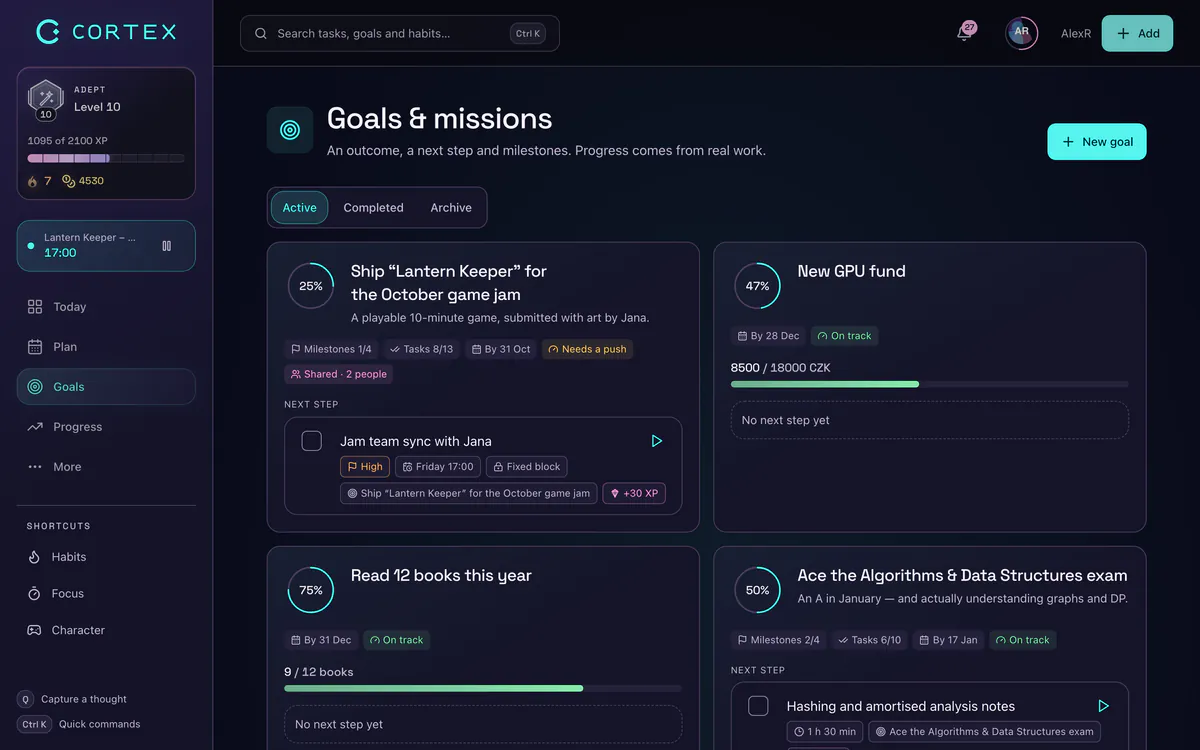
- Exam = goal with a deadline. Add study tasks to the goal and its progress fills up as you finish them, like a boss health bar in reverse.
- Spaced reviews = recurring tasks. Set a review to repeat every few days (any custom interval from 2 to 365 days). It is a fixed interval, not an adaptive algorithm, but it covers the basics of spacing.
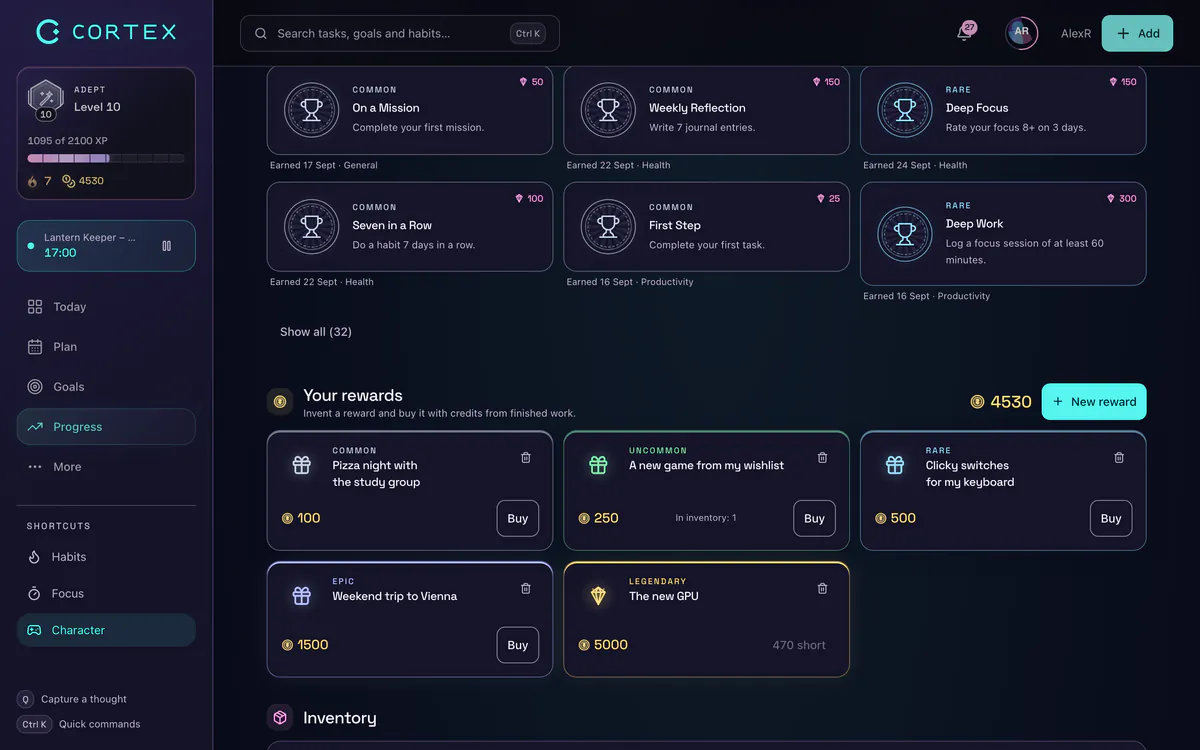
- XP and credits. Finished tasks give XP based on priority and estimate, and credits based on priority, estimate and difficulty (trivial to heroic). Credits buy the loot you define in your own reward shop.
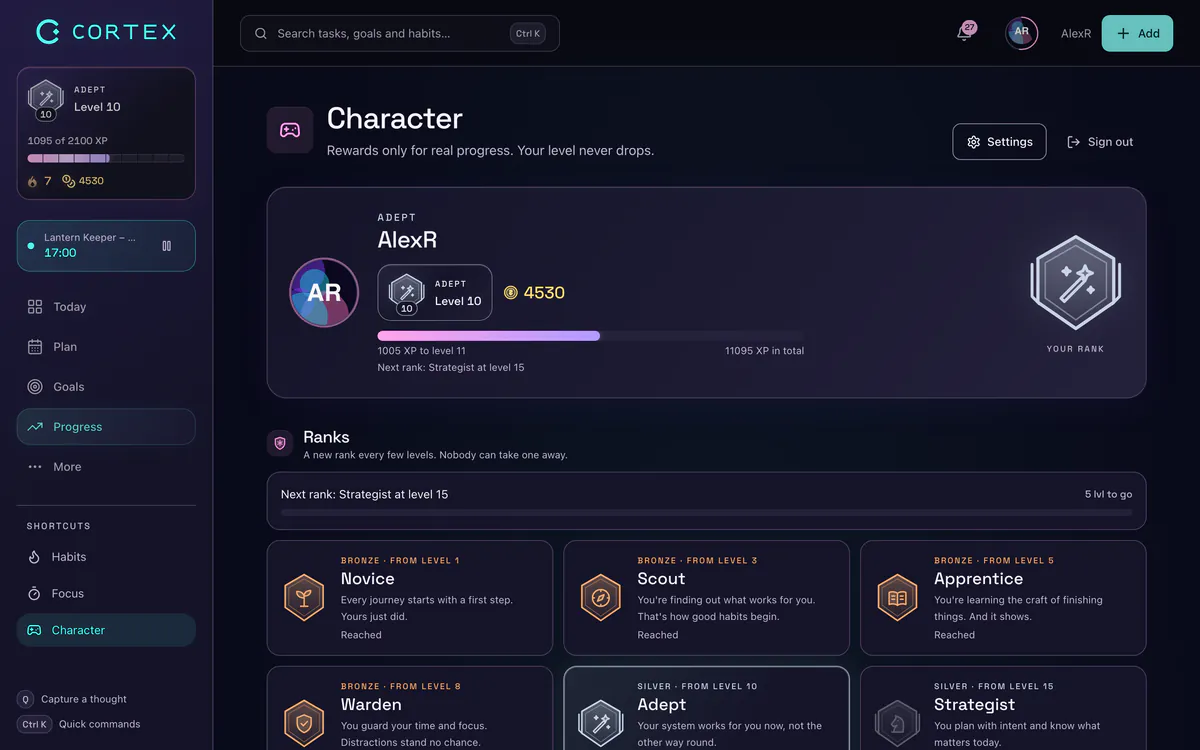
- INT grows as you study. CORTEX has five attributes. Tasks feed INT unless their goal's category matches another attribute (like Health for STR), so study goals build your INT score.
- Focus countdown: 25 or 50-minute blocks in the top bar, with optional focus sounds. Use a named work timer per subject if you want hours per subject in your reports.
- Study alliances: create an alliance with classmates for a shared chat, challenges and a leaderboard.
One honest gap: CORTEX has no flashcards. Use a dedicated flashcard app such as Anki alongside it, and log each finished deck session as a 10 XP quest.
More on the mechanics: the life RPG page explains levels and attributes, gamification examples shows what works in education and beyond, and how to focus covers the study sessions themselves. Need a break from the books? Roll one of our real-life side quests. For the timer method itself, see the Pomodoro Technique guide.
Anki is a trademark of its respective owner. CORTEX is not affiliated with it.
Frequently asked questions
How do I gamify studying?
Turn study tasks into specific quests, give each one XP (more for practice tests and spaced reviews, less for re-reading), level up every 100 XP, and pick a small real reward for each level. Treat each exam as a boss whose HP is the number of topics, and track damage as you master each topic.
Does gamification actually help you learn?
On average a little. A 2020 meta-analysis found small positive effects on learning, motivation and behavior, with the learning effect holding up best in rigorous studies. Results depend on the design and on the person, so test your setup for a couple of weeks.
What rewards should I use for studying?
Use small experiences you genuinely want, like a movie night, an afternoon of gaming or a café breakfast, and give them for the study tasks you tend to avoid. Avoid paying yourself for things you already enjoy, and count visible progress and feedback as rewards too.
How do I gamify studying with ADHD?
Use short quests with instant feedback, a visible timer for 15 or 25-minute blocks, body doubling with a friend, and change themes or rewards every few weeks to keep it novel. This is practical advice, not medical advice; talk to a professional about ADHD itself.
What is the best gamified study app?
It depends on what you need. Flashcard apps like Anki are best for memorizing; a gamified productivity app like CORTEX handles the rest of the system: exams as goals, recurring reviews, focus timers, XP, levels and a reward shop. Many students use one of each.
Can rewards make me like studying less?
They can, if they are expected, tangible rewards for something you already enjoy; research on the overjustification effect shows they can lower your interest. Reward the boring tasks instead, keep rewards small, and rely on progress and feedback, which tend to increase motivation.
Sources and further reading
- Sailer & Homner (2020): The Gamification of Learning – a Meta-analysis, Educational Psychology Review
- Hamari, Koivisto & Sarsa (2014): Does Gamification Work? A Literature Review of Empirical Studies on Gamification, HICSS
- Deci, Koestner & Ryan (1999): A meta-analytic review of experiments examining the effects of extrinsic rewards on intrinsic motivation, Psychological Bulletin
- Dunlosky et al. (2013): Improving Students' Learning With Effective Learning Techniques, Psychological Science in the Public Interest
- Roediger & Karpicke (2006): Test-Enhanced Learning, Psychological Science
Level up your life
CORTEX is free for everyone. Tasks, a one-click day plan, time tracking, habits and rewards in one system – on desktop and mobile.
CREATE A FREE ACCOUNT