How to stop being lazy: why it isn't a character flaw – and how to get moving
You won't stop being lazy by pushing harder – you will by understanding what is behind it. What we call laziness is usually a brain that has judged a task too expensive: lots of effort, a small or distant reward, an unclear start. It helps to make the start cheaper (five minutes, one clear step), raise the reward (visible progress, pairing with something pleasant) and deal with tiredness. And sometimes "laziness" is not laziness at all, but exhaustion or low mood that needs different care. Below: what science says, how to tell the difference, and six steps for today.
- What feels like laziness is often your brain deciding that effort does not pay right now – it weighs effort against reward.
- In the model by Kurzban and colleagues (2013), the feeling of effort signals that your time could be used elsewhere, not that your "energy has run out".
- The idea of willpower as a battery that drains (ego depletion) failed a large multi-lab replication (Hagger et al., 2016).
- Effort both costs and rewards us: we value things more when we have put effort into them (Inzlicht, Shenhav & Olivola, 2018).
- If "laziness" lasts for weeks, nothing feels enjoyable or sadness and hopelessness join in, it may be a health issue – findahelpline.com lists free helplines.
What laziness really is
We use the word lazy for all sorts of things: not wanting to clean, study or get off the couch. Psychology rarely uses the word, because the same behaviour can have very different causes. One common cause: the brain compares effort with reward and concludes it is not worth it right now.
Robert Kurzban and colleagues (2013) proposed a useful view: the feeling of effort is not a fuel gauge on empty but a signal that your time and attention could be used for something else – something more pleasant. That is why long, boring tasks feel heavy and why your phone pulls you away so easily.
Laziness is also not the same as procrastination. Procrastination is putting off something you do want to do, and feeling bad about it – mostly a quick mood fix, according to Sirois and Pychyl (2013). "Laziness" is more like moments when you do not want to do anything at all.
The myth of willpower as a battery
For years we were told that willpower works like a battery: use it up on self-control in the morning and you have none left in the evening ("ego depletion"). A large preregistered replication across 23 labs found practically no effect (Hagger et al., 2016). That does not mean tiredness is not real – only that the simple "my willpower ran out" picture probably does not hold.
The practical good news: you do not need to "save" willpower. It helps far more to shape your surroundings and the start of a task so that you barely need willpower at all. More in self-discipline.
Lazy, tired or low?
| What you feel | What it often is | What helps |
|---|---|---|
| I don't want to do one specific thing | The task is unpleasant, unclear or too big | Shrink the first step, five minutes, a clear goal |
| I don't want to do anything, I'm tired | Too little sleep, overload, illness | Rest, sleep, a simpler day |
| Nothing interests me, not even what used to | Possibly a health issue, such as depression | Talk to a doctor or mental health professional |
| I want to, but I can't start | Procrastination, fear of failure | A good-enough version, an if–then plan |
Effort that pays off
Michael Inzlicht, Amitai Shenhav and Christopher Olivola (2018) described the effort paradox: effort costs us, yet we value things more when we have put effort into them – flat-pack furniture we built ourselves, a run that hurt. So the brain only hates effort when it cannot see what it is for.
In practice: the clearer why you are doing something and the more progress you can see, the less "lazy" you feel about it. That is why small visible goals and ticking things off work (more in no motivation to do anything).
6 steps to get moving
- Name exactly what you don't want to do. "I don't want to do anything" is too broad. "I don't want to do the laundry" can be solved.
- Make the start cheap. Five minutes with permission to stop. See how to get motivated to do anything.
- Prepare your surroundings. Things within reach, phone out of reach. The fewer steps to start, the less willpower you need.
- Add an instant reward. A podcast only while cleaning, coffee after the first block, a tick on your list.
- Look after your body. Sleep, food, a short walk. A tired brain prices every effort higher.
- Be kind to yourself. "I'm lazy" is a label that fixes nothing. "Today is slow, I'll do five minutes" does.
Try it now: five minutes instead of a label
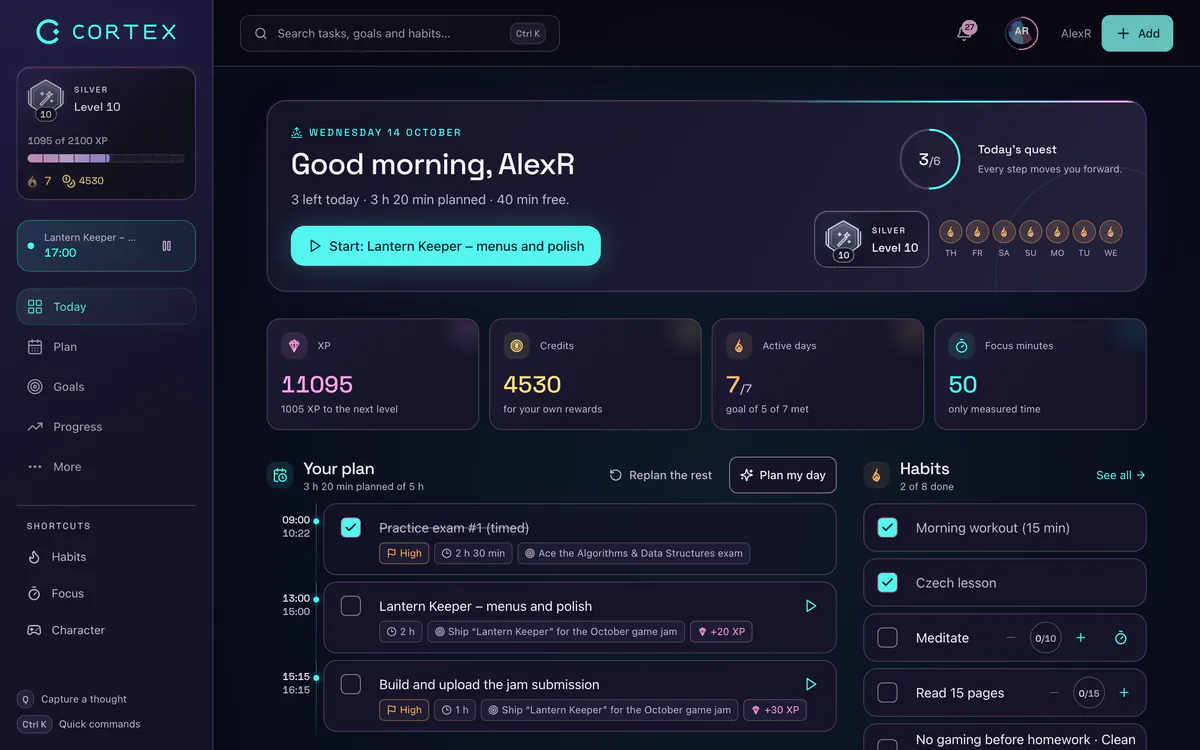
In CORTEX (free for everyone) turn it into a task with one press of Q ("Laundry today ~5m"), start a five-minute Focus session and earn XP when it is done. Spend credits in the shop on a reward you set yourself – so effort gets a visible payoff straight away.
Frequently asked questions
How do I stop being lazy?
Work out exactly what you do not want to do and make the start cheaper: five minutes with permission to stop, prepared surroundings and a small reward straight after. Look after your sleep and drop the "lazy" label – laziness is usually an expensive start, not a character flaw.
How do I stop being lazy and unmotivated?
Pick one small, specific task, set five minutes and make progress visible by ticking it off. Pair dull tasks with something pleasant. If you have felt unmotivated and flat for weeks, talk to a doctor – it may be more than laziness.
How can I tell laziness from depression?
With ordinary reluctance you avoid specific things but still enjoy others. If for two weeks or more nothing feels enjoyable, or sadness, hopelessness or changes in sleep and appetite join in, see a professional. In a crisis, call your local emergency number.
Why am I always lazy and tired?
Common causes are too little sleep, overload or illness. A tired brain rates every effort as more costly. If tiredness lasts a long time without an obvious reason, get checked by a doctor.
Is willpower like a battery?
Probably not. The "ego depletion" theory failed a large multi-lab replication (Hagger et al., 2016). Rather than saving willpower, shape your surroundings and the start of a task so you barely need it.
Sources and further reading
- Kurzban, R., Duckworth, A., Kable, J. W. & Myers, J. (2013). An opportunity cost model of subjective effort and task performance. Behavioral and Brain Sciences, 36(6), 661–679
- Hagger, M. S. et al. (2016). A multilab preregistered replication of the ego-depletion effect. Perspectives on Psychological Science, 11(4), 546–573
- Inzlicht, M., Shenhav, A. & Olivola, C. Y. (2018). The effort paradox: Effort is both costly and valued. Trends in Cognitive Sciences, 22(4), 337–349
- Sirois, F. & Pychyl, T. (2013). Procrastination and the priority of short-term mood regulation. Social and Personality Psychology Compass, 7(2), 115–127
Level up your life
CORTEX is free for everyone. Tasks, a one-click day plan, time tracking, habits and rewards in one system – on desktop and mobile.
CREATE A FREE ACCOUNT