How to restart a habit after a break – without guilt and without starting from zero
The best way to restart a habit after a break is to come back with a smaller version, tie it to the same cue as before and pick a specific start date – ideally a "fresh start" like a Monday or the first of the month. Missing days doesn't erase a habit: in a study on how habits form, missing a single opportunity did not materially affect the process. Below are six steps back and how to keep a short break from turning into months.
- In Lally et al. (2009), missing one opportunity did not materially affect how habit automaticity built up.
- People are more likely to start new goals after temporal landmarks – a new week, month, year or birthday (Dai, Milkman & Riis, 2014); use that for your restart.
- Come back with a smaller version of the habit and the same cue ("after my morning coffee…").
- What matters most is avoiding a second miss right after you return – "never miss twice".
- Planning breaks for illness or vacation in advance is easier than treating them as failures afterwards.
Why a break drags on so easily
Breaks rarely start as a decision. Illness, travel, exams or a demanding project knock the habit out of your routine. Then two thoughts block the comeback:
- "The streak is gone, so what's the point." When the measure was an unbroken chain, its end feels like losing everything.
- "I'll start when everything is perfect." Waiting for the ideal Monday that never comes.
Both are false. Lally and colleagues (2009) followed people building new habits and found that missing a single opportunity did not materially affect the build-up of automaticity. A habit isn't a chain that snaps at one link – it is a path you stepped off for a while.
6 steps back to your habit
- Name the break without judgment. "I haven't run for two weeks because I was ill." A fact, not a verdict.
- Pick a start date. Dai, Milkman and Riis (2014) showed that people more often start new goals after temporal landmarks – a Monday, the first of the month, a birthday. Use it: write down a specific date, ideally the nearest "fresh start".
- Start smaller. Two kilometres instead of five, five pages instead of twenty. The comeback should be easy, not heroic – see the two-minute rule.
- Bring back the same cue. If you read "after dinner", return to "after dinner". If-then plans make the action more likely (Gollwitzer & Sheeran, 2006).
- Guard day two. The first comeback is easy; the second day decides. "Never miss twice" beats a perfect streak.
- After a week, build up. When the smaller version holds for a week, work back to the full one step by step.
Plan the break in advance: illness, vacation, exams
The easiest comeback is the one you planned. Before you leave or a demanding period starts:
- Decide what pauses. Skip the gym on vacation; ten minutes of reading works anywhere.
- Define a "minimum version" for hard days – five squats, one page, one sentence in your journal.
- Put the return date in your calendar right away.
How to build habits from scratch: how to build habits that stick; why it is not about willpower: self-discipline.
Example: back to running after the flu
Martin ran three times a week, then had the flu for two weeks and "no time" the week after. Instead of "from Monday, 5K three times a week again", he plans:
| Week | Plan |
|---|---|
| 1 | Twice a week, 20 minutes of brisk walk–jog, after work as before |
| 2 | Three times a week, 20 minutes, more jogging |
| 3 | Three times a week, one 5K |
| 4 | Original plan |
He starts on Monday, not "when I feel fit". And he agrees to text a friend after each run – see accountability partner.
After an illness, check with a doctor before returning to exercise if you are unsure.
Restarting several habits at once
After a vacation or a hard stretch, several habits often drop at once – exercise, reading, journaling, sleep. Restarting them all on the same day is the most common reason comebacks fail. Instead:
- Rank the habits by impact. Which one pulls the others? Often it is sleep or the morning routine.
- In week one, restart only one – the most important one, in a smaller version.
- Add one per week once the previous one holds.
- Chain them: "after my coffee, ten minutes of reading, then I plan the day". A routine of linked steps comes back more easily than separate items – see the morning routine.
A month later you have four habits back – and more stable than if you had tried to restart them all on one Monday.
Comeback mistakes
- Coming back at full strength. Overload after a break is the fastest route to the next break.
- Catching up. "I need to make up the missed runs" – you don't. Start where you are now.
- Waiting for the perfect day. The nearest Monday is enough.
- Guilt. Self-criticism makes the break longer; a fact and a plan end it.
Restarting habits in CORTEX
- Pause and freeze – mark illness or vacation as a pause on a habit, or freeze a single day; the streak doesn't break.
- Heatmap and completion rate – see the whole year, not just the last missed day.
- X times a week – "3× a week" instead of every day, on any days.
- No punishment – no negative points for a missed day; XP never goes down.
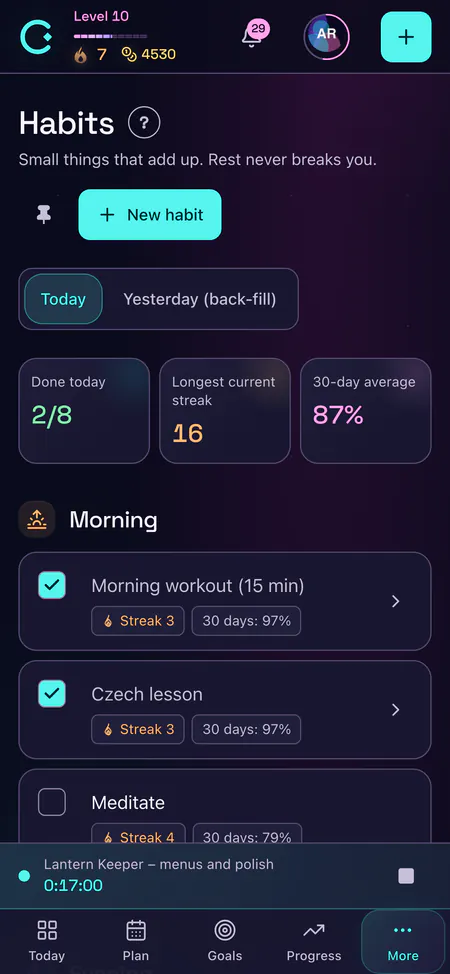
The whole module: the habit tracker app.
Frequently asked questions
Does missing one day ruin a habit?
No. In Lally and colleagues' 2009 study, missing a single opportunity did not materially affect habit formation. Avoiding a second miss in a row matters more.
How do I restart a habit after a long break?
Pick a specific start date, come back with a smaller version, tie it to the same cue as before and focus the first week on never missing twice in a row. Then build up gradually.
Should I start on a Monday?
Sure. People more often start goals after temporal landmarks such as a new week or month (the fresh start effect). Just don't wait for the "perfect" Monday – pick the next one.
What if I'm ill?
Pause the habit or switch to a minimum version so illness doesn't add stress. Come back gradually, and check with a doctor about exercise if you are unsure.
How do I stop a break from dragging on?
Plan the break and the return date in advance, define a minimum version for hard days, and track the share of days done rather than an unbroken streak.
Sources and further reading
- Lally et al. (2009): How are habits formed: Modelling habit formation in the real world, European Journal of Social Psychology
- Dai, Milkman & Riis (2014): The Fresh Start Effect: Temporal Landmarks Motivate Aspirational Behavior, Management Science
- Gollwitzer & Sheeran (2006): Implementation intentions and goal achievement – a meta-analysis
Level up your life
CORTEX is free for everyone. Tasks, a one-click day plan, time tracking, habits and rewards in one system – on desktop and mobile.
CREATE A FREE ACCOUNT