How to get motivated to study when you really don't feel like it
To get motivated to study, start small and specific: write three questions you will answer today, put your phone in another room and set a 25-minute timer. Instead of rereading, test yourself – it works better and gives your brain a quicker sense of progress, which makes you want to keep going. Below: why studying is so hard to start, a plan for today, the techniques with the best research behind them, and what to do when there is far too much to learn.
- Studying is hard to start because the reward (an exam, a grade) is far away and the material feels big and vague.
- The best start: three specific questions for today, one 25-minute block and your phone out of the room.
- A review by Dunlosky et al. (2013) rated practice testing and spacing as the most useful techniques; highlighting and rereading came out as low-utility.
- Students who practised recalling a text remembered it better a week later than those who simply reread it (Roediger & Karpicke, 2006).
- Spreading study over several days leads to better retention than the same time in one sitting (Cepeda et al., 2006).
Why you don't feel like studying (and why it isn't laziness)
Studying has three features the brain dislikes: the reward is far away (an exam next month), the task is vague ("learn history") and progress is not visible right away. Against that stands a phone that rewards you within a second. No wonder it wins. More on why we put things off in why do I procrastinate.
The good news: all three can be changed. Bring the reward closer with small goals, shrink the vagueness with specific questions, and make progress visible by testing yourself and ticking things off.
How to get motivated to study: a plan for today
- Write three questions. Not "chapter 4" but "What caused the First World War? What is photosynthesis? How do I differentiate a product?" A question is a clear target.
- Phone into another room. Not face down on the desk. Adrian Ward and colleagues (2017) found that the mere presence of a phone on the desk was linked to worse scores on attention tests; later experiments did not always confirm this, but moving the phone costs nothing.
- 25 minutes, then a break. Start a countdown and promise yourself you can stop afterwards. Setting up blocks: the Pomodoro Technique.
- Start with the easiest question. A quick first win gets you rolling.
- Test yourself at the end. Close your notes and answer the three questions from memory. Write what you missed on tomorrow's list.
Study techniques that actually work
John Dunlosky and colleagues (2013) reviewed hundreds of studies on ten popular learning techniques. Here is how they rated them:
| Technique | Utility in the review | How to do it |
|---|---|---|
| Practice testing (retrieval) | High | Questions, flashcards, past papers, explaining aloud without notes |
| Spaced practice | High | Revisit the same material after 1, 3 and 7 days instead of all at once |
| Asking "why" | Moderate | For each fact, ask "why is this true?" |
| Interleaving | Moderate | Mix different problem types instead of ten of the same in a row |
| Summarising, keywords | Low | Useful only as an extra |
| Highlighting and rereading | Low | Feels like knowing, but does little for retention |
Henry Roediger and Jeffrey Karpicke (2006) showed it in an experiment: students who practised recalling a text after reading it remembered it better a week later than those who reread it – even though right after studying they felt less confident. And Nicholas Cepeda and colleagues (2006) synthesised hundreds of experiments: spreading study across days beats the same time crammed into one session. For a gamified approach, see how to gamify studying.
When there is far too much to learn
A mountain of material paralyses. Turn it into small pieces:
- List the chapters or topics (say, 20 exam topics).
- Count the days until the exam and subtract two for review.
- Spread the topics over the days – maybe "2 topics today".
- Every day: new material plus a short self-test on yesterday's.
Suddenly it is not "learn all of biology" but "today cells and photosynthesis, 3 blocks". For splitting big tasks, see how to break down a big task.
Rewards and progress that keep you going
- Tick things off. Every finished question or block is one tick. Visible progress motivates (see no motivation to do anything).
- A small reward right away. After three blocks a walk, a snack, an episode – decided in advance, not negotiated.
- Same time, same place. Study at the same time at the same desk each day so your brain learns "this is where I study".
- No guilt. Missed a day? Pick up tomorrow. Self-blame tends to prolong procrastination.
Try it now: 3 questions and 25 minutes
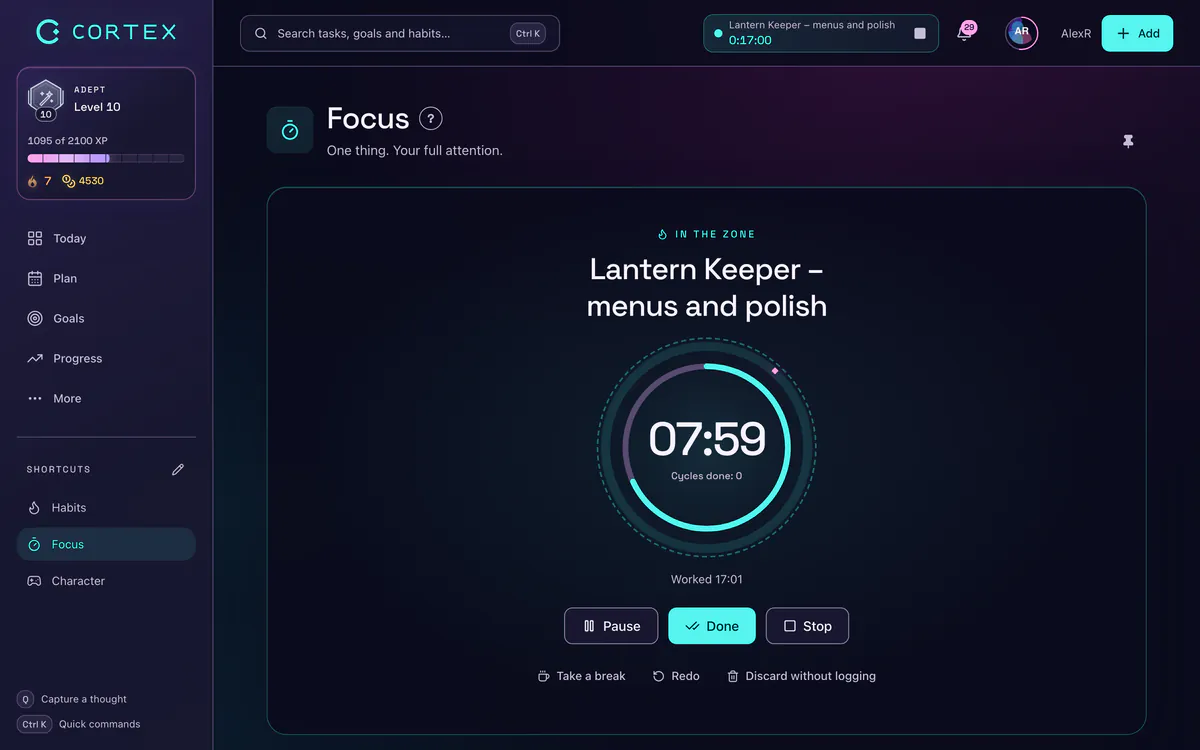
In CORTEX (free for everyone) press Q, type "Biology: 3 questions today ~25m" and start a 25-minute Focus session on the task. Every finished block earns XP and shows up in your progress – studying becomes a small game instead of an endless mountain. For review, add a daily habit "Self-test 10 min".
Frequently asked questions
How do I get motivated to study when I don't want to?
Write three specific questions for today, put your phone in another room and set 25 minutes, knowing you can stop afterwards. Start with the easiest question. At the end, test yourself from memory – the sense of progress carries you into the next block.
How can I stop procrastinating and start studying?
Make the first step tiny and specific (open the book and write three questions), remove the phone, and use a short timer. Starting is the hardest part; a visible first win usually gets you going.
What is the most effective way to study?
According to a major review (Dunlosky et al., 2013), practice testing and spaced practice work best. Rereading and highlighting feel productive but do little for long-term memory.
How long should I study at a time?
For most people 25–50 minutes followed by a short break works well. Long marathons without breaks tend to be less effective than the same time spread over several blocks and days.
What if there is too much to learn?
List the topics, count the days until the exam and spread them across the days with time left for review. Each day: new material plus a short self-test on the previous day's. A small daily plan is manageable; a mountain is not.
Sources and further reading
- Dunlosky, J. et al. (2013). Improving students’ learning with effective learning techniques. Psychological Science in the Public Interest, 14(1), 4–58
- Roediger, H. L. & Karpicke, J. D. (2006). Test-enhanced learning: Taking memory tests improves long-term retention. Psychological Science, 17(3), 249–255
- Cepeda, N. J. et al. (2006). Distributed practice in verbal recall tasks: A review and quantitative synthesis. Psychological Bulletin, 132(3), 354–380
- Ward, A. F. et al. (2017). Brain drain: The mere presence of one’s own smartphone reduces available cognitive capacity. Journal of the Association for Consumer Research, 2(2), 140–154
Level up your life
CORTEX is free for everyone. Tasks, a one-click day plan, time tracking, habits and rewards in one system – on desktop and mobile.
CREATE A FREE ACCOUNT