Motivation vs discipline: why neither wins, but a system does
Motivation is wanting to do something; discipline is doing it even when you don’t want to – and in the long run neither carries you on its own. A system of habits and surroundings that barely needs willpower does. Self-control research shows something surprising: the people who look the most disciplined actually resist temptation less often on an ordinary day, not more. They face fewer temptations, have more automatic habits and set up their environment so the right choice is the easy one. Use motivation to start, discipline for the first weeks, and then let habit take over.
- Motivation is a state that comes and goes; discipline (self-control) is the ability to act on a goal even when you don’t feel like it.
- People with higher self-control reported fewer strong temptations and fewer goal conflicts during an ordinary week (Hofmann et al., 2012).
- Six studies with more than 2,200 people found that self-control leads to better outcomes mainly through good habits, not constant resisting (Galla & Duckworth, 2015).
- Among students, reaching goals was predicted mostly by how many temptations they faced, not by how much they resisted (Milyavskaya & Inzlicht, 2017).
- In practice: use enthusiasm to set up the system, discipline for the first few weeks, then let habits and environment do the work.
Motivation and discipline: definitions
Motivation is the desire or reason to do something. It can be intrinsic (I enjoy it, it matters to me) or extrinsic (a reward, a deadline, a boss). Its defining feature: it fluctuates. After a good night’s sleep you have more; after a hard day, less.
Discipline, in psychology usually self-control, is the ability to act on a long-term goal when something pulls you elsewhere. It is often pictured as a muscle you flex – but as you will see below, people with good self-control flex it surprisingly rarely.
The “motivation or discipline” debate is a bit of a false choice. You need both, just at different stages. And both are expensive fuel if your every day depends on them.
What research shows: disciplined people resist less
Wilhelm Hofmann, Roy Baumeister and colleagues (2012) gave 205 adults a beeper for a week. Whenever it went off, people noted whether they had a desire right then, whether it conflicted with their goals and whether they were resisting it. Result: people with higher self-control reported fewer problematic temptations – not because they resisted harder, but because they ended up in such situations less often.
Brian Galla and Angela Duckworth (2015) went further. Across six studies (2,274 people in total) they found that self-control is linked with better outcomes – healthier eating, regular sleep, finished homework, better grades – mainly through habits. People with self-control had automated the good stuff, so they didn’t have to fight for it every time.
Marina Milyavskaya and Michael Inzlicht (2017) followed students for a whole semester. Goal attainment was predicted mainly by how many temptations they experienced. Effortful resisting itself was unrelated to success; frequent temptation, on the other hand, left people feeling drained.
In short: discipline as it looks from the outside is mostly a cleverly arranged life, not heroic resistance.
When motivation helps and when discipline helps
| Stage | What carries you | What to use it for |
|---|---|---|
| Start | Motivation | Decide why you are doing it and set up the system: time, place, first step, environment |
| First few weeks | Discipline | Do the small version even on a no-motivation day; focus on consistency, not performance |
| Long term | Habit and environment | The activity starts by itself in its usual situation; effort is needed only occasionally |
| Crisis, a lapse | Self-kindness and a plan to return | Go back to the small version without guilt |
If motivation has been completely missing for a long time, it is not a discipline problem. See no motivation to do anything, which also covers when to ask for help.
What about willpower depletion?
For years it was claimed that willpower is a limited resource that runs out during the day (“ego depletion”). A large preregistered study across 23 labs did not confirm the effect – the measured difference was close to zero (Hagger et al., 2016). Tiredness is real and you do feel like doing less in the evening, but the idea of a “willpower tank” you mustn’t spend in the morning is questionable at best.
The practical takeaway matches the research above: don’t try to have more willpower. Try to need it less.
How to build a system that carries you
- Reduce temptations in advance. Phone in another room, no sweets in the cupboard, social media bookmarks gone. Angela Duckworth and colleagues (2016) show that changing the situation is the most effective form of self-control.
- Decide when and where. “After my morning coffee, at the kitchen table.” An if–then plan moves the decision from the moment to a calm time (implementation intentions).
- Attach it to something you already do. Habit stacking saves you the reminding.
- Make the minimum version bulletproof. Two minutes on your worst day. Discipline then only means “start”, not “last an hour”.
- Add an immediate reward. Kaitlin Woolley and Ayelet Fishbach (2017) found that for long-term goals, persistence is predicted more by immediate enjoyment than by distant benefits. Music while cleaning, a tick, a small point.
- Track consistency, not perfection. Five days out of seven is a win.
The full step-by-step approach is in self-discipline.
Try it now in CORTEX
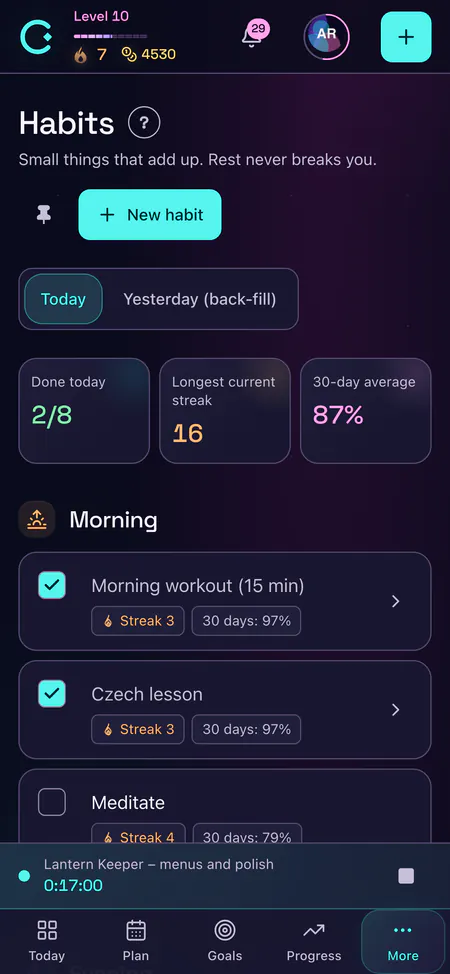
In CORTEX (free for everyone) there is a template for exactly this: “Start in 2 minutes” (More → Templates) – one thing you keep putting off and seven days of just two minutes a day. The template creates the habit and the first tasks, and every check-in earns XP – a small immediate reward. If a day doesn’t work out, you can freeze it in the habit’s detail (today or yesterday), and pause the habit when you are ill or on holiday – your streak survives. If you have an account, open the Start in 2 minutes template.
Frequently asked questions
Which is more important, motivation or discipline?
Neither is enough on its own. Motivation helps you start, discipline gets you through the first weeks, and in the long run habits and environment carry you. Research shows people with good self-control resist less because they have more habits and fewer temptations.
How can I be disciplined when I have no motivation?
Shrink the task to a version you can do without feeling like it (two to five minutes), decide in advance when and where you will do it and remove the biggest distraction. Motivation often arrives once you have started. If it has been missing for weeks and nothing feels enjoyable, talk to a doctor.
Can discipline be trained?
Rather than training “willpower”, it pays to train skills: planning when and where, shaping your environment and building habits. They then do the work for you, and you only need to push yourself occasionally.
Is it true that willpower runs out during the day?
A large international replication (Hagger et al., 2016) did not confirm willpower depletion. Evening tiredness is real, but the idea of a limited willpower tank is questionable. It is more useful to arrange your day so you need less willpower.
Why does my motivation always fade after a few days?
Because motivation is a naturally fluctuating state, not a permanent trait. Initial excitement fades when the first hard day comes. That is why it pays to use the excitement to set up a system that works without it.
Sources and further reading
- Hofmann, W., Baumeister, R. F., Förster, G. & Vohs, K. D. (2012): Everyday temptations: An experience sampling study of desire, conflict, and self-control – Journal of Personality and Social Psychology
- Galla, B. M. & Duckworth, A. L. (2015): More than resisting temptation: Beneficial habits mediate the relationship between self-control and positive life outcomes – Journal of Personality and Social Psychology
- Milyavskaya, M. & Inzlicht, M. (2017): What’s so great about self-control? Examining the importance of effortful self-control and temptation in predicting real-life depletion and goal attainment – Social Psychological and Personality Science
- Hagger, M. S. et al. (2016): A multilab preregistered replication of the ego-depletion effect – Perspectives on Psychological Science
- Duckworth, A. L., Gendler, T. S. & Gross, J. J. (2016): Situational strategies for self-control – Perspectives on Psychological Science
- Woolley, K. & Fishbach, A. (2017): Immediate rewards predict adherence to long-term goals – Personality and Social Psychology Bulletin
Level up your life
CORTEX is free for everyone. Tasks, a one-click day plan, time tracking, habits and rewards in one system – on desktop and mobile.
CREATE A FREE ACCOUNT