What is dopamine, and why it isn’t the “happy hormone”
Dopamine is a chemical messenger (a neurotransmitter) that nerve cells use to pass on signals – above all about what matters, what is worth the effort and what is worth repeating next time. It is often called the happy hormone, but that is a simplification: dopamine has less to do with how much we enjoy something and more to do with how much we want it and whether we get up and go for it. It also helps with movement and attention. Below: how dopamine works, what a “reward prediction error” is and which popular claims about dopamine don’t hold up.
- Dopamine is a neurotransmitter that carries signals in the brain; it plays a role in motivation, learning, movement and attention.
- Dopamine neurons respond less to a reward itself than to the gap between what was expected and what happened – the reward prediction error (Schultz, Dayan & Montague, 1997).
- Dopamine is linked more to “wanting” and willingness to make an effort than to pleasure itself (Berridge & Robinson, 1998; Salamone & Correa, 2012).
- People with a stronger dopamine response in the striatum were more willing to work harder for bigger rewards (Treadway et al., 2012).
- Dopamine can’t be “drained” or “reset” with a detox; supplements and drugs that affect it belong in a doctor’s hands.
What dopamine is
Dopamine is a substance nerve cells use to pass messages to each other – a neurotransmitter. It is made by small groups of cells deep in the brain, but their fibres reach many areas. That is why dopamine has several jobs at once:
- motivation and effort – whether you get going on something,
- learning from rewards – what the brain remembers as “that paid off”,
- movement – the loss of dopamine cells underlies the symptoms of Parkinson’s disease (Poewe et al., 2017),
- attention and working memory – keeping in mind what you are working on.
Dopamine also acts outside the brain, for example in the kidneys, but this article is about the brain and motivation.
Prediction error: dopamine as a teacher
Wolfram Schultz, Peter Dayan and Read Montague (1997) described how dopamine neurons behave during learning. When a monkey unexpectedly got juice, the neurons fired. Once it learned that juice came after a light signal, the neurons fired at the signal – and almost stopped responding to the juice itself. And when the juice did not come after the signal, their activity briefly dipped.
Dopamine thus works as a teacher: it reports “better than expected” (remember this), “exactly as expected” (nothing new) or “worse than expected” (do something different next time). This also explains the pull of unpredictable rewards – notifications that sometimes bring something interesting and sometimes don’t keep the prediction permanently “open”.
Wanting is not the same as liking
Kent Berridge and Terry Robinson (1998) showed that dopamine is tied mainly to wanting – how strongly something pulls us – and much less to liking, the pleasure we feel when we get it. That is why you can want to open your phone even though scrolling doesn’t actually make you happy.
John Salamone and Mercè Correa (2012) add that dopamine in one key area (the nucleus accumbens) is mostly involved in whether we put in effort, set off towards a goal and stick with it. It does not run hunger or basic appetite.
Michael Treadway and colleagues (2012) measured this in people: those whose brains released more dopamine in the striatum were more willing to choose a harder task for a bigger reward.
Dopamine myths
| Claim | What’s actually true |
|---|---|
| Dopamine is the happy hormone | It is more a signal for motivation and learning. Feeling happy comes from many systems working together. |
| Social media “fries” your dopamine | Dopamine doesn’t run down like a battery. The issue is a learned habit of reaching for quick rewards, not an empty tank. |
| A dopamine detox resets your brain | There is no scientific basis for a “reset”; cutting specific triggers does make sense. More in dopamine detox. |
| You can raise dopamine with the right food or a pill | Diet and supplements have an unclear effect on brain dopamine; drugs that affect dopamine are prescribed by doctors. We give no advice on medication or supplements. |
| More dopamine always means more motivation | No. The system is finely balanced; too much and too little both cause problems. |
What this means for motivation
- Shorten the gap between effort and result. The brain learns from what comes right away. Break a big task into steps where you see progress within minutes (how to break down a big task).
- Make progress visible. A tick, a progress bar, a done list. Each is a small “better than expected”.
- Make the quickest rewards less available. Phone out of reach while you work; otherwise the reward that arrives in a second always wins.
- Prepare healthy quick rewards. A short walk, music, a cup of tea. Ideas in dopamine menu.
- Don’t take dips in drive personally. Motivation varies with tiredness, sleep and stress. If it has been gone for a long time, read no motivation to do anything.
Try it now in CORTEX
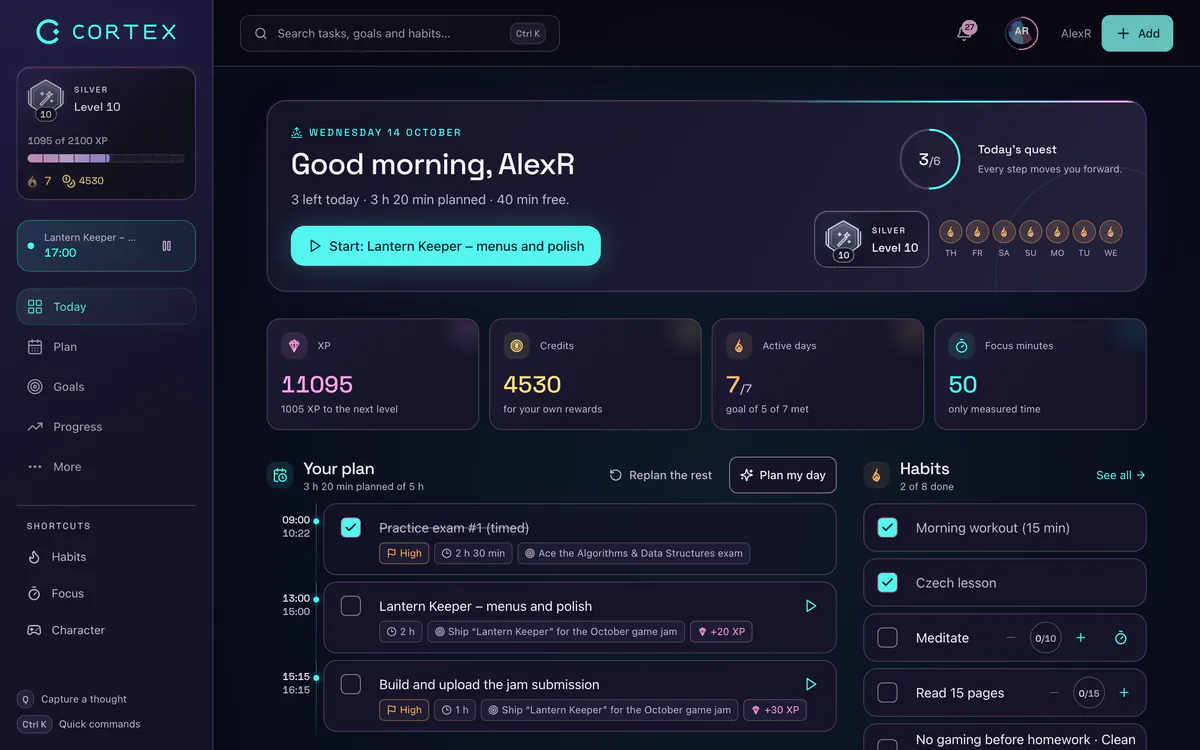
In CORTEX (free for everyone) every finished task earns XP based on its priority and you level up – exactly the kind of immediate, visible reward the brain responds to. Press Q to add a task, split it into subtasks and start Focus on the first one. If you can’t get going at all, try the “Start in 2 minutes” template (More → Templates): seven days, just two minutes a day. If you have an account, open the template directly.
Frequently asked questions
What is dopamine in simple terms?
Dopamine is a chemical messenger in the brain. It helps decide what matters and is worth the effort, teaches the brain from rewards and is involved in movement and attention. It is not really a “happy hormone”.
What is dopamine responsible for?
Mainly motivation and willingness to make an effort, learning from rewards (what is worth repeating), smooth movement and part of attention and working memory. Pleasure itself is less tied to dopamine than popular accounts suggest.
What is the difference between dopamine and serotonin?
Both are neurotransmitters but they do different jobs. Dopamine is mainly linked to motivation, wanting and learning from rewards. Serotonin is involved in mood, sleep, appetite and digestion, among other things. Neither is the single “happy chemical”.
Can you run out of dopamine, for example by scrolling?
Not in the way it is often described. Dopamine is not a tank that empties. Frequent quick rewards do strengthen the habit of reaching for them, and other activities then feel less appealing. Cutting specific triggers helps.
How can I naturally support motivation?
Enough sleep, movement, tasks broken into small steps with visible progress and fewer instant distractions within reach. We don’t recommend supplements or medication without talking to a doctor.
Sources and further reading
- Schultz, W., Dayan, P. & Montague, P. R. (1997): A neural substrate of prediction and reward – Science
- Berridge, K. C. & Robinson, T. E. (1998): What is the role of dopamine in reward: hedonic impact, reward learning, or incentive salience? – Brain Research Reviews
- Salamone, J. D. & Correa, M. (2012): The mysterious motivational functions of mesolimbic dopamine – Neuron
- Treadway, M. T. et al. (2012): Dopaminergic mechanisms of individual differences in human effort-based decision-making – Journal of Neuroscience
- Poewe, W. et al. (2017): Parkinson disease – Nature Reviews Disease Primers
Level up your life
CORTEX is free for everyone. Tasks, a one-click day plan, time tracking, habits and rewards in one system – on desktop and mobile.
CREATE A FREE ACCOUNT