Habit stacking: attach a new habit to one you already have
Habit stacking means linking a new habit to something you already do every day on autopilot: “After I pour my morning coffee, I write down my three priorities.” The existing habit becomes the trigger, so you don’t have to remember when to do the new one. It works because habits form through repetition in a stable situation, and research suggests the anchor you pick matters: flossing after brushing became automatic more easily than flossing before it. Below: the formula, twenty examples and the mistakes that make the chain break.
- Habit stacking is a plan in the form “After [current habit], I will [new habit]” – an if–then plan where your own routine is the cue.
- Habits form through repetition in a consistent context; in a classic study, reaching automaticity took 18 to 254 days, around two months in a typical case (Lally et al., 2010).
- People who flossed after brushing their teeth built a stronger habit than those who flossed before, and flossed more often eight months later (Judah et al., 2013).
- The best anchor happens every day at the same time and place and ends with a clear moment.
- Chains usually break when the new habit is too big, the anchor is vague or you stack too many habits at once.
What habit stacking is
Habit stacking is a way to start a new habit by attaching it to something you already do. The formula is simple:
The name was popularised by habit books, but the principle is older and well studied. Psychologists call it an implementation intention, or if–then plan: you decide in advance in which situation you will act. With habit stacking, that situation is the end of another habit – finishing your coffee, closing your laptop, switching off the bathroom light.
The benefit is that you don’t have to watch the clock or set dozens of reminders. You do the anchor anyway, and the new habit gradually sticks to it. More on if–then plans in implementation intentions.
Why it works: habits live in situations
Wendy Wood and Dennis Rünger (2016) summarise habit research like this: a habit is a learned response to a situation. When you repeat something in the same context, your brain links the situation with the action and over time triggers it without a decision. That is why you brush your teeth in the morning without thinking about it.
Phillippa Lally and colleagues (2010) followed 96 people who each picked one new behaviour to do daily in the same situation, such as “after breakfast”. The time it took for the behaviour to become nearly automatic ranged from 18 to 254 days; a typical case was around two months. And one important detail: missing a single day did not derail the process. How long it really takes, and why “21 days” is a myth, is covered in how to build habits.
Habit stacking is a practical shortcut to that “same situation”. You don’t have to invent one – you use the one you already have.
The anchor matters: what the flossing study showed
Gaby Judah, Benjamin Gardner and Robert Aunger (2013) asked 50 people to start flossing. Half were told to floss before brushing, half after. The “after” group built a stronger habit and, eight months later, flossed more often.
The authors note that it was a small exploratory study, so don’t treat it as a law. It does illustrate a useful rule: attach the new habit to the end of an activity, not to its start or middle. The end is a clear moment (“I spit out the toothpaste”), while “before brushing” is easy to skip.
How to choose a good anchor
- It happens every day (or every day you want the new habit).
- It has a clear end: an empty coffee cup, a closed door, a switched-off computer.
- It fits the place: the new habit can be done where the anchor ends. Push-ups after coffee in the kitchen, yes; reading a book that lives in another room, less so.
- It fits your energy: you feel different after lunch than after waking up. Put a demanding habit after an anchor that leaves you with energy.
20 habit stacking examples
| After… | …I will |
|---|---|
| I turn off my alarm | drink the glass of water by my bed |
| I brush my teeth in the morning | do 10 squats |
| I pour my morning coffee | write my three priorities for the day |
| I sit down at my computer | open my most important task before email |
| my first meeting ends | write down the three tasks it created |
| I finish lunch | walk outside for 10 minutes |
| every client call | log the time I worked |
| I close my laptop | note where I will start tomorrow |
| I get home | put my keys and phone in the bowl by the door |
| I take off my shoes | change into workout clothes |
| I finish dinner | wash the dishes and wipe the counter |
| I start the dishwasher | lay out tomorrow’s clothes |
| I brush my teeth at night | put my phone on charge outside the bedroom |
| I get into bed | read two pages of a book |
| my morning shower | put on sunscreen |
| I get back from the gym | write down what I trained |
| Sunday breakfast | review my plan for the week |
| I open my textbook | first try to recall last session from memory |
| every purchase | log the expense |
| I switch off the TV | turn off the main lights and use only a lamp |
Notice that the new habits are small. At first the goal is just to form the link “anchor → habit”. You can grow it later – see the two-minute rule.
A habit chain: a whole routine in a row
Once the first link holds, you can attach another habit after the new one. That gives you a routine: water → stretch → three priorities. Each step triggers the next. This is how a morning routine or an evening routine ends up running on autopilot.
A chain has one weakness: when one link drops out, the ones after it often go too. So:
- Add one at a time. Attach the next habit only when the previous one runs on its own, usually after a few weeks.
- Keep the chain short. Three to five steps. Longer routines fall apart on a busy day.
- Have an emergency version. On days you can’t fit it in, do just the first step. The chain stays alive.
Common mistakes
- A vague anchor. “In the morning” is not an anchor; “after I turn off my alarm” is.
- Too big a habit. “After coffee I run for an hour” lasts a week. “After coffee I put on my running shoes” lasts longer.
- An anchor that doesn’t happen every day. If you go to the office twice a week, “after I arrive at the office” won’t help on the other days.
- Five new habits at once. The brain learns one link at a time.
- Guilt after a miss. Lally et al. (2010) found that one missed day doesn’t undo a habit. Just carry on. How to come back after a longer break: how to restart a habit.
Try it now in CORTEX
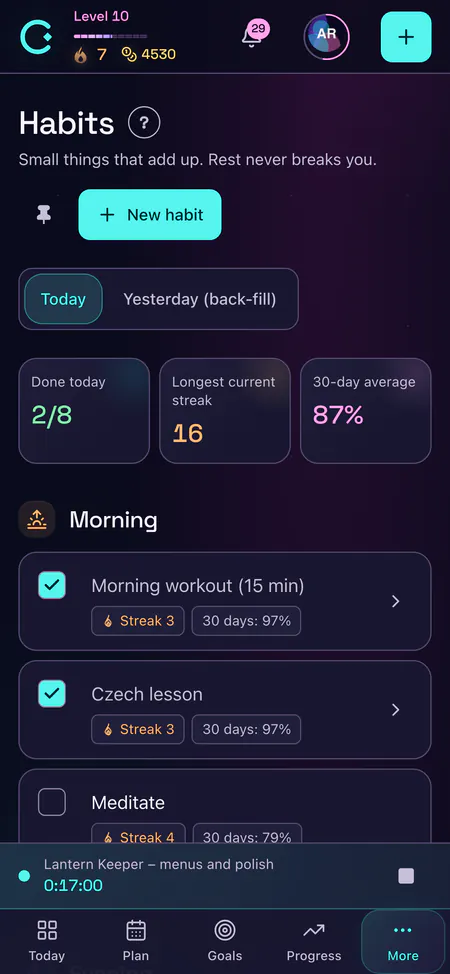
In CORTEX (free for everyone) create a “New habit” in Habits, choose a part of the day (morning, daytime, evening) and a usual time for the reminder. Put the “After …, I will …” sentence in the name so you see it every time. When you have several habits in a row, combine them under Routines: order them as a chain and tick them off in one pass. A ready-made chain comes with the “Morning routine” template (More → Templates): while you set it up, it asks “When and where?” and writes your answer into the habit. If you have an account, open the Morning routine template directly.
Frequently asked questions
What is habit stacking?
Habit stacking means attaching a new habit to something you already do automatically, using the formula “After [current habit], I will [new habit]”. For example: after I pour my morning coffee, I write my three priorities for the day.
How long does it take for a stacked habit to stick?
It varies. In Lally et al. (2010), reaching automaticity took between 18 and 254 days, around two months in a typical case. Simple habits form faster, harder ones slower. Missing a day does not stop the process.
What makes a good anchor habit?
An activity that happens every day, has a clear end and takes place where you can do the new habit straight away – finishing your coffee, brushing your teeth or closing your laptop. Attach the new habit to the end of the anchor, not before it.
How many habits can I stack?
Start with one. Add the next only when the previous one runs on its own, usually after a few weeks. A routine of three to five steps is sustainable; longer ones fall apart easily on a busy day.
Is habit stacking the same as an implementation intention?
Essentially yes. An implementation intention is a plan in the form “When situation X happens, I will do Y”. In habit stacking, situation X is the end of another habit. If–then plans are among the best-supported behaviour change techniques (Gollwitzer & Sheeran, 2006).
Sources and further reading
- Lally, P., van Jaarsveld, C. H. M., Potts, H. W. W. & Wardle, J. (2010): How are habits formed: Modelling habit formation in the real world – European Journal of Social Psychology
- Judah, G., Gardner, B. & Aunger, R. (2013): Forming a flossing habit: An exploratory study of the psychological determinants of habit formation – British Journal of Health Psychology
- Wood, W. & Rünger, D. (2016): Psychology of Habit – Annual Review of Psychology
- Gollwitzer, P. M. & Sheeran, P. (2006): Implementation intentions and goal achievement: A meta-analysis of effects and processes – Advances in Experimental Social Psychology
- Gardner, B., Lally, P. & Wardle, J. (2012): Making health habitual: the psychology of “habit-formation” and general practice – British Journal of General Practice
Level up your life
CORTEX is free for everyone. Tasks, a one-click day plan, time tracking, habits and rewards in one system – on desktop and mobile.
CREATE A FREE ACCOUNT