How to get motivated to work out: a system that works without motivation
To get motivated to work out, plan for consistency, not performance: pick a minimum you can manage even on a bad day (say, 10 minutes), give it a fixed day, time and place, lay out your clothes in advance and arrange to meet someone who is waiting for you. Motivation comes and goes; a habit stays. Below: why exercise is so hard to start, seven steps, what research says about how exercise habits form, and how to pair workouts with something you look forward to.
- With exercise, consistency beats intensity: a short workout you stick to beats an ambitious plan you abandon.
- For new gym members, exercise became a habit when they went at least four times a week for about six weeks (Kaushal & Rhodes, 2015).
- A specific if–then plan (when, where, what) increased physical activity in a meta-analysis (Bélanger-Gravel et al., 2013).
- People who only allowed themselves a favourite audiobook at the gym went more often, although the effect faded (Milkman et al., 2014).
- The WHO recommends 150–300 minutes of moderate activity a week for adults – but every bit of movement counts, even 10 minutes (Bull et al., 2020).
Why working out is so hard to start
Exercise has a lot of friction: changing, getting there, sweating, showering. The payoff – fitness, a better mood, health – arrives slowly, while the couch pays off now. On top of that we often set the bar too high ("an hour a day from Monday") and give up after a few days.
That is why waiting for the urge does not work. What works is shrinking the start and planning it in advance so the workout becomes automatic. The general approach to starting without motivation is in how to get motivated to do anything.
7 steps to get motivated to work out
- Pick a minimum. Ten minutes, five squats, one lap around the block. The minimum is for bad days; on good days do more.
- Fixed day, time and place. "Monday, Wednesday, Friday at 7:00 in the living room." Put it in your calendar like a meeting.
- Prepare the night before. Clothes on the chair, water bottle by the door, workout video saved on your phone.
- Attach it to a habit you already have. "After my morning coffee, I change into workout clothes." See implementation intentions.
- Find a buddy. Skipping is harder when someone is waiting. Even a text – "done today?" – helps.
- Pair it with something you enjoy. A favourite podcast or show only during workouts.
- Track it. A row of ticked-off days is a reward in itself – and proof that you can.
What research says about how exercise habits form
Navin Kaushal and Ryan Rhodes (2015) followed new gym members for 12 weeks. Exercise became a habit when they went at least four times a week for roughly six weeks. Besides frequency, consistency helped too – a similar time and a similar routine.
In general, habits take longer than the 21-day myth promises: in another study it took people about two months on average before a new daily behaviour felt automatic (Lally et al., 2010). More in how to build habits.
A concrete plan helps as well. A meta-analysis by Amélie Bélanger-Gravel and colleagues (2013) found that people who wrote down "when, where and how I will exercise" were more active than those with only a general intention. The effect was small to moderate, but it costs just a few minutes.
Rewards that help (and ones that backfire)
Katherine Milkman and colleagues (2014) gave people gripping audiobooks they could listen to only at the gym. They went more often than the control group, though the effect faded over the months. This is called temptation bundling – pairing "have to" with "want to".
- Helps: a podcast, music or a show only while exercising; coffee with a friend after a run; a tick in your tracker.
- Backfires: food as a reward for every workout, or a "week off" after three sessions – they undermine the goal.
More ideas in how to reward yourself.
How much exercise is enough?
The World Health Organization recommends that adults get 150–300 minutes of moderate activity a week (or 75–150 minutes of vigorous activity) plus muscle-strengthening on at least two days. It also stresses that every bit of movement counts, including short bouts (Bull et al., 2020).
At the start, though, the goal is not to meet the guideline but to build the habit. Ten minutes three times a week that you keep is a better start than an hour a day that you drop. If you have health conditions, check a new type of exercise with your doctor. This article is general information, not medical advice.
Try it now: book your first workout
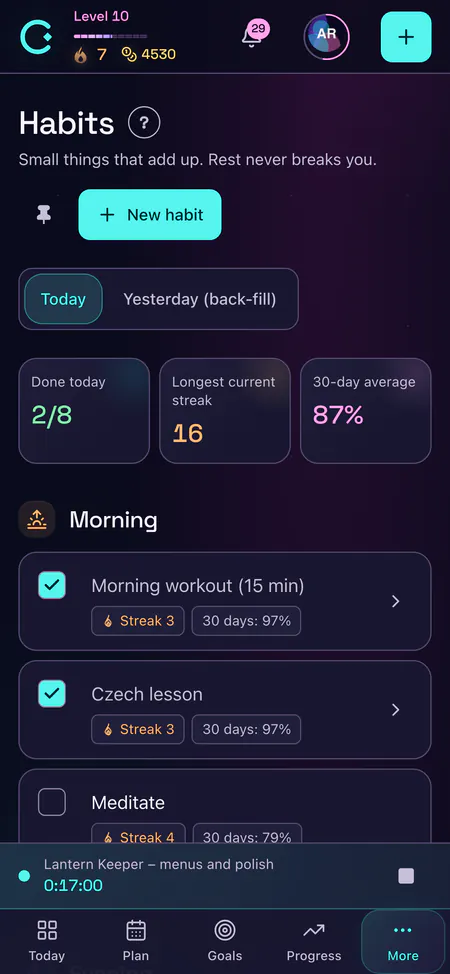
In CORTEX (free for everyone) set up exercise as a habit with a frequency such as "3× a week", or as a repeating task: press Q and type "Workout Monday @7:00 ~10m *weekly". Every completed day shows up in the habit's streak and earns XP. For illness or holidays you can pause the habit so the streak does not break.
Frequently asked questions
How do I get motivated to work out when I don't feel like it?
Shrink the workout to a minimum you can do on a bad day (say 10 minutes), schedule it for a fixed day, time and place, and lay out your clothes the night before. Arrange it with a buddy and pair it with something you enjoy, like a podcast you only listen to while exercising.
How do I get motivated to go to the gym?
Lower the friction: pack your bag the night before, go at the same time on the same days and make the first goal simply to show up. Going at least four times a week for about six weeks helped new gym members form the habit (Kaushal & Rhodes, 2015).
How long does it take for exercise to become a habit?
It varies by person and frequency. New gym members formed the habit when exercising at least four times a week for about six weeks. In general, expect months rather than 21 days.
How much should I exercise?
The WHO recommends 150–300 minutes of moderate activity a week for adults plus muscle-strengthening at least twice a week, but every bit counts. At the start, consistency matters more than volume. If you have a health condition, talk to your doctor first.
What if I miss a workout?
Nothing dramatic – come back at your next planned session, even with just the minimum. "Never miss twice" helps. Guilt is more likely to lead to another skipped day.
Sources and further reading
- Kaushal, N. & Rhodes, R. E. (2015). Exercise habit formation in new gym members: a longitudinal study. Journal of Behavioral Medicine, 38(4), 652–663
- Bélanger-Gravel, A., Godin, G. & Amireault, S. (2013). A meta-analytic review of the effect of implementation intentions on physical activity. Health Psychology Review, 7(1), 23–54
- Milkman, K. L., Minson, J. A. & Volpp, K. G. M. (2014). Holding the Hunger Games hostage at the gym: An evaluation of temptation bundling. Management Science, 60(2), 283–299
- Lally, P. et al. (2010). How are habits formed: Modelling habit formation in the real world. European Journal of Social Psychology, 40(6), 998–1009
- Bull, F. C. et al. (2020). World Health Organization 2020 guidelines on physical activity and sedentary behaviour. British Journal of Sports Medicine, 54(24), 1451–1462
Level up your life
CORTEX is free for everyone. Tasks, a one-click day plan, time tracking, habits and rewards in one system – on desktop and mobile.
CREATE A FREE ACCOUNT