SMART goals: meaning, format and examples that actually work
SMART goals are goals written to be Specific, Measurable, Achievable, Relevant and Time-bound, so you know exactly what you are aiming for and when you have hit it. The idea goes back to George T. Doran's 1981 article in Management Review. Use the builder below to write yours in two minutes, then see 12 real rewrites and how to break a yearly goal down into this week's tasks.
SMART goal builder
Fill in the fields – your goal sentence and a quick SMART check update as you type. Nothing is sent anywhere.
Your SMART goal will appear here.
- SMART stands for Specific, Measurable, Achievable, Relevant and Time-bound. In George T. Doran's original 1981 version the A meant "Assignable" and the R meant "Realistic".
- A simple SMART goal format: "By [date], I will [specific result], measured by [number], by doing [weekly action], because [reason]."
- Goal-setting research by Locke and Latham (2002) found that specific, challenging goals lead to better performance than vague "do your best" goals.
- Big SMART goals work best when you cascade them: year → quarter → week → day, with a short weekly review.
- The most common SMART mistake is setting a goal you cannot control directly; pair every outcome with an action you fully control.
What does SMART stand for?
The acronym first appeared in November 1981, when consultant George T. Doran published "There's a S.M.A.R.T. way to write management's goals and objectives" in Management Review. It was meant for company objectives, which is why his original letters were a bit different from the version you usually see today:
| Letter | Common meaning today | Doran 1981 | Question to ask |
|---|---|---|---|
| S | Specific | Specific | What exactly will be different? |
| M | Measurable | Measurable | Which number tells me I am done? |
| A | Achievable | Assignable | Can I do it with my time and skills? (Doran: who will do it?) |
| R | Relevant | Realistic | Does it matter to me right now? |
| T | Time-bound | Time-related | By when? |
Doran himself noted that not every objective has to hit all five criteria. Treat SMART as a writing checklist, not a law.
The SMART goal format (copy this)
Most SMART goals fit into one sentence:
"By [date], I will [specific result], measured by [number + unit], by doing [weekly action], because [reason]."
Example: "By March 31, I will run a 5 km race without walking, measured by my race result, by doing three beginner-plan runs a week, because I want more energy for my kids."
Notice the two halves. The outcome (run 5 km) is what you want; the weekly action (three runs) is what you control. Outcomes motivate you, actions get you there. A goal with only an outcome leaves you hoping; a goal with only actions can become busywork.
12 SMART goal examples: before and after
| Area | Vague goal | SMART rewrite |
|---|---|---|
| Fitness | Get in shape | Run 5 km without walking by March 31 – three runs a week following a beginner plan. |
| Study | Do better in math | Raise my calculus grade from C to B by the end of the semester – 4 practice problem sets a week and one office-hours visit every two weeks. |
| Career | Get promoted | Lead one cross-team project to launch by Q2 and present the results to my manager in the June review. |
| Freelance | Get more clients | Sign 3 new clients in the next 12 weeks – 5 personalized pitches and 1 case study per week. |
| Money | Save more | Save $3,000 for an emergency fund by December 31 – automatic $250 transfer on each payday. |
| Reading | Read more | Read 12 books this year – 20 pages every evening before bed. |
| Language | Learn Spanish | Hold a 10-minute conversation in Spanish by July 1 – 20 minutes of practice daily and one tutor session a week. |
| Side project | Build an app | Ship a working beta of my habit app to 10 friends by May 15 – two 90-minute build sessions every week. |
| Health | Drink more water | Drink 2 liters of water on at least 25 days this month – a filled bottle on my desk every morning. |
| Screen time | Use my phone less | Keep social media under 30 minutes a day for 4 weeks – apps moved off the home screen, daily check of screen time. |
| Writing | Start a blog | Publish 8 blog posts by the end of the quarter – one post drafted every Saturday morning. |
| Team | Improve response time | Reply to every support ticket within 24 hours by the end of next month – two fixed inbox blocks per day. |
For student goals, keep the weekly action tiny and visible – a study session is something you can check off the same day, a grade is not.
Why SMART goals work (and when they don't)
Edwin Locke and Gary Latham summarized decades of research in 2002: specific, challenging goals led to higher performance than vague "do your best" goals in a large number of studies. Specific goals direct attention, increase effort and make you persist, and they let you see progress – which fuels motivation.
Three caveats are worth knowing:
- "Achievable" is not "easy". Locke and Latham found that harder goals tended to produce more effort, as long as people were committed and had the skills. Do not water a goal down until it is boring.
- Very complex or new tasks sometimes do better with a learning goal ("try 5 different outreach scripts and note which one gets replies") than with a hard outcome number.
- Outcomes outside your control (a promotion, a viral post) are fine as direction, but your SMART goal should hinge on actions you can actually do.
From yearly goal to today's task: the goal cascade
A yearly SMART goal is too big to act on. Cascade it down until you get something you can do today:
| Level | Question | Example (freelance designer) |
|---|---|---|
| Year | Where do I want to be in 12 months? | Earn 50% of income from 5 retainer clients by December 31 |
| Quarter | What milestone gets me a quarter of the way? | Sign 2 retainer clients by March 31 |
| Week | What actions move the milestone this week? | Send 5 pitches, publish 1 case study, follow up with 3 old clients |
| Day | What is the one task for today? | Write the Corner Café case study (90 min, 9:00) |
Most people should work on no more than three goals per quarter. More than that, and the weekly actions compete for the same hours. Twelve-week horizons are long enough to make real progress and short enough to keep the deadline feeling real.
To make the daily level happen, give the task a fixed slot – that is what time blocking is for. And to turn a weekly action into an automatic behavior, use the ideas in how to build habits that stick.
How often to review your goals
| Cadence | Time | What you do |
|---|---|---|
| Daily | 2 min | Check today has at least one task linked to a goal. |
| Weekly | 20–30 min | Count what moved, pick next week's actions, reschedule what slipped. |
| Monthly | 30 min | Compare progress with the needed pace; adjust the plan, not the deadline, first. |
| Quarterly | 1 hour | Close finished goals, drop dead ones, set the next 12-week milestones. |
If you are behind, ask in this order: is the weekly action happening? If not, fix the schedule. If it is happening but not working, fix the action. Only then question the goal. A printable weekly planner is enough for the weekly review if you prefer paper.
Tracking SMART goals in CORTEX
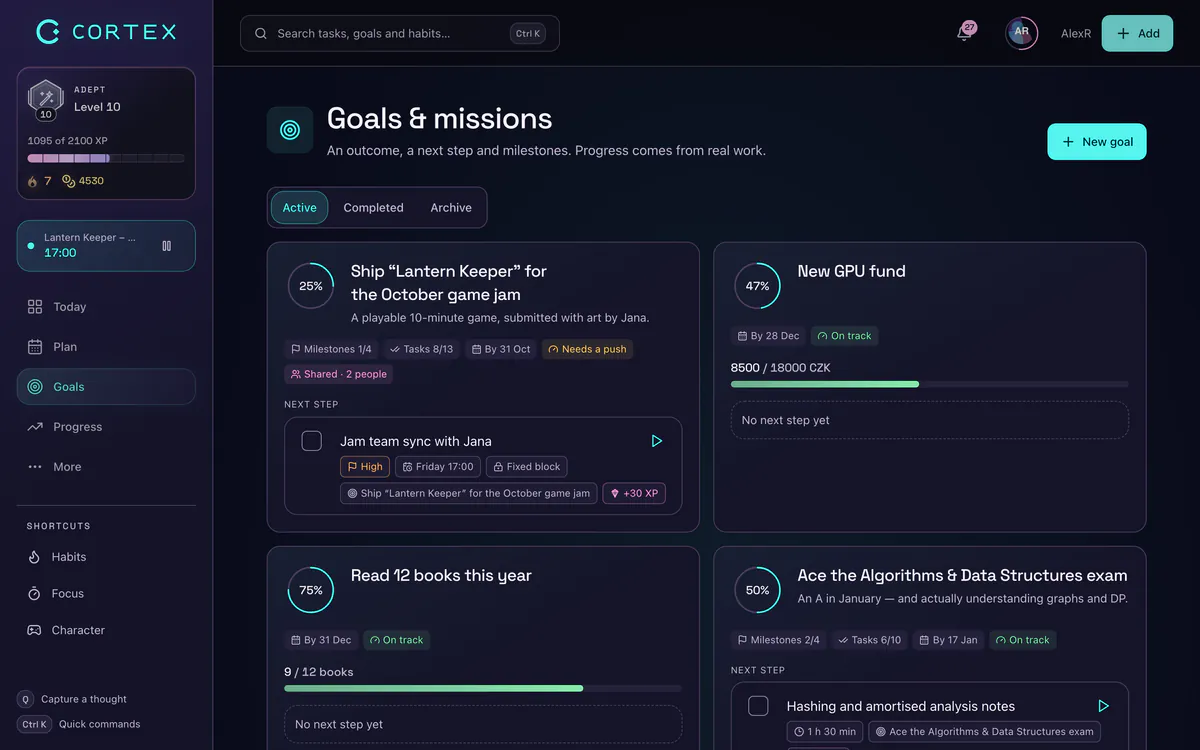
CORTEX is a free gamified productivity app – tasks, a one-click day plan, time tracking and habits, with XP, levels and real-life rewards. Its goal system follows the cascade above:
- Goals have a title, description, color category, deadline and difficulty. Progress is calculated from the tasks you link to them, so the percentage reflects finished work – see the goal tracker page for details.
- Weekly actions become tasks with quick capture (press Q):
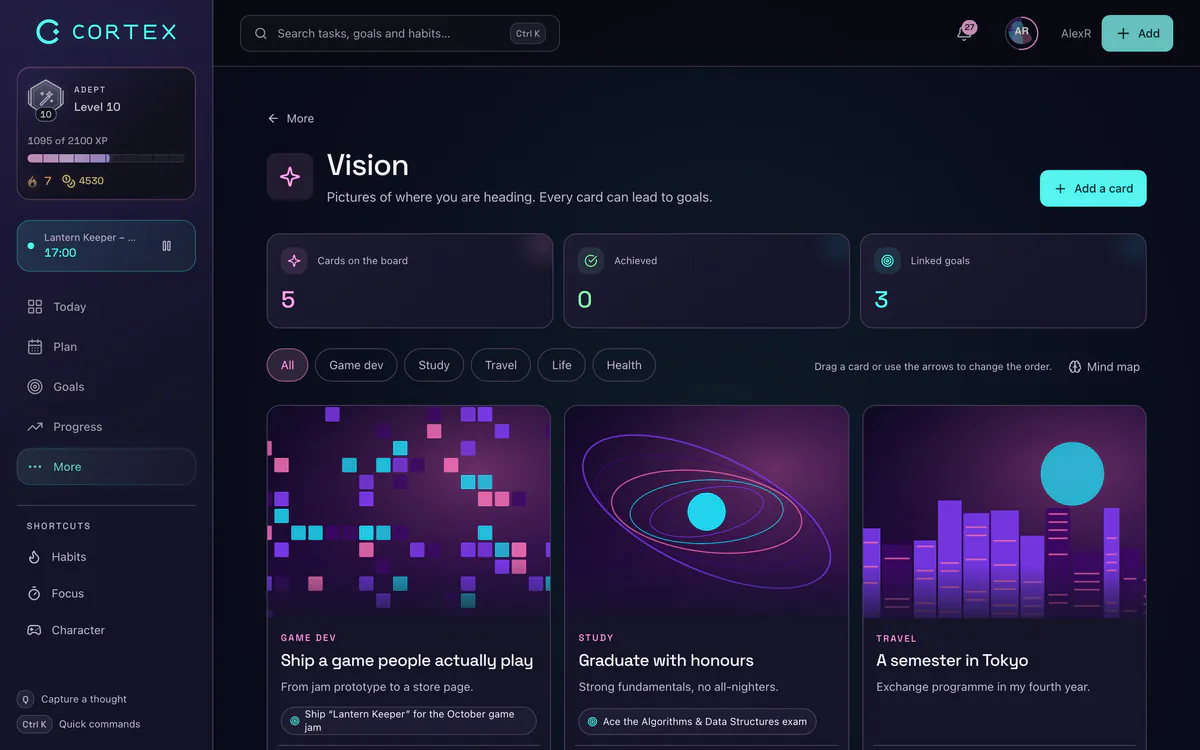
Send 5 pitches mon ~60m !p2 #Clientsor a repeating one likeDrafting session sat @9:00 ~90m *weekly #Blog. - The vision board sits next to goals for the "why" – images and short descriptions of what you are working towards, and the mind map links vision, goals, tasks and subtasks.
- Shared goals let you invite a partner by email or username and assign tasks to each other.
- Finishing a goal earns 100 XP on top of the XP from its tasks.
Want more commitment than a goal list? The optional 30-day commitment contract turns up to three pillars into daily tasks and habits that you sign with your own signature.
Frequently asked questions
What are SMART goals?
SMART goals are goals that are Specific, Measurable, Achievable, Relevant and Time-bound. The format makes it clear what you are aiming for, how you will measure it and by when. The acronym was introduced by George T. Doran in 1981.
What is an example of a SMART goal?
"By March 31, I will run 5 km without walking by doing three beginner-plan runs a week." It names a specific result, a measure, a weekly action you control, and a deadline. See the table above for 12 more examples across study, work, money and health.
What is the SMART goal format?
A reliable one-sentence format is: "By [date], I will [specific result], measured by [number], by doing [weekly action], because [reason]." The reason covers "relevant", the weekly action covers "achievable".
What does the A in SMART stand for?
Today it usually means Achievable (sometimes Attainable). In Doran's original 1981 version it meant Assignable – specifying who will do the work – because the method was written for managers.
What are good SMART goals for students?
Focus on actions you control: "Complete 4 practice problem sets every week until the exam on May 20" or "Study 2 Pomodoros of vocabulary every weekday this month." Grades are fine as the outcome, but the weekly study action is what you track.
Are SMART goals outdated?
Not really, but they are incomplete. Research by Locke and Latham supports specific and challenging goals, so do not use "achievable" as an excuse to aim low. Add a regular review and break the goal into weekly actions, and SMART still works well.
Sources and further reading
- SMART criteria – Wikipedia (history and variants, incl. Doran 1981, Management Review 70(11))
- Locke, E. A. & Latham, G. P. (2002). Building a practically useful theory of goal setting and task motivation: A 35-year odyssey. American Psychologist
- MindTools – SMART Goals: How to Make Your Goals Achievable
Level up your life
CORTEX is free for everyone. Tasks, a one-click day plan, time tracking, habits and rewards in one system – on desktop and mobile.
CREATE A FREE ACCOUNT