Bedtime procrastination: why we stay up even when we are tired
Bedtime procrastination means going to bed later than you intended even though nothing is stopping you – just one more video, a few more minutes on your phone. It is often not laziness but a wish to finally have time for yourself after a day full of obligations, plus evening tiredness that makes it harder to stop. It helps to have your "me time" earlier in the evening, set a clear end-of-day signal and get your phone out of the bedroom. Below: what research says, how much sleep experts recommend, and six steps to get to bed earlier.
- Bedtime procrastination is going to bed late without an external reason, even though you know it will hurt the next day (Kroese et al., 2014).
- In a representative sample of adults, bedtime procrastination was linked with insufficient sleep and daytime tiredness (Kroese et al., 2016).
- Experts recommend 7–9 hours of sleep for adults and 8–10 hours for teenagers (Hirshkowitz et al., 2015).
- Moving your evening "me time" earlier, setting an end-of-day signal and keeping your phone out of the bedroom help.
- Five minutes of writing tomorrow's to-do list before bed shortened the time to fall asleep in a sleep-lab study (Scullin et al., 2018).
What bedtime procrastination is
Floor Kroese and colleagues (2014) described bedtime procrastination as going to bed later than you planned without an external reason. It is not about finishing work or looking after a baby. It is the evenings when you could go to bed, want to go to bed – and still keep scrolling, watching the next episode or "just looking something up".
Online, one version of it got the name revenge bedtime procrastination: people who have little time for themselves during the day take it back at night, even at the cost of sleep.
Why we do it
- Time for yourself. After a day of work, school and obligations, the evening is the only time nobody wants anything. Ending it with sleep feels like a loss.
- Evening tiredness. A tired brain finds it harder to stop and harder to resist "just one more". That is why things you would easily refuse in the morning win at night.
- No natural end. Feeds and series never finish; the next video starts by itself.
- A head full of tomorrow. When a stressful day is coming, sleep brings it "closer" – so you put it off.
It is the same mechanism as other kinds of procrastination: short-term relief now, the cost tomorrow (more in why do I procrastinate).
What it means for your sleep
Kroese and colleagues (2016) studied a representative sample of Dutch adults: those who put off bedtime more slept less and felt more tired during the day, even after accounting for other factors. It is correlational research, but it makes sense.
How much sleep do we need? An expert panel of the US National Sleep Foundation recommends 7–9 hours for adults, 8–10 hours for teenagers and 7–8 hours for older adults (Hirshkowitz et al., 2015). If you regularly sleep less and feel tired, bedtime procrastination may be one of the things worth changing.
This article is general information, not medical advice. If you cannot fall asleep even when you go to bed on time, often wake at night or are very sleepy during the day, talk to a doctor.
6 steps to go to bed earlier
- Have your "me time" earlier. Plan an hour just for you at 8 pm, not at midnight. If you get it earlier, you will not need to steal it from sleep.
- Set an end-of-day signal. An alarm not for waking up but for "start getting ready for bed" – say at 10:15 pm.
- Phone out of the bedroom. Charge it in the kitchen or hallway. Get a simple alarm clock if you need one.
- Write tomorrow down. Five minutes of tomorrow's to-do list; in a sleep-lab study it shortened the time people needed to fall asleep (Scullin et al., 2018). Method in brain dump.
- An if–then plan for the critical moment. "When the episode ends, I turn off the TV and go brush my teeth." How to write one: implementation intentions.
- Kindly and gradually. Move your bedtime by 15 minutes every few days, not two hours at once. If it does not work, no guilt – try again tomorrow.
The full evening routine these steps fit into is in the evening routine.
A 30-minute wind-down (example)
| Time | What |
|---|---|
| 10:00 pm | "End of day" alarm, phone on the charger outside the bedroom |
| 10:05 pm | 5 minutes: tomorrow's to-do list |
| 10:10 pm | Quick desk tidy, things ready for the morning |
| 10:15 pm | Wash up and brush teeth |
| 10:25 pm | A book or quiet music in bed |
| 10:30 pm | Lights out |
Shift the times to suit you – what matters is the order and a clear start.
Try it now: an end-of-day signal
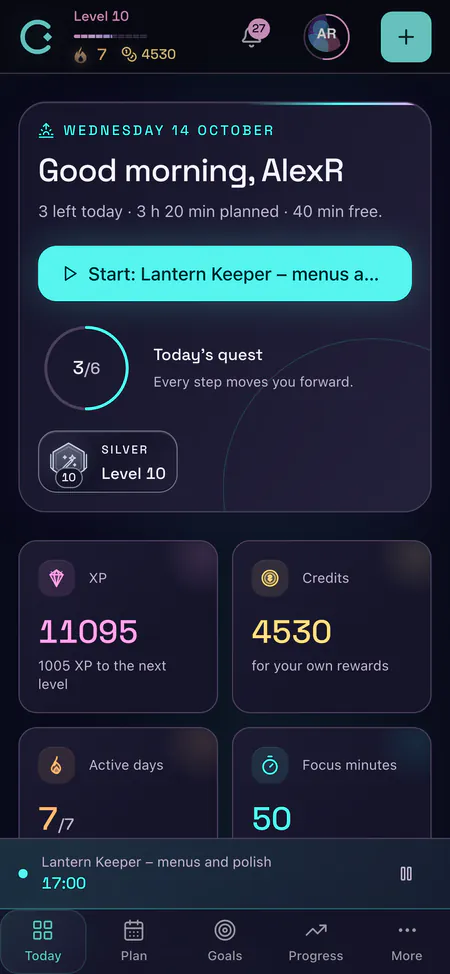
In CORTEX (free for everyone) set a repeating task "End of day: phone on charger @22:00 *daily" or a habit "In bed by 10:30" and watch the streak of days you managed it. In notification settings you can turn on quiet hours so the app does not disturb you in the evening.
Frequently asked questions
Why do I procrastinate going to bed?
Often because the evening is your only time for yourself, a tired brain finds it harder to stop and phone content never ends. Having your "me time" earlier, setting an end-of-day signal and keeping your phone out of the bedroom help.
What is bedtime procrastination?
Bedtime procrastination is going to bed later than you planned without an external reason. The term was introduced by Kroese and colleagues (2014), and it is linked with insufficient sleep and daytime tiredness.
What is revenge bedtime procrastination?
It is an internet name for staying up late to "take back" time for yourself after a day with no free time, even though it costs you sleep. Finding time for yourself earlier in the evening usually helps.
How many hours of sleep do I need?
National Sleep Foundation experts recommend 7–9 hours for adults, 8–10 hours for teenagers and 7–8 hours for older adults. Needs vary; if you are tired during the day for a long time, talk to a doctor.
How do I stop scrolling in bed?
Charge your phone outside the bedroom, set an "end of day" alarm and keep a book by your bed. An if–then plan ("When I lie down, my phone stays in the kitchen") means you do not have to decide again in the critical moment.
Sources and further reading
- Kroese, F. M., De Ridder, D. T. D., Evers, C. & Adriaanse, M. A. (2014). Bedtime procrastination: introducing a new area of procrastination. Frontiers in Psychology, 5, 611
- Kroese, F. M. et al. (2016). Bedtime procrastination: A self-regulation perspective on sleep insufficiency in the general population. Journal of Health Psychology, 21(5), 853–862
- Hirshkowitz, M. et al. (2015). National Sleep Foundation’s sleep time duration recommendations: methodology and results summary. Sleep Health, 1(1), 40–43
- Scullin, M. K. et al. (2018). The effects of bedtime writing on difficulty falling asleep. Journal of Experimental Psychology: General, 147(1), 139–146
Level up your life
CORTEX is free for everyone. Tasks, a one-click day plan, time tracking, habits and rewards in one system – on desktop and mobile.
CREATE A FREE ACCOUNT