Free habit tracker app: build good habits, starve the bad ones
A habit tracker app is a daily checklist for recurring behaviors – you mark what you did today and see the pattern over time. CORTEX is a free one that runs in the browser, so it works on a Windows PC, a Mac, a Chromebook or your phone without installing anything from a store. It tracks good habits (buffs) and bad habits (debuffs), either as a simple yes/no or as a number with a daily target, and turns check-ins into XP. Here is how to set habits up so they last, what the app tracks – and, honestly, what it does not.
- CORTEX is a free gamified productivity app – tasks, a one-click day plan, time tracking and habits, with XP, levels and real-life rewards.
- CORTEX tracks good habits (buffs) and bad habits (debuffs); each habit is either yes/no or numeric with a daily target, and a numeric bad habit fails when you go over its limit.
- Check-ins on good habits earn XP; logging a bad habit costs XP.
- CORTEX shows an overall activity streak (current and best) and a daily-log streak; it does not keep a separate streak per habit.
- In a study by Lally et al. (2009), forming a new habit took a median of 66 days, with a range of 18 to 254 days.
How habit tracking actually helps
A habit is a behavior that runs on autopilot when a familiar cue appears. Tracking does not create that autopilot – repetition does – but tracking keeps the repetition going during the fragile weeks before it is automatic. James Clear sums up the mechanism in Atomic Habits: a tracker makes the behavior obvious, satisfying to record, and it gives you visible evidence that you are becoming the kind of person who does it.
How long until a habit sticks? The often-quoted "21 days" has no solid research behind it. In the best-known study, Lally and colleagues (2009) followed 96 people building a new daily habit: it took a median of 66 days to reach automaticity, ranging from 18 to 254 days depending on the person and the habit. They also found that missing a single day did not materially derail the process. Plan for two to three months, not three weeks – and do not panic over one missed day. The full guide is on how to build habits that stick.
Good habits and bad habits
Most habit trackers only count things you want to do more of. CORTEX splits habits into two columns, borrowed from RPG language:
- Buffs (good habits) – things that make you stronger: stretching, reading, a walk, inbox zero by 17:00.
- Debuffs (bad habits) – things that drain you: doomscrolling, late-night coffee, snacking after 21:00.
Tracking bad habits is underrated. You cannot reduce what you do not notice, and an honest tally of "doomscrolling: yes" five days in a row says more than any app-usage report you will never open.
Yes/no or a daily target: which to choose
Each habit is one of two types. Pick based on whether "how much" matters:
| Habit | Type | Setup | Counts as done when |
|---|---|---|---|
| Morning stretching | Good, yes/no | – | You tick it |
| Drink water | Good, numeric | target 8 glasses | You log 8 |
| Read | Good, numeric | target 20 pages | You log 20 pages |
| Doomscrolling | Bad, yes/no | – | Ticking it marks a slip |
| Coffee | Bad, numeric | limit 2 cups | Fails once you log a 3rd cup |
| Cigarettes | Bad, numeric | limit 5, lowered weekly | Fails above the limit |
Decision rule: use yes/no for habits where showing up is the win (meditation, a walk, flossing). Use numeric when quantity is the point (water, pages, push-ups) or when you are cutting down rather than quitting (coffee, cigarettes). A numeric bad habit with a limit lets you taper gradually – lower the limit by one every week or two.
Setting up your habits in CORTEX
- Open Habits from the sidebar or the Habits button in the top bar.
- Add two or three habits at most. One good, one bad is a great start. You can always add more; dropping a failed habit hurts motivation.
- Choose yes/no or numeric and, for numeric, the daily target or limit.
- Attach each habit to a cue you already have: "after coffee → stretch", "when I sit at the desk → open the planner". This is the habit-stacking idea from Atomic Habits, and a morning routine or evening routine is the easiest place to stack them.
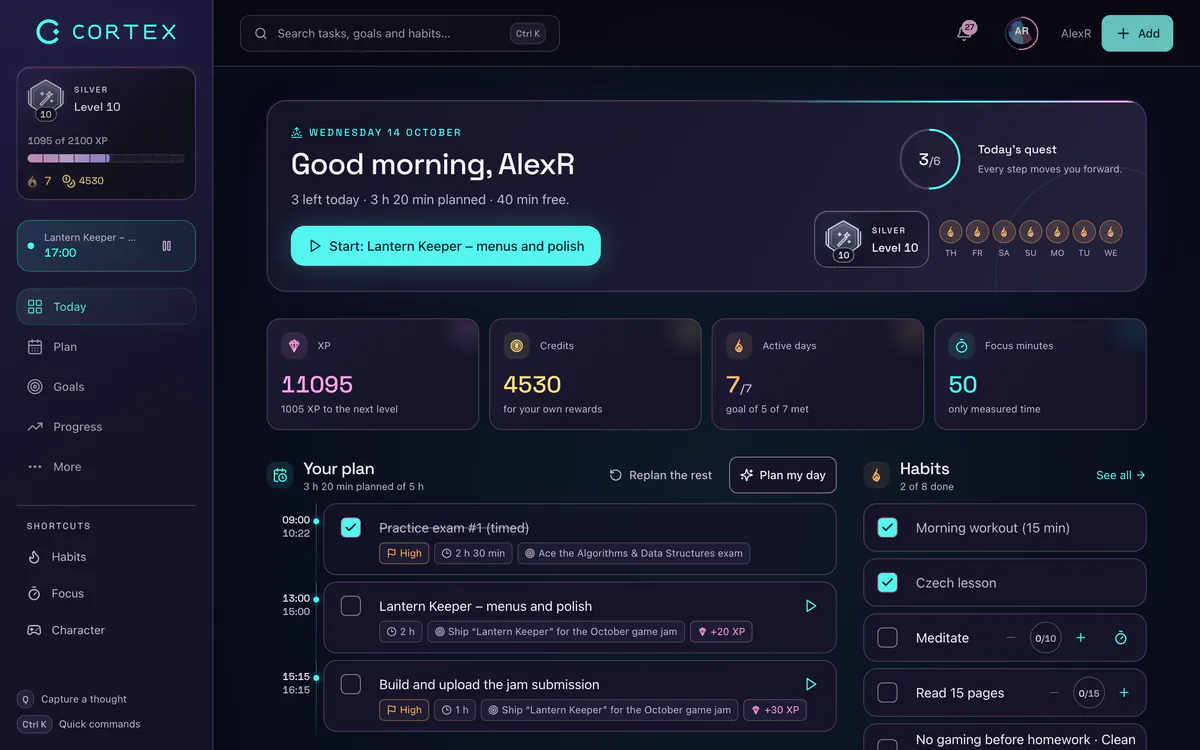
- Check in from the Today screen, where your habits sit next to the morning brief and evening debrief, with a progress bar for the day (for example 3/4).
Habits can also be part of a 30-day commitment contract: you write down why, choose up to three pillars and optional habits, sign it, and CORTEX generates the habits, tasks and a goal for you.
XP, streaks and what the app counts
Because CORTEX is a gamified productivity app, habits are wired into the game layer:
- Good habit check-ins earn XP, which feeds your level and rank.
- Logging a bad habit costs XP. Small, fair, and visible – enough to sting, not enough to make you quit.
- A daily log (energy, focus, sleep, diet, exercise, water, weight) adds XP for healthy days such as 7–9 hours of sleep or 30+ minutes of exercise.
About streaks – honestly: CORTEX shows an overall activity streak (current and best) and a daily-log streak. It does not keep a separate streak counter for each habit. If a per-habit chain is what keeps you going, a dedicated streak app or a printable habit tracker on your wall will serve you better – or use both: paper for the chain, CORTEX for the XP and the rest of your day.
There is an argument for this design, too. Lally’s data suggest one missed day does not reset habit formation, but a per-habit streak counter dropping to zero often feels like it does – and that "what-the-hell" moment is where many people quit. An overall streak rewards showing up for anything, and your habit check-ins still count every day.
A habit tracker app for PC and laptop
Many "habit tracker for PC" results are phone apps you are supposed to run inside an Android emulator. That is a lot of setup for a checklist. CORTEX is a web app, so on a Windows PC, a Mac, Linux or a Chromebook you just open it in the browser and log in with email, Google or Facebook. Your habits are the same on your laptop and your phone.
On the phone, use the browser menu and choose Add to Home Screen to install it as a PWA. CORTEX is not in the App Store or Google Play. Reminders arrive as a morning and evening summary push notification rather than as separate alarms per habit.
Who it suits and when to choose something else
CORTEX works well if you want habits in context: next to your tasks, day plan, time tracking and goals, with rewards for all of it. Choose a dedicated habit app if you want per-habit streaks, habit-specific charts, home-screen widgets or per-habit reminders at set times. Gamers who want the full RPG treatment should also look at the RPG habit tracker page.
Frequently asked questions
What is the best free habit tracker app?
The best one is the app you will open every day without effort. If you want habits alongside tasks, a day plan and rewards, CORTEX is free for everyone with good and bad habits, yes/no or numeric targets and XP. If you only want per-habit streaks and widgets, a dedicated streak app may suit you better.
Is there a free habit tracker app for PC or laptop?
Yes. CORTEX runs in any modern browser on Windows, macOS, Linux and ChromeOS, so you do not need an emulator or an install. Log in on your laptop and your phone and you see the same habits.
Can I track bad habits, not just good ones?
Yes. In CORTEX bad habits are debuffs. You can track them as yes/no or set a daily limit, for example 2 coffees, and the habit fails when you go over it. Logging a bad habit costs XP.
Does CORTEX show a streak for each habit?
No. CORTEX shows an overall activity streak (current and best) and a daily-log streak, not a separate streak per habit. If per-habit chains motivate you, pair it with a printable tracker.
How long does it take to form a habit?
In Lally et al. (2009), the median was 66 days, with a range of 18 to 254 days depending on the person and the behavior. The popular "21 days" figure is not supported by that research, and missing a single day did not materially affect habit formation.
Sources and further reading
Level up your life
CORTEX is free for everyone. Tasks, a one-click day plan, time tracking, habits and rewards in one system – on desktop and mobile.
CREATE A FREE ACCOUNT