Deep work: how to do it, what the book says and how to measure it
Deep work is focused, distraction-free work that pushes your thinking to its limit – the term comes from Cal Newport's 2016 book Deep Work, and it is the kind of work that produces your best output in the fewest hours. This guide shows you how to deep work in practice: pick a schedule that fits your life, run a repeatable session ritual, shut down cleanly at night and count your deep hours so you know it is actually happening.
- Deep work is "professional activity performed in a state of distraction-free concentration" that stretches your skills; shallow work is logistical work you can do while distracted (Newport, 2016).
- Newport describes four ways to schedule deep work: monastic, bimodal, rhythmic and journalistic. Most people with a normal job do best with the rhythmic approach – the same block at the same time every day.
- Switching tasks leaves "attention residue" that lowers performance on the next task (Leroy, 2009); writing a quick plan for where you will resume reduces the effect (Leroy & Glomb, 2018).
- Newport suggests that even experts top out at around four hours of deep work a day; beginners should start with one focused hour and grow from there.
- The simplest way to make deep work stick is to count it: log deep hours every day and review the weekly total.
What is deep work?
Cal Newport, a computer science professor at Georgetown, defines deep work as professional activity done in distraction-free concentration that pushes your cognitive abilities to their limit. The opposite is shallow work: non-demanding, logistical tasks that you can do while half-distracted – email, scheduling, most chat, a lot of meetings.
His core argument in Deep Work: Rules for Focused Success in a Distracted World (Grand Central, 2016) is economic: the ability to learn hard things quickly and produce high-quality output is getting more valuable, while the ability to do it is getting rarer, because modern work is built around constant interruption. Newport sums it up with a simple formula:
High-quality work produced = time spent × intensity of focus
You can double your output either by working twice as long, or by working with far fewer interruptions. The second option is the one that leaves you a life.
Deep work vs shallow work: a quick test
Newport offers a useful question for sorting tasks: how many months would it take to train a smart recent graduate with no specialized training to do this? The longer the answer, the deeper the task. Here is what that looks like in practice:
| Role | Deep work | Shallow work |
|---|---|---|
| Developer | Designing a data model, debugging a race condition | Updating tickets, code-review comments on typos |
| Designer | Exploring a new layout concept | Exporting assets, renaming layers |
| Student | Solving problem sets, writing an essay argument | Formatting references, reorganizing notes |
| Freelancer | Writing a proposal that wins the project | Invoices, scheduling calls, inbox |
| Manager | Writing the strategy doc, hiring decisions | Status updates, approving expenses |
Shallow work is not bad. It has to get done. The problem is when it fills the hours where your brain is sharpest. A good rule of thumb: protect your best two to four hours for deep work and batch shallow work into the rest.
The four deep work philosophies (pick one that fits your life)
Newport's most practical idea is that there is no single right way to schedule depth. He describes four "philosophies":
| Philosophy | What it looks like | Good fit for | Watch out for |
|---|---|---|---|
| Monastic | Eliminate or radically minimize shallow obligations. Newport's example is computer scientist Donald Knuth, who does not use email. | Researchers, writers, people whose value is one big output | Almost impossible in most jobs |
| Bimodal | Split time into clearly defined deep stretches (days, weeks, a season) and open periods. Example: Carl Jung retreating to his tower in Bollingen. | Academics, founders, freelancers who can block whole days | Needs control over your calendar |
| Rhythmic | The same deep block at the same time, most days. It runs on habit, not decision. | Most employees, students, parents | Blocks get eaten by meetings if not defended |
| Journalistic | Switch into deep mode whenever free time appears, as journalist Walter Isaacson did while writing books. | Experienced people with unpredictable schedules | Hard for beginners – switching takes practice |
If you are unsure, start rhythmic: one 60–90-minute block every workday at the same time, ideally in the morning before your inbox gets a vote. It pairs perfectly with time blocking: the deep block is the first thing you put on the calendar, everything else goes around it.
How to deep work: a session ritual you can copy
Newport recommends building a ritual so you do not spend willpower deciding how to start. His ritual answers three questions: where you will work and for how long, how you will work once you start, and how you will support the work. Here is a version you can use tomorrow:
- Pick one target. Write a single sentence: "Draft sections 2 and 3 of the proposal." Not "work on the proposal".
- Set a fixed length. 50 or 90 minutes. A clear end makes it easier to stay in.
- Prepare the space. Close chat and email, put your phone in another room (not face-down on the desk), open only the files you need.
- Set a rule for the session. For example: "No internet except the docs I have open" or "Count words every 25 minutes".
- Keep a distraction notepad. Every "I should check…" thought goes on paper and waits until the break. This alone saves dozens of switches.
- Start the timer and work. Any timer works, including our free online focus timer. If you get stuck, stay with the problem – boredom and discomfort are part of the work, not a signal to switch. (If you cannot even start, read how to stop procrastinating first.)
- Close with a one-line note: where you stopped and the very next step. That note matters more than it looks (see the next section).
Attention residue: why "just a quick check" ruins depth
In 2009, Sophie Leroy published a study with a memorable title: "Why is it so hard to do my work?" She found that when people switch from an unfinished task to a new one, part of their attention stays stuck on the first task. She called this attention residue, and it lowered performance on the next task.
That is why the "quick" email check during a deep block is so costly: the check takes thirty seconds, but your head keeps processing the email for much longer afterwards. Interruptions have an emotional price too: in a study by Mark, Gudith and Klocke (2008), interrupted people compensated by working faster, but reported more stress, frustration and time pressure.
A follow-up study by Leroy and Glomb (2018) found something practical: writing a brief "ready-to-resume" plan – where you are and what you will do next – before switching away from an interrupted task reduced attention residue and improved performance on the interrupting task. In plain terms:
- Batch shallow work into its own blocks instead of sprinkling it through deep time.
- If you must switch, spend 30 seconds writing where you stopped and the next step.
- Check email and chat at set times (say 11:00, 14:00 and 16:30) instead of on demand.
The shutdown ritual: end the workday on purpose
One of the most quoted parts of the book is Newport's shutdown ritual: a fixed routine at the end of the workday that makes sure nothing is left hanging, after which you stop thinking about work. Newport ends his with a spoken phrase: "Shutdown complete."
The idea has research behind it: Masicampo and Baumeister (2011) found that making a specific plan for an unfinished goal reduced the intrusive thoughts about it. Your brain lets go once it trusts there is a plan. A 10-minute version:
- Check email and chat one last time for anything that needs a reply today.
- Capture every open loop into your task list – nothing stays in your head (the GTD method is built on exactly this).
- Look at tomorrow's calendar and the next few days of deadlines.
- Pick tomorrow's deep work target and write it at the top of the list.
- Close everything and say (or think) the phrase. Then stop.
The full end-of-day version, including sleep basics, is in our evening routine guide.
How to measure deep work (and a printable tracker)
What gets counted gets protected. Newport recommends keeping a visible scoreboard of deep hours – a "lead measure" you control directly, unlike results you only influence. Here is a realistic scale:
| Level | Deep hours per workday | Note |
|---|---|---|
| Starting out | 1 | One protected block is already a big change for most people |
| Solid | 2–3 | Typical for focused knowledge workers with some meetings |
| Expert ceiling | ~4 | Newport's estimate of the practical daily limit, based on research on deliberate practice |
Track three things per day: deep hours, what you produced, and the main thing that broke your focus. After two weeks, the pattern tells you what to fix.
Deep work tracker – week of ______
| Day | Deep target | Deep hours | What I produced | Biggest distraction |
|---|---|---|---|---|
| Mon | ||||
| Tue | ||||
| Wed | ||||
| Thu | ||||
| Fri | ||||
| Sat | ||||
| Sun | ||||
| Total | Next week I will protect: | |||
Running deep work in CORTEX
You can do everything above with paper and a kitchen timer. If you prefer an app, here is how the pieces map onto CORTEX, a free gamified productivity app – tasks, a one-click day plan, time tracking and habits, with XP, levels and real-life rewards.
- The session: the focus timer in the top bar counts down 15, 25 or 50 minutes with a progress bar and tells you when you are done. Turn on an ambient sound (Lofi, Synth, Bio/nature, Zen or Wave) if silence feels too loud.
- The scoreboard: create a named work timer such as "Deep work – thesis" on the Today screen and start it with the session. The countdown itself is not logged, but the work timer is, so your deep hours land in reports.
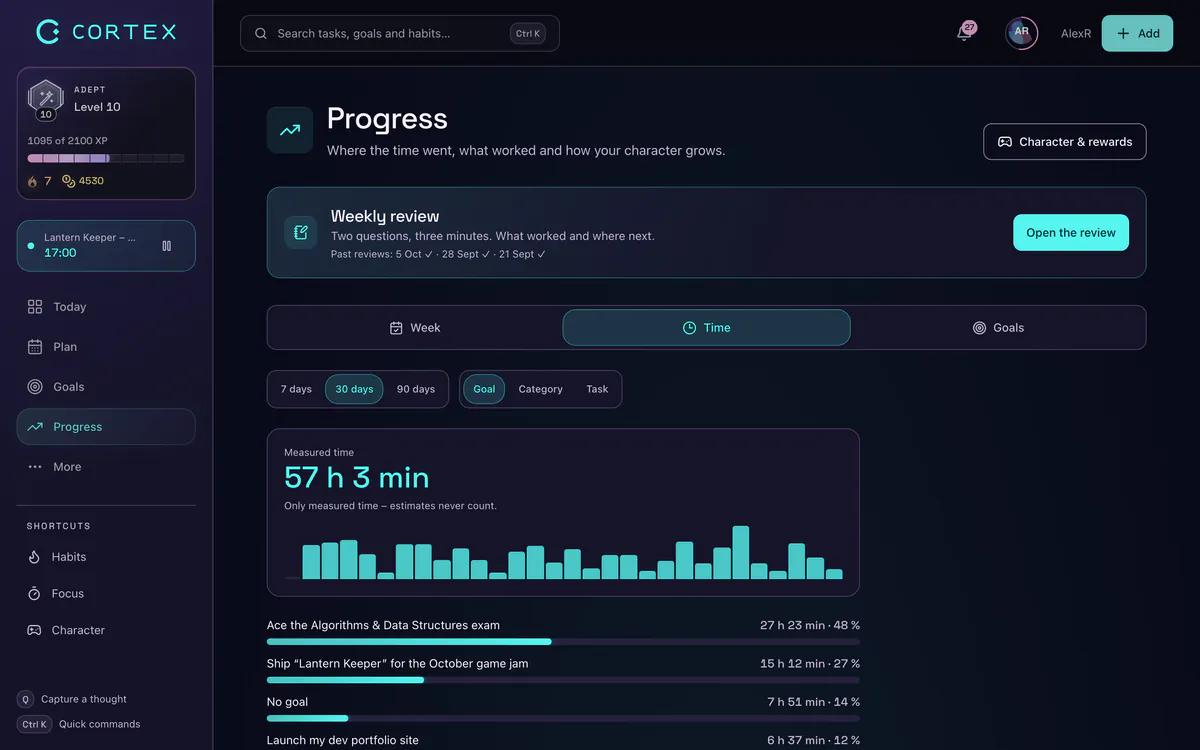
- The weekly review: reports show total tracked time and time per goal or category, with CSV and PDF export – an instant deep-hours chart.
- Tomorrow's target: add it with quick capture (press Q):
Draft chapter 2 tomorrow @9:00 ~90m !p1 #Thesis.

The game layer helps on the days motivation is low: finished tasks earn XP and credits you can spend on your own rewards. More on tracking hours in the time tracking app overview.
Deep Work book summary: the four rules
The book has two parts. Part 1 argues that deep work is valuable, rare and meaningful. Part 2 gives four rules:
- Work deeply. Choose a scheduling philosophy, build rituals, make "grand gestures" (an unusual place or investment that signals the work matters), and keep a scoreboard.
- Embrace boredom. Concentration is a skill. If you reach for your phone every time you queue for coffee, you train your brain to need novelty. Newport suggests scheduling internet use rather than scheduling offline breaks.
- Quit social media. Use a tool only if its benefits substantially outweigh its costs for your core goals – not because it offers some benefit.
- Drain the shallows. Schedule every minute of your workday (loosely, revisable), estimate how deep each activity is, and agree on a shallow-work budget with your boss or yourself.
Who it is for: knowledge workers, students and freelancers who control at least part of their day. Common criticism: the advice assumes a fair amount of autonomy, and some examples (professors, famous authors) are hard to copy in customer-facing roles. The underlying ideas – protect a block, batch the shallow stuff, count your hours – work in almost any job. If focus is your bottleneck rather than scheduling, start with our guide on how to focus better.
Frequently asked questions
What is deep work in simple terms?
Deep work is uninterrupted, focused work on something cognitively demanding – writing, coding, designing, studying hard material. The term comes from Cal Newport's 2016 book Deep Work. Its opposite, shallow work, is logistical stuff you can do while distracted, like email.
How many hours of deep work per day is realistic?
Newport estimates that even experienced people top out at around four hours a day. If you are starting out, one protected hour a day is a strong result. Increase slowly and measure actual hours rather than planned ones.
How do I start deep work if my job is full of meetings?
Use the rhythmic approach: block the same 60–90 minutes every day, ideally early, and defend it like a meeting. Batch email and chat into fixed check times, and write a short "where I stopped" note whenever you get pulled away.
Is Deep Work by Cal Newport worth reading?
Yes, if you control at least part of your schedule. The book is short on fluff and its rules – work deeply, embrace boredom, quit social media, drain the shallows – are practical. If you only want the method, the ritual, shutdown routine and deep-hours tracker in this guide cover the core of it.
What is the difference between deep work and the Pomodoro Technique?
Deep work is a goal: long stretches of distraction-free, demanding work. The Pomodoro Technique is a timing method of 25-minute focus intervals with short breaks. Pomodoros are a good way to build up to deep work; many people later move to 50- or 90-minute blocks.
What is attention residue?
Attention residue is the part of your attention that stays stuck on a previous task after you switch away, described by Sophie Leroy in 2009. It lowers performance on the next task. Batching shallow work and writing a quick "ready-to-resume" note before switching both help.
Sources and further reading
- Cal Newport – Deep Work (Grand Central Publishing, 2016)
- Leroy, S. (2009). Why is it so hard to do my work? The challenge of attention residue when switching between work tasks. OBHDP 109(2)
- Leroy, S. & Glomb, T. (2018). Tasks interrupted … and how a "ready-to-resume" plan mitigates the effects. Organization Science
- Masicampo, E. J. & Baumeister, R. F. (2011). Consider it done! Plan making can eliminate the cognitive effects of unfulfilled goals. JPSP
- Mark, G., Gudith, D. & Klocke, U. (2008). The cost of interrupted work: more speed and stress. CHI '08
Level up your life
CORTEX is free for everyone. Tasks, a one-click day plan, time tracking, habits and rewards in one system – on desktop and mobile.
CREATE A FREE ACCOUNT