How to Stop Procrastinating: 9 Techniques and a 10-Minute Emergency Plan
To stop procrastinating, shrink the task until starting feels harmless, deal with the bad feeling the task triggers instead of the task itself, and remove the friction between you and the first step. Procrastination is mostly a mood problem, not a time-management problem – so the fixes below target the feeling first and the to-do list second.
- Researchers Fuschia Sirois and Timothy Pychyl (2013) describe procrastination as putting short-term mood repair ahead of long-term goals – you avoid the task to avoid the feeling it causes.
- The costs of procrastination usually land on your "future self", which is why it feels harmless in the moment and painful later.
- The fastest fix is a tiny, concrete first action with a short time box (2–10 minutes); starting reduces the dread more reliably than waiting for motivation.
- If-then plans ("If it is 9:00, then I open the report") are one of the best-supported tools for closing the gap between intention and action (Gollwitzer, 1999).
- Forgiving yourself for past procrastination was linked to less procrastination later in a study of students (Wohl, Pychyl & Bennett, 2010) – beating yourself up tends to backfire.
The 10-minute emergency protocol (use this right now)
If you are reading this instead of doing something, here is the short version. It takes ten minutes and you do not need any app.
- Minute 0–1 – Name the task and the feeling. Write one line: "I am avoiding the tax form because it feels confusing and boring." Naming the emotion takes some of its power away and tells you what to fix.
- Minute 1–2 – Find the next visible action. Not "do taxes" but "open the folder and find last year's PDF". It must be physical and obvious – something you could film.
- Minute 2–3 – Clear one source of friction. Close the tab you were hiding in, put your phone in another room or face down, open the file you need.
- Minute 3–8 – Do five minutes, timer on. Set a 5-minute timer and promise yourself you may stop when it rings. Most of the time you won't – and if you do, you still made progress.
- Minute 8–10 – Leave a breadcrumb. Write the next step down ("next: fill in section 2") so restarting later costs nothing.
Why you procrastinate (hint: it's not laziness)
Procrastination is the voluntary delay of something you intended to do, even though you expect to be worse off for the delay. That last part matters: you know it's a bad deal, and you do it anyway.
Psychologists Fuschia Sirois and Timothy Pychyl (2013) argue that procrastination is best understood as a failure of emotion regulation. A task triggers something unpleasant – boredom, anxiety, confusion, self-doubt, resentment – and avoiding the task gives you instant relief. Your brain learns that avoidance "works", at least for the next ten minutes. Meanwhile the real costs are pushed onto your future self, the person who will have to deal with the deadline, and we tend to care less about that person than about how we feel right now.
A large meta-analysis by Piers Steel (2007) found procrastination is closely tied to impulsiveness and to tasks that feel aversive, and that people procrastinate more when the reward is far away. Put together, the picture is simple: you put off tasks that feel bad now and pay off later.
That changes the strategy. Time-management tricks help, but the real lever is making the task feel less bad to start – smaller, clearer, less risky – and making the payoff feel closer.
9 techniques to stop procrastinating
1. Shrink the first step until it's laughably small
Big, vague tasks ("work on thesis") are procrastination magnets because your brain can't see where to begin. Rewrite every task as the next physical action: "write the heading of chapter 3", "email Jana for the brief". If you still hesitate, the step is still too big.
2. Use a time box instead of a finish line
"Finish the report" has no visible end. "Work on the report for 25 minutes" does. A focused block with a timer – the core of the Pomodoro Technique – turns an open-ended task into a game with a clear win condition. Our free online Pomodoro timer works in any browser.
3. Write if-then plans
Peter Gollwitzer's research on implementation intentions (1999) showed that plans in the form "If situation X, then I will do Y" make people much more likely to follow through than goals alone. Examples: "If I sit down at my desk after lunch, then I open the client brief first." "If I notice I've opened social media, then I close it and do two minutes on the task."
4. Get the task out of your head and into a plan
Unfinished goals keep nagging at you. Masicampo and Baumeister (2011) found that simply making a specific plan for an unfulfilled goal reduced its intrusive effect on other work. Practically: when a task keeps popping into your head, don't fight it – write it down with a date and a first step.
5. Remove friction from the start, add friction to distractions
Leave the document open at night. Put the running shoes by the door. On the other side, log out of the apps you hide in, move them off your home screen, or use a website blocker during focus blocks. You're not fighting willpower; you're redesigning the path of least resistance.
6. Make the reward immediate
Long-term rewards are weak motivators in the moment. Bring the payoff closer: a coffee after the first block, a checked box, a progress bar, points in a game. This is exactly why gamified productivity apps work for many procrastinators – they put a small, instant reward on a task whose real reward is weeks away.
7. Decide what matters before the day starts
When everything is on the list, the easiest task wins and the important one waits. Pick one "must-do" for the day the evening before. If you struggle to choose, sort the list with the Eisenhower Matrix and give the top task a fixed slot with time blocking.
8. Forgive yourself – seriously
It sounds soft, but it's practical. In a study of first-year students, Wohl, Pychyl and Bennett (2010) found that those who forgave themselves for procrastinating before a first exam procrastinated less before the next one. Guilt keeps the task associated with bad feelings, which is exactly what drives avoidance. Acknowledge it, then move to the next tiny step.
9. Add a witness or a commitment
Tell someone what you will finish and when, work alongside a friend (in person or on a video call), or sign a written commitment with yourself. External structure helps bridge the gap when internal motivation is low. A personal commitment contract is one simple way to do this.
Match the fix to your procrastination trigger
Not all procrastination feels the same. Ask "what exactly is unpleasant about this task?" and pick the fix that targets it.
| The task feels… | What's going on | Try this first |
|---|---|---|
| Boring | No immediate reward | Time box + instant reward (#2, #6) |
| Confusing | No clear first step | Write the next physical action (#1) |
| Too big | Can't see the end | Break into subtasks, do only the first (#1, #2) |
| Scary / high stakes | Fear of judgment or failure | Do a deliberately "bad first draft" for 10 minutes |
| Unfair / imposed | Resentment, low ownership | Name your own reason for doing it; add a witness (#9) |
| Easy to start "later" | No deadline or slot | Give it a time slot and an if-then plan (#3, #7) |
How to stop procrastinating at work
At work, procrastination often hides behind busyness: you answer emails, attend meetings and tidy files while the one task that actually matters waits. A few rules that help:
- Do the hard thing before the inbox. Your first focused block of the day goes to the task you most want to avoid, before email and chat pull you into reactive mode.
- Book meetings with yourself. Put the important task in your calendar as an appointment. If it isn't on the calendar, other people's priorities will fill the space.
- Ask one clarifying question early. Many work tasks stall because the brief is vague. A two-line message to your manager or client often unblocks days of avoidance.
- Ship a rough version early. Sharing a draft at 50% removes the pressure of perfection and gets you feedback before it's expensive.
- Batch the small stuff. Collect quick tasks into one block in the afternoon instead of letting them fragment the morning.
For freelancers the stakes are higher because nobody is checking in. A visible daily plan and a timer running on client work make the day concrete – see our app for freelancers page for a full daily setup.
Procrastination and ADHD
Many people with ADHD describe procrastination as one of their biggest daily struggles, especially with tasks that are boring, multi-step or far from their deadline. This guide isn't medical advice, and if you suspect ADHD, a qualified professional is the right person to talk to. That said, the same principles tend to matter even more for ADHD-style brains:
- Externalize everything. Don't rely on remembering. Capture tasks the moment they appear, in one place.
- Make time visible. A countdown timer you can see helps when "later" feels abstract.
- Use urgency on purpose. Create artificial deadlines: a body-doubling session with a friend, a short sprint before a break, a commitment to send a draft at 3 p.m.
- Reward fast. A reward that arrives in seconds (a checkmark, points, a level-up) works better than one that arrives next month.
- Lower the bar for starting, not for finishing. "Two minutes on it" is a valid daily goal on a hard day.
We collected more ideas, and how CORTEX handles them, on our ADHD planner app page. CORTEX is a productivity tool, not a medical device or a treatment.
Books on procrastination worth reading
If you want to go deeper, these books are written by people who have studied procrastination for years:
- Timothy A. Pychyl – Solving the Procrastination Puzzle (2013). Short, research-based and practical. The best starting point if you want the emotion-regulation view in plain language.
- Piers Steel – The Procrastination Equation (2010). Builds on his meta-analysis: how expectancy, value, impulsiveness and delay combine. Good for analytical readers.
- Neil Fiore – The Now Habit (1988, revised edition later). Known for the "unschedule": plan your guilt-free leisure first and fit work around it.
- Jane B. Burka & Lenora M. Yuen – Procrastination: Why You Do It, What to Do About It Now (1983, updated 2008). Leans into the fears and personal history behind procrastination.
Reading about procrastination can itself become procrastination. Read one chapter, then go back to the 10-minute protocol.
Putting it into practice with CORTEX
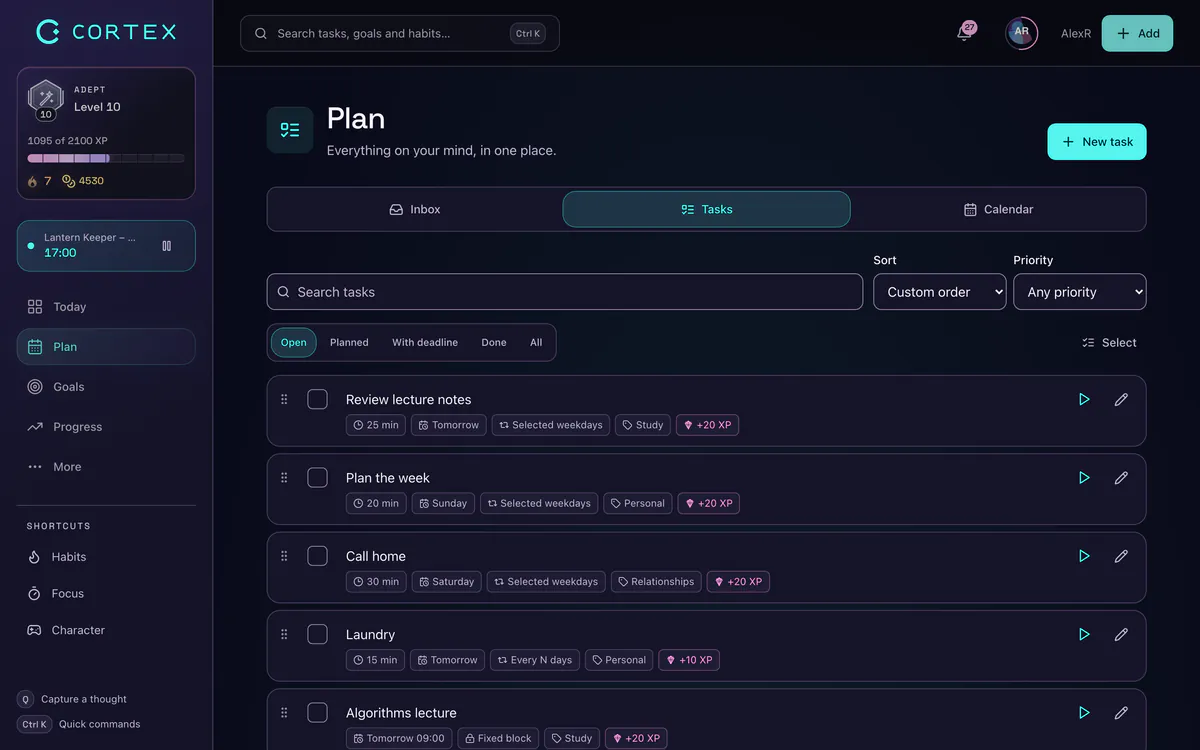
You can run every technique above with paper and a kitchen timer. If you prefer an app, CORTEX – a free gamified productivity app with tasks, a one-click day plan, time tracking and habits, plus XP, levels and real-life rewards – bundles the pieces that matter most for procrastinators:
- Capture in seconds: press Q and type "Draft report intro tomorrow @9:00 ~25m !p1" – date, time, duration and priority are parsed for you. That's an if-then plan in one line.
- Small steps: split a scary task into subtasks and watch the progress bar move.
- Plan My Day: one click puts today's, overdue and undated tasks into free time slots, overdue first, then by priority, then shortest first – so you start with quick wins.
- A visible timer: the focus timer in the top bar counts down 15, 25 or 50 minutes.
- Instant rewards: every finished task gives XP and credits you spend in a reward shop on rewards you choose yourself – an episode, a coffee, a guilt-free gaming hour.
Frequently asked questions
How do I stop procrastinating right now?
Pick the task, write the very next physical action (like "open the file"), remove one distraction and set a timer for five minutes with permission to stop when it rings. Starting tiny lowers the dread, and most people keep going once they have begun.
Why do I procrastinate even when I want to do the task?
Because procrastination is mostly about feelings, not intentions. Researchers Sirois and Pychyl (2013) describe it as prioritizing short-term mood repair: the task triggers boredom, anxiety or self-doubt, and avoiding it brings quick relief while the cost is pushed onto your future self.
How do I stop procrastinating at work?
Do your most avoided task in the first focused block of the day, before email and chat. Book it in your calendar as an appointment, clarify vague briefs early and share rough drafts instead of waiting for perfect.
How can I stop procrastinating with ADHD?
Externalize tasks, make time visible with a countdown timer, create artificial deadlines (for example working alongside a friend) and use rewards that arrive immediately. These are general strategies, not medical advice; for diagnosis or treatment talk to a qualified professional.
What is the best book on procrastination?
For a short, research-based read, start with Timothy Pychyl's Solving the Procrastination Puzzle (2013). Piers Steel's The Procrastination Equation (2010) suits analytical readers, and Neil Fiore's The Now Habit is known for its "unschedule" technique.
Is procrastination a sign of laziness?
No. Lazy people don't want to do anything; procrastinators usually want to do the task and feel bad about not doing it. The delay is an attempt to avoid an unpleasant feeling, which is why emotion-focused fixes work better than self-criticism.
Sources and further reading
- Sirois, F. & Pychyl, T. (2013). Procrastination and the Priority of Short-Term Mood Regulation. Social and Personality Psychology Compass, 7(2), 115–127
- Steel, P. (2007). The nature of procrastination: A meta-analytic and theoretical review. Psychological Bulletin, 133(1), 65–94
- Gollwitzer, P. M. (1999). Implementation intentions: Strong effects of simple plans. American Psychologist, 54(7), 493–503
- Masicampo, E. J. & Baumeister, R. F. (2011). Consider it done! Plan making can eliminate the cognitive effects of unfulfilled goals. Journal of Personality and Social Psychology
- Wohl, M. J. A., Pychyl, T. A. & Bennett, S. H. (2010). I forgive myself, now I can study. Personality and Individual Differences, 48(7), 803–808
Level up your life
CORTEX is free for everyone. Tasks, a one-click day plan, time tracking, habits and rewards in one system – on desktop and mobile.
CREATE A FREE ACCOUNT