How to reward yourself: a reward system that motivates without backfiring
Rewarding yourself works when the reward comes soon, is tied to a specific finished step and matches the effort. Research shows that immediate enjoyment keeps people going on long-term goals better than distant payoffs, and that pairing an unpleasant task with something you enjoy helps you start. Rewards can also backfire – mostly for things you already enjoy. Here is how to build a reward system that lasts.
- Immediate rewards predict persistence on long-term goals better than delayed ones (Woolley & Fishbach, 2016).
- Temptation bundling – enjoying something only while doing a chore, like a favorite audiobook only at the gym – increased gym visits, though the effect faded over time (Milkman, Minson & Volpp, 2014).
- Expected tangible rewards for an activity you already enjoy can undermine intrinsic motivation (Deci, Koestner & Ryan, 1999); praise and feedback tend to support it.
- A good system has small, frequent rewards for steps and bigger, rarer rewards for milestones, priced by effort.
- Rewards come after, not instead: task first, reward second – otherwise the reward becomes procrastination.
Why rewards work (and when they don't)
Our brains respond more strongly to what comes now. Across several studies, Woolley and Fishbach (2016) found that for long-term goals – exercise, studying, healthy eating – immediate enjoyment predicted persistence better than the distant benefit. A reward a week away motivates you today far less than a small pleasure right after you finish a step.
Second, rewards are not always harmless. A meta-analysis by Deci, Koestner and Ryan (1999) found that tangible rewards promised in advance for simply doing an interesting activity can weaken the desire to do it without a reward. Positive feedback, on the other hand, tended to strengthen intrinsic motivation.
In practice: reward yourself mainly for things you don't enjoy or are just starting, and for things you love, seeing your progress is usually enough.
Temptation bundling: the nice thing only with the hard thing
Milkman, Minson and Volpp (2014) gave participants access to page-turner audiobooks they could only listen to at the gym. People with "locked" audiobooks exercised more often than a control group; the effect faded over time, especially after a holiday break. The idea works almost anywhere:
- a favorite podcast only while ironing or cleaning,
- good coffee only during admin,
- a playlist you only play while studying,
- a show only on the exercise bike.
How to build your reward system in 5 steps
- List rewards you actually want. Small (coffee at your favorite café, one episode), medium (a guilt-free movie night) and big (new gear for a hobby, a trip). For ideas, see the dopamine menu.
- Price them. The size of the reward should match the effort: small for a day of finished tasks, big for a month of a habit or a finished project.
- After, not instead. Task first, then reward. "One episode, and only after the task is done" keeps the reward from turning into procrastination.
- Reward steps, not only goals. A big goal is far away; the small steps toward it need their own small rewards.
- Review once a month. Which rewards still pull you? Which don't? Swap them.
Example: a student's rewards during exams
| For | Reward |
|---|---|
| One hour of study without the phone | Ten minutes of social media with a timer |
| The day's study plan done | One episode in the evening |
| A whole chapter tested from memory | Coffee with a friend |
| Exam passed | The concert she saved up for |
Rewards grow with effort, and none of them replaces the studying itself. For the study side, see how to gamify studying.
Common mistakes
- Reward before work. "One more episode and then I'll start" is procrastination with a nicer name.
- Expensive rewards for small things. They soon stop making sense – and your wallet notices.
- Food as the only reward. It works short term and backfires long term.
- Rewards for what you already enjoy. They can weaken your interest in the activity itself.
- Punishments instead of rewards. Losing something for a missed day motivates briefly and often makes people quit the whole system.
Rewards in CORTEX
CORTEX has a reward system built in:
- Credits for finished work – for completed tasks, goals and missions. Credits can't be bought, only earned.
- A shop for your own rewards – define a reward and pick its rarity (common, uncommon, rare, epic, legendary), which sets the price. Buying it is an earned break, not an escape.
- XP and levels – instant feedback for every finished step; XP never goes down and there are no negative points for a missed day.
- A bonus for your first task of the day – a small reward exactly where starting is hardest.
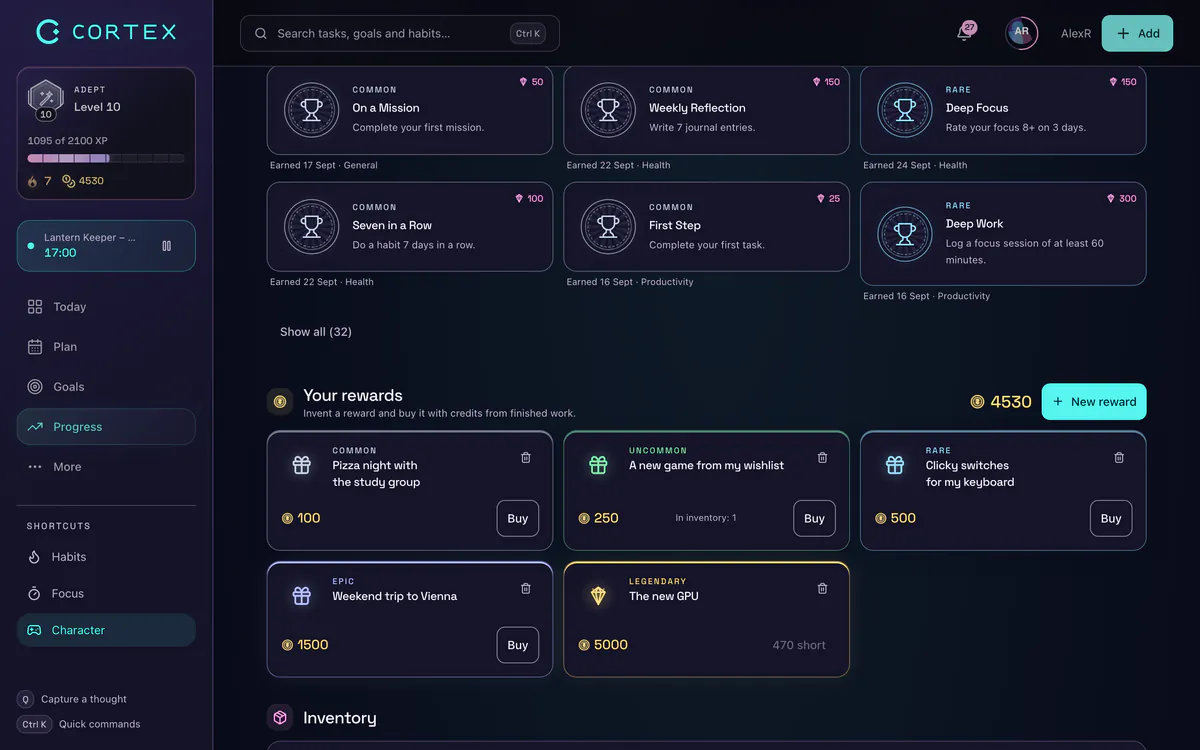
How the whole game layer works: gamified productivity app; why game mechanics motivate and when they backfire: how to gamify your life.
Frequently asked questions
How should I reward myself?
Reward yourself soon after finishing a step, keep the reward in proportion to the effort, and give it after the work, not instead of it. Combine small, frequent rewards for steps with bigger ones for milestones, and refresh them from time to time.
Can rewards make motivation worse?
Yes. A 1999 meta-analysis by Deci, Koestner and Ryan found that tangible rewards promised in advance for an interesting activity can weaken intrinsic motivation. Reward yourself mainly for things you don't enjoy or are just starting.
What is temptation bundling?
Pairing something you enjoy with something you avoid, and allowing the enjoyable thing only during the chore – for example a favorite audiobook only at the gym. In Milkman et al. (2014) it increased gym visits, though the effect faded over time.
What are good ways to reward yourself?
Things you genuinely want that don't hurt you: time for a hobby, an episode of a show, coffee with a friend, a day trip. Food as the only reward tends to backfire.
Should I punish myself for missed tasks?
Usually not. Punishment motivates briefly and often makes people abandon the system. It works better to admit the miss, adjust the plan and continue.
Sources and further reading
- Woolley & Fishbach (2016): Immediate Rewards Predict Adherence to Long-Term Goals, Personality and Social Psychology Bulletin
- Milkman, Minson & Volpp (2014): Holding the Hunger Games Hostage at the Gym: An Evaluation of Temptation Bundling, Management Science
- Deci, Koestner & Ryan (1999): A meta-analytic review of experiments examining the effects of extrinsic rewards on intrinsic motivation, Psychological Bulletin
Level up your life
CORTEX is free for everyone. Tasks, a one-click day plan, time tracking, habits and rewards in one system – on desktop and mobile.
CREATE A FREE ACCOUNT