Freelance hourly rate calculator: what you really need to charge
A freelance hourly rate calculator works backwards from the income you want to keep: add taxes and business expenses, then divide by the hours clients will actually pay for. Enter your numbers below to get your minimum hourly rate, day rate and monthly revenue target – free, no sign-up, and nothing you type leaves your browser.
- Freelance hourly rate = (desired take-home income ÷ (1 − tax rate) + business expenses) ÷ billable hours per year.
- Billable hours are far fewer than working hours: with 6 weeks off, 5 sick days, 8-hour days and a 60 % billable share, a freelancer bills about 1,080 hours a year, not 2,080.
- With those inputs, a take-home target of 60,000 with 30 % taxes and 6,000 in expenses requires about 85 per hour.
- Your effective hourly rate on a job = what the client paid ÷ every hour you tracked on it; tracking time is the only way to know it.
- CORTEX is a free gamified productivity app – tasks, a one-click day plan, time tracking and habits, with XP, levels and real-life rewards.
How to calculate your hourly rate as a freelancer
Most people start from the wrong end: "I earned 30 an hour as an employee, so I'll charge 40." That ignores everything an employer quietly paid for – taxes and contributions, paid vacation, sick days, equipment and all the hours that were never billed to anyone. The right method works backwards in four steps:
- Money you want to keep. Your desired take-home income for the year – living costs plus savings.
- Gross it up for taxes. Divide by (1 − your combined tax and social contribution rate). At 30 %, 60,000 becomes 60,000 ÷ 0.70 = 85,714.
- Add business expenses. Software, hardware, insurance, accountant, coworking, training. These are usually deductible, which is why they are added after the tax gross-up in this simple model.
- Divide by billable hours. Not working hours – the hours a client actually pays for.
Formula: hourly rate = (income ÷ (1 − tax %) + expenses) ÷ billable hours
And billable hours = ((52 − weeks off) × 5 − sick days) × hours per day × billable share.
Worked example
Let's run the calculator's default values, step by step. Currency doesn't matter – the math is the same in dollars, euros, pounds or crowns.
| Step | Calculation | Result |
|---|---|---|
| Working days | (52 − 6 weeks) × 5 − 5 sick days | 225 days |
| Working hours | 225 × 8 h | 1,800 h |
| Billable hours | 1,800 × 60 % | 1,080 h |
| Revenue before expenses | 60,000 ÷ (1 − 0.30) | 85,714 |
| Revenue needed | 85,714 + 6,000 expenses | 91,714 / year |
| Hourly rate | 91,714 ÷ 1,080 h | ≈ 85 / hour |
| Day rate | 84.92 × 8 h | ≈ 679 / day |
| Monthly revenue target | 91,714 ÷ 12 | ≈ 7,643 / month |
Compare that with the naive approach: 60,000 ÷ 2,080 "full-time hours" = about 29 per hour. Charging 29 would leave this freelancer with less than a third of the income they want. That gap is why so many freelancers feel busy and broke at the same time.
Typical inputs (and where to get your own)
Every number in the calculator should be yours. Use this table as a starting point, not as advice for your tax situation.
| Input | Typical starting point | How to get your real number |
|---|---|---|
| Take-home income | Your current net salary or monthly budget × 12 | Monthly living costs + savings goal |
| Taxes & contributions | Varies widely by country and income – the 30 % default is a placeholder | Your accountant or your tax authority's calculator. In the US, self-employment tax alone is 15.3 % (on 92.35 % of net earnings), on top of income tax. |
| Business expenses | Last 12 months of business spending | Bank statements; add planned purchases |
| Weeks off | Public holidays + vacation (e.g. US: 11 federal holidays; England & Wales: 8 bank holidays; EU employees get at least 4 weeks of paid leave) | Your own calendar – be generous, burnout is expensive |
| Sick days | 5–10 days | Your last two or three years |
| Hours per day | 6–8 | Tracked time over a normal month |
| Billable share | Often well below 100 %; 50–70 % is a common planning range for solo freelancers | Tracked billable ÷ total hours over 4–8 weeks |
For a quick sanity check, run the calculator twice: once with optimistic inputs and once with pessimistic ones. Your rate should survive the pessimistic version.
Day rate, monthly target and fixed-price jobs
Day rate. The calculator multiplies your hourly rate by your working hours per day, i.e. the price of a fully booked day. If a client books whole days, you avoid unbilled gaps between small tasks, so some freelancers offer a small discount on day rates – but never price a day below what the gaps would cost you.
Monthly revenue target. Annual revenue ÷ 12. It is the number to check your invoices against every month. Freelance income is lumpy, so look at a rolling three-month average rather than panicking about one slow month.
Fixed-price jobs. Estimate hours, add a buffer for revisions and communication, multiply by your hourly rate. Then track the hours anyway – that's how you learn whether your estimates are right.
Your effective rate: what tracked time reveals
The calculator gives the rate you need. Your effective hourly rate is the rate you actually got:
Effective rate = amount paid for a job ÷ all hours spent on it
"All hours" includes the calls, emails, revisions, admin and the invoice. Say you quoted 2,400 for a website, expecting 28 hours (≈ 86/h, just above your 85 target). Your tracked time says 41 hours. Effective rate: 2,400 ÷ 41 ≈ 59/h – well below what you need. One job like that is bad luck; three in a row is a pricing problem.
This is where a time tracker earns its keep. In CORTEX you set up each client job as a goal and start a named timer when you work on it – several can run at once. Reports show hours per goal and category for any period, with CSV and PDF export.
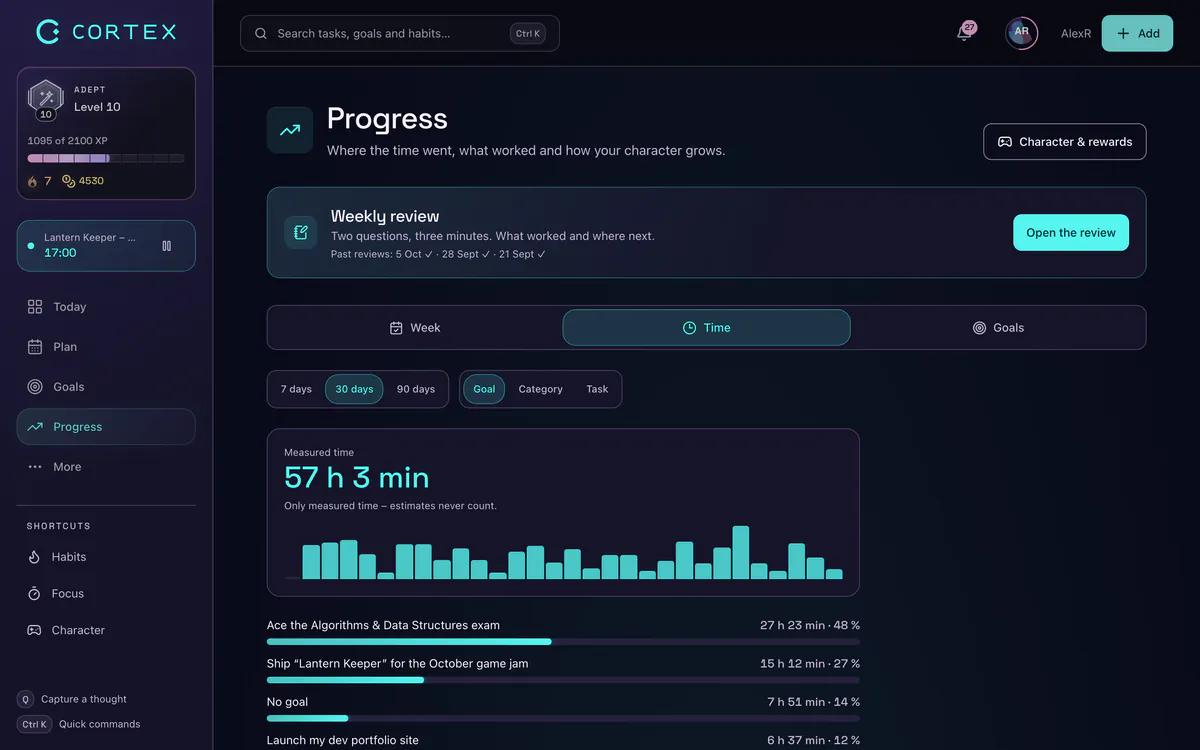
CORTEX doesn't store rates or do the money math – it gives you honest hours, and you divide (or export to a spreadsheet). After a month you will also know your real billable share, which is the most uncertain input in the calculator. More on the workflow in CORTEX for freelancers and the time tracking app.
How to raise your billable share (without working more)
- Batch admin. Email, invoicing and bookkeeping in one or two fixed blocks a week instead of all day. See time blocking.
- Protect deep work. Billable creative work happens in long focus blocks; a 50-minute focus timer helps. See deep work and the free Pomodoro timer.
- Charge for revisions and calls. Put the number of revision rounds in the contract.
- Plan the day in one click. Less time deciding what to do next means more time doing it – that's the idea behind Plan My Day.
- Drop the lowest effective-rate clients once your tracking shows who they are.
Frequently asked questions
How can I calculate my hourly rate?
Take your desired annual take-home income, divide it by (1 − your tax rate), add yearly business expenses, then divide by the number of hours you can bill in a year. The calculator on this page does it for you and also shows a day rate and monthly revenue target.
What is a good hourly rate for a freelancer or contractor?
There is no universal number: it depends on your market, skills, taxes and costs. Start from the minimum rate the calculator gives you, then compare it with market rates for your field and charge the higher of the two.
How many billable hours does a freelancer have per year?
Far fewer than 2,080. With 6 weeks off, 5 sick days, 8-hour days and 60 % billable time, it is about 1,080 hours. Track your time for a few weeks to find your own number.
How do I convert my salary to a contractor hourly rate?
Use your current net salary as the take-home income, then add your expected taxes and contributions, business costs and unpaid time off. Simply dividing a salary by 2,080 hours typically understates the rate you need by a large margin.
Is this hourly rate calculator free and private?
Yes. It is free with no sign-up, runs entirely in your browser and does not send or store anything you enter. The currency selector only changes the symbol.
Does this calculator give tax advice?
No. The tax percentage is a single placeholder you can edit; real taxes depend on your country, income and deductions. Check your numbers with an accountant or your tax authority.
Sources and further reading
Level up your life
CORTEX is free for everyone. Tasks, a one-click day plan, time tracking, habits and rewards in one system – on desktop and mobile.
CREATE A FREE ACCOUNT