Does the Pomodoro Technique work? An honest look at the evidence
Does the Pomodoro Technique work? Mostly yes as a way to get started and to make sure you actually take breaks, and short breaks themselves have decent evidence for reducing fatigue. But the claim that a fixed 25/5 schedule beats taking breaks when you feel like it is shaky: the direct research is a handful of small, recent studies, and their results point in different directions. Nobody has shown that Pomodoro boosts output by a specific percentage. Below is what each study found, why the method works for some people and fails for others, and a two-week experiment you can run on yourself.
- Only a few controlled studies have tested Pomodoro-style breaks directly, all with university students, all small (87 to 176 participants) and all short (one session or one day).
- Biwer et al. (2023) found that fixed 24/6 breaks went with less fatigue and more motivation than self-chosen breaks, with the same task completion in less time.
- Smits, Wenzel & de Bruin (2025) found no overall differences between 25/5 Pomodoro, self-chosen and Flowtime breaks, and Göksu et al. (2026) found self-chosen breaks led to better mood.
- A 2022 meta-analysis of micro-breaks found small benefits for vigor and fatigue, but no significant effect on overall performance (Albulescu et al.).
- Popular figures like "Pomodoro increases productivity by 25%" have no traceable research source.
The short answer: what the evidence supports
The Pomodoro Technique, created by Francesco Cirillo, is simple: pick one task, work on it for 25 minutes, take a 5-minute break, and take a longer break after four rounds. If you need the full how-to, read our Pomodoro Technique guide. This page is about a narrower question: does it actually do anything?
Here is the evidence, claim by claim:
| Claim | What the research says | Strength |
|---|---|---|
| Short breaks reduce fatigue | A meta-analysis of 22 study samples found small but significant effects on vigor and fatigue (Albulescu et al., 2022). | Moderate |
| Short breaks raise overall performance | The same meta-analysis found a small, non-significant effect on performance. | Weak |
| Fixed Pomodoro breaks beat self-chosen breaks | One study says yes (Biwer et al., 2023), one found no overall difference (Smits et al., 2025), one favored self-chosen breaks for mood (Göksu et al., 2026). | Mixed |
| Pomodoro helps you stop procrastinating | Plausible and widely reported, but we found no controlled trial that tests it directly. | Untested |
| "Pomodoro boosts productivity by 25%" | No traceable study behind the number. | Myth |
So the honest verdict is: breaks help, structure helps many people start, and the exact 25/5 rhythm is a reasonable default rather than a scientifically optimal setting.
What the studies actually found
Biwer et al. (2023): fixed breaks vs. self-chosen breaks
Researchers in the Netherlands ran a one-day study with 87 bachelor's and master's students at a Dutch university, during their real self-study. Students were randomly assigned to one of three conditions: take breaks whenever they wanted (35 students), take a 6-minute break after every 24 minutes of study (25 students, the "Pomodoro" condition), or take a 3-minute break after every 12 minutes (27 students).
Students who chose their own breaks studied in longer stretches and took longer breaks. That went with more fatigue and distractedness and lower concentration and motivation than in the fixed-break groups. There was no difference in mental effort or in how much of their planned work students finished, so the fixed-break groups reached similar completion in less time. Note the details: 24/6, not 25/5, and one day, not a semester.
Smits, Wenzel & de Bruin (2025): Pomodoro vs. Flowtime vs. free breaks
A follow-up study with 94 university students compared three ways of taking breaks during a two-hour study session: self-regulated breaks (25 students), classic 25/5 Pomodoro (36), and Flowtime (33), where you stop when you want and your break length depends on how long you worked.
Fatigue rose faster in the Pomodoro group, and motivation dropped faster with both Pomodoro and Flowtime than with self-chosen breaks. But those slopes did not add up to overall differences in fatigue or motivation, and the groups did not differ in productivity, task completion or flow. In plain English: in this study, the method you used mattered less than the marketing suggests.
Göksu, Wiradhany & de Bruin (2026): a larger replication attempt
The largest study so far had 176 students read a text on climate change, rate their mood repeatedly and take a comprehension test, with either systematic short breaks or self-chosen ones. Performance did not differ significantly (the authors note their test may not have been sensitive enough). This time, self-chosen breaks led to more positive mood, including more energy, concentration and motivation, and less distraction. The authors suggest that flexibility may matter and that the effect of fixed breaks may depend on their exact timing and length.
Reviews: thin ground
A 2025 scoping review by Ogut in BMC Medical Education mapped 32 studies on the Pomodoro Technique and reported, among other things, roughly 20% lower fatigue with structured intervals. Read that number carefully: it is a scoping review, not a meta-analysis; only three of its studies were randomized trials, and those add up to just 87 participants. None of the studies looked at anatomy, the subject the review set out to examine. It is a useful map of the literature, not proof.
Why breaks help at all
Two lines of research explain why stopping on schedule might help even if 25 minutes is not magic:
- Brief goal switches keep you sharp. In a lab experiment, Ariga and Lleras (2011) found that people's performance on a long, monotonous attention task steadily declined, but when they were asked to switch briefly to another task from time to time, the decline did not appear. Their explanation: the brain gets used to a goal held for too long, and a short break "resets" it.
- Micro-breaks help how you feel more than what you produce. Albulescu et al. (2022) pooled 22 study samples with 2,335 people. Breaks of up to 10 minutes had small, significant effects on vigor (d = 0.36) and fatigue (d = 0.35), but the effect on overall performance (d = 0.16) was not significant. Performance gains showed up mainly on less demanding tasks, and longer breaks went with bigger gains. The authors suggest that very draining work may need more than a 10-minute break.
Together, that supports regular breaks for staying fresh. It does not support the idea that any particular timer will make you produce more.
Why it works when it works
If the research on output is mixed, why do so many people swear by Pomodoro? Because most people's real problem is not stamina. It is starting, and staying on one thing. The method targets exactly that:
- It shrinks the start. "Write the report" is scary. "Work on the report for 25 minutes" is a small promise you can keep. That is the same reason our guide on how to stop procrastinating recommends tiny first steps.
- It makes time visible. A countdown turns a vague afternoon into units you can see disappearing.
- It adds a deadline. A ticking clock creates mild urgency, which helps when a task has no real deadline yet.
- It gives distractions a parking spot. Cirillo's rule is to write down interruptions and deal with them later. That turns "I should check that now" into "it's on the list".
- It guarantees the break. You don't have to decide when you deserve rest, which also removes guilt from resting.
Why Pomodoro doesn't work for some people
If you've tried it and hated it, you are not doing it wrong. These are the usual reasons it fails:
- It breaks your flow. Programmers, writers and designers often need 20 minutes just to load the problem into their head. A bell at minute 25 can throw that away. Try 50/10, or protect longer blocks with deep work sessions.
- Your job is reactive. Support, retail, parenting and on-call work interrupt you by design. Use pomodoros only for the protected gaps.
- 25 minutes is the wrong size. On a bad day it is too long to start; on a good day it is too short. The 2026 study above hints that flexibility may matter more than the exact number.
- Your breaks are on your phone. Five minutes of scrolling rarely stays five minutes, and it pulls you into a new context. Stand up, drink water, look out of the window.
- Fatigue builds up. In Smits et al. (2025), fatigue rose faster with strict 25/5. If you feel drained after three rounds, take the long break earlier.
- No task is chosen. The timer measures focus. It doesn't decide what to focus on.
Does Pomodoro work for ADHD?
Many people with ADHD say short, timed sprints are one of the few things that help them start boring tasks. The reasons make sense: a visible countdown gives external structure, makes time concrete for people who struggle to feel it passing (often called "time blindness"), and turns an open-ended task into a short one with a clear end.
But be clear about the evidence: the studies above were done with general student samples, and we could not find a controlled trial of the Pomodoro Technique specifically in people with ADHD. So treat it as a practical tool to test, not a treatment. Variations people with ADHD often find easier:
- Shorter sprints (10 to 15 minutes) to get started, then lengthen them once you are moving.
- Body doubling: working alongside someone else, in person or on a video call, during the same timer.
- A visible timer in your line of sight, rather than one hidden in a tab.
- A reward at the end of a set of sprints, ideally one you chose in advance. Our dopamine menu guide has ideas for breaks that don't swallow your afternoon.
This is not medical advice, and CORTEX is not a medical device. If you think you have ADHD, talk to a qualified healthcare professional; the NIMH ADHD page is a good starting point. More practical ideas are on our ADHD planner page.
Pomodoro vs. 52/17 vs. 90-minute blocks
You will see three popular rhythms recommended online. Here is how much is actually behind each one:
| Rhythm | Where it comes from | Evidence | Good for |
|---|---|---|---|
| 25 / 5 (Pomodoro) | Francesco Cirillo's method, developed from the late 1980s | A few small studies with mixed results (see above) | Starting, studying, admin, tasks you avoid |
| 52 / 17 | A time-tracking company's analysis of its own users' data | No peer-reviewed study | People who like longer sessions and long breaks |
| 90 / 15–20 | Based on the "basic rest-activity cycle" idea from sleep research (Nathaniel Kleitman) | Weak: the evidence that a 90-minute cycle governs daytime focus is limited | Writing, coding, design, deep work |
| Flowtime | Work until focus fades, then rest in proportion | One study, no clear advantage (Smits et al., 2025) | Experienced people who know their rhythm |
None of these numbers is a law of nature. A sensible rule: use short blocks to start and for shallow work, long blocks for work with a long warm-up, and plan bigger chunks of the day with time blocking. Then test which length works for you, as shown below.
How to test it on yourself in 2 weeks
Since the research can't tell you what works for you, run a small experiment. It takes no extra time, just a little logging.
- Pick comparable work. Use the same type of task in both weeks: studying, writing, coding or admin.
- Week A: 25/5. Work in classic pomodoros with a long break after four.
- Week B: 50/10. Same tasks, longer blocks.
- Log three things every day: focus blocks completed, tasks finished, and how drained you feel at the end of the day (1 to 5).
- Compare at the end. More finished tasks and lower fatigue win. If the results are close, pick the rhythm you enjoyed more, since that is the one you will keep using.
| Day | Rhythm | Blocks done | Tasks finished | Drained (1–5) |
|---|---|---|---|---|
| Mon | 25/5 | 6 | 3 | 3 |
| Tue | 25/5 | 8 | 4 | 4 |
| … | … | … | … | … |
| Mon | 50/10 | 3 | 3 | 2 |
Example rows only, to show the format.
Two rules keep the test fair: don't change rhythms mid-week, and don't count a block you abandoned halfway.
Running the experiment in CORTEX
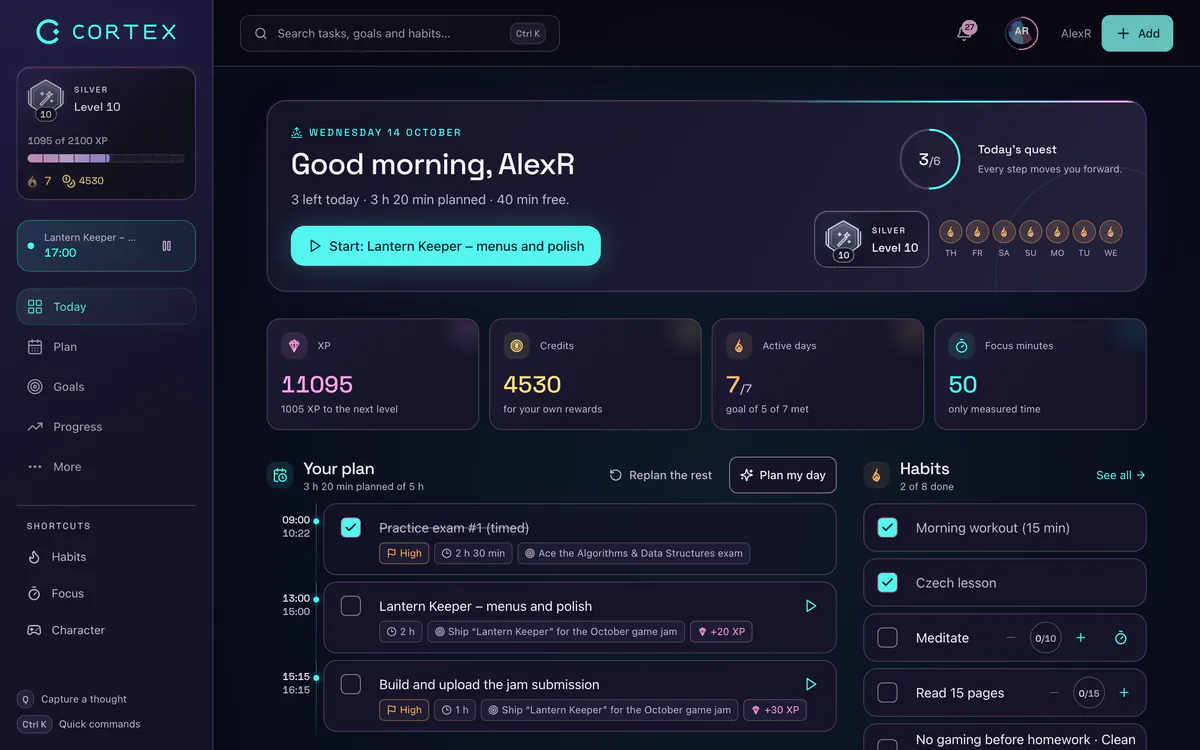
CORTEX is a free gamified productivity app with tasks, a one-click day plan, time tracking and habits, plus XP, levels and real-life rewards. It has what you need for the experiment:
- Focus countdown in the top bar: 15, 25 or 50 minutes, with a progress bar, optional ambient sounds and an in-app notification when time is up. That covers week A and week B.
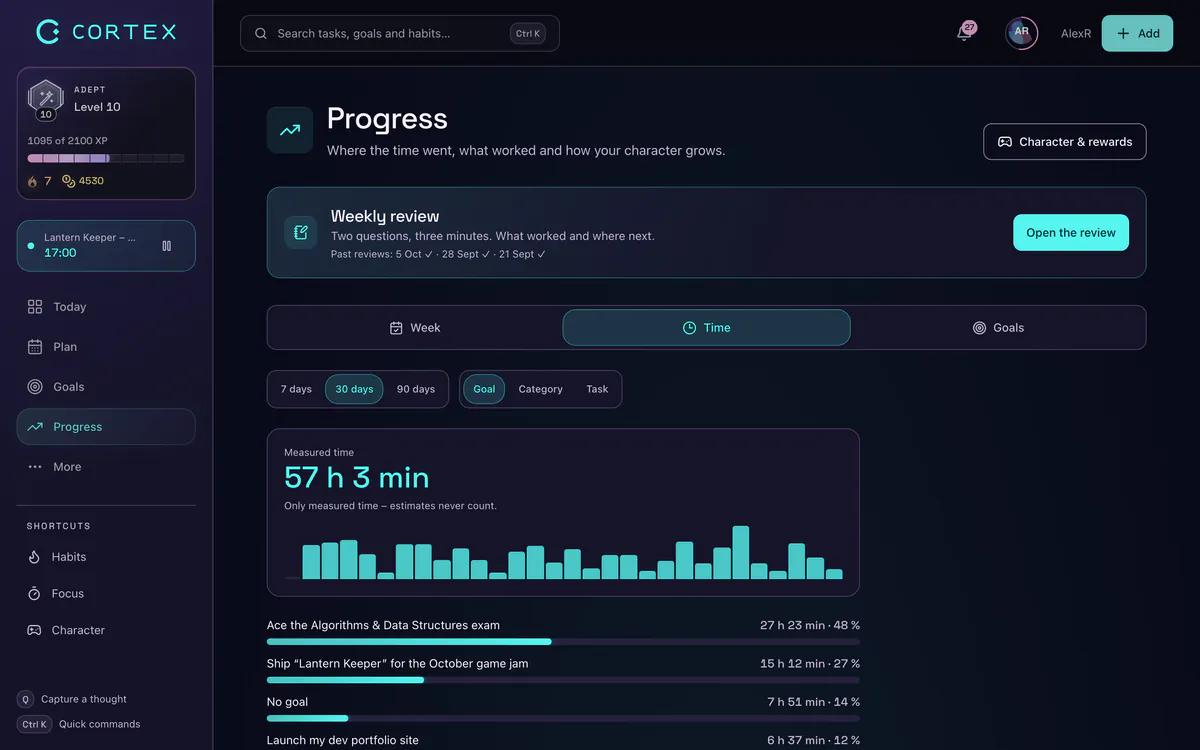
- Named work timers: start a timer like "Thesis" or "Client work" on the Today screen. Those minutes go into your reports. The countdown itself is not logged, so run a work timer alongside it if you want records.
- Estimate vs. time spent: give each task an estimate and compare it with the time you actually tracked. That is a second, sneaky result of the experiment: how good your estimates are.
- Reports: compare hours per timer and tasks finished for each week, and export to CSV or PDF.
- XP comes from finished tasks, not minutes, so the game rewards what you get done rather than how long you sat at the desk.
Prefer a separate tab? Our free online Pomodoro timer works without an account. For tracking hours across projects, see the time tracking app page, and for more ways to stay on task, read how to focus.
Pomodoro® is a registered trademark of Francesco Cirillo. CORTEX is not affiliated with or endorsed by its owner.
Frequently asked questions
Does the Pomodoro Technique actually work?
It works well for many people as a way to start tasks and to make sure they take breaks, and short breaks have decent evidence for reducing fatigue. Whether a fixed 25/5 schedule beats taking breaks when you choose is unclear: small studies from 2023 to 2026 point in different directions, and none shows a reliable boost in output.
Is the Pomodoro Technique scientifically proven?
Not in a strong sense. A few small, short studies with university students have tested Pomodoro-style breaks, with mixed results, and a 2025 review notes the evidence base is thin. The broader research on micro-breaks supports taking regular short breaks for energy and fatigue, but not for higher performance.
Why doesn't Pomodoro work for me?
Common reasons are that 25 minutes interrupts your flow, your work is too reactive for fixed blocks, your breaks turn into phone time, or you start the timer without a clear task. Try 50/10 blocks for deep work or 15-minute blocks to get started, and test each version for a week.
Does Pomodoro work for ADHD?
Many people with ADHD find short, timed sprints helpful because a visible countdown gives structure and makes time feel concrete. There are no controlled trials we know of on Pomodoro specifically in ADHD, so treat it as a tool to test, not a treatment, and talk to a healthcare professional about ADHD itself.
Is 25 minutes the best length for a pomodoro?
There is no evidence that 25 minutes is optimal. It is a good default for starting and for shallow work; many people do better with 50-minute blocks for writing or coding, or with 15 minutes on low-energy days. Pick one length per week and compare.
Pomodoro or 90-minute blocks?
Use Pomodoro for getting started, studying and admin, and longer 60 to 90-minute blocks for work with a long warm-up like writing or programming. The 90-minute rhythm is based on a sleep-research idea with weak evidence for daytime work, so judge it by your own results.
Sources and further reading
- Biwer, Wiradhany, oude Egbrink & de Bruin (2023): Understanding effort regulation – comparing "Pomodoro" breaks and self-regulated breaks, British Journal of Educational Psychology
- Smits, Wenzel & de Bruin (2025): Investigating the effectiveness of self-regulated, Pomodoro, and Flowtime break-taking techniques among students, Behavioral Sciences
- Göksu, Wiradhany & de Bruin (2026): When to take a break – systematic short (Pomodoro) vs. self-regulated breaks, Behavioral Sciences
- Ogut (2025): Assessing the efficacy of the Pomodoro technique in enhancing anatomy lesson retention – a scoping review, BMC Medical Education
- Ariga & Lleras (2011): Brief and rare mental "breaks" keep you focused, Cognition
- Albulescu et al. (2022): "Give me a break!" A systematic review and meta-analysis on the efficacy of micro-breaks, PLOS ONE
- Pomodoro Technique – official site (Francesco Cirillo)
- NIMH: Attention-Deficit/Hyperactivity Disorder
Level up your life
CORTEX is free for everyone. Tasks, a one-click day plan, time tracking, habits and rewards in one system – on desktop and mobile.
CREATE A FREE ACCOUNT