How to study for exams: questions and review
Start exam preparation by checking the required scope and trying one question without your notes. Check the answer, identify what needs work and schedule another opportunity to practise. The methods and sample 14-day plan below are options to adapt to your assessment, rather than a promise that one timetable suits every exam.
- Test yourself: recalling material from memory helps you keep it far better than rereading (Roediger & Karpicke, 2006).
- Space it out: several short sessions over days beat one long session the night before (Cepeda et al., 2006).
- Mix question types once you know the basics; it is harder, but you learn to choose the right method (Rohrer & Taylor, 2007).
- Rereading and highlighting feel productive but rank low in a large review of study techniques (Dunlosky et al., 2013).
- Ten minutes of writing about your worries before an exam improved results for anxious students (Ramirez & Beilock, 2011).
Why rereading your notes is not enough
Rereading feels like studying. The text becomes familiar, the highlighted lines look reassuring, and you leave the desk with a sense of progress. The problem is that familiarity is not the same as being able to recall something on a blank exam sheet.
John Dunlosky and colleagues (2013) reviewed ten popular study techniques and rated how well each is supported by research. Rereading, highlighting and summarising got low ratings. Two techniques came out on top: practice testing and distributed practice (spacing). Both are uncomfortable because they show you what you do not know yet. That discomfort is the point.
Four methods that work
1. Test yourself
Close the book and try to recall: write down everything you remember about a topic, answer practice questions, use flashcards or explain the topic out loud to an imaginary friend. Then check and fill the gaps. In a classic experiment by Henry Roediger and Jeffrey Karpicke (2006), students who tested themselves on a text remembered clearly more a week later than students who spent the same time rereading it.
2. Space your study
Four one-hour sessions spread over two weeks beat one four-hour session the evening before. Cepeda and colleagues (2006) pooled hundreds of experiments and found this spacing effect consistently. Plan to meet each topic at least three times: learn it, review it a few days later, review it again near the exam. Spaced repetition explains the intervals.
3. Mix it up
Once you know the basics, practise different types of problems in one session instead of twenty of the same kind. In a study by Doug Rohrer and Kelli Taylor (2007), students who practised mixed maths problems scored much better on a later test, because in the exam you also have to recognise which method a question needs.
4. Sleep
Sleep is when the brain consolidates what you learned during the day (Diekelmann & Born, 2010). An all-nighter trades the memory of everything you studied for a few more hours of tired reading. Keep your normal bedtime, especially the night before the exam.
A 14-day exam study plan
Assuming one exam and about two hours a day. Adjust the numbers if you have more topics or less time.
- Day 1 – Map the material. List all topics or chapters. Mark each 1 (I know it), 2 (partly) or 3 (new to me). Collect old exam papers or practice questions.
- Days 2–7 – Learn each topic once. Start with the 3s. Short blocks (25 + 5 minutes), each ending with a self-test. Note every question you could not answer.
- Day 8 – First review. Go through all topics by testing yourself, not by reading. Spend most time on what you missed.
- Days 9–11 – Mixed practice. Practice questions from different topics in one session. Re-learn what is still weak.
- Day 12 – Practice exam. An old paper or your own questions, timed, without notes. Mark it honestly and list the gaps.
- Day 13 – Close the gaps. Only the topics the practice exam exposed. Finish early.
- Day 14 – Light day. Skim your list of questions, prepare your things (ID, pens, calculator) and go to bed at your usual time.
Less time than 14 days? Keep the shape: map, learn with testing, one review, one practice exam, a light last day. If you need a schedule for a whole semester rather than one exam, see the study schedule guide.
Continue with the wider guide: Sleep and study planning: protect your focus. Try the focused follow-up: Winter exam study schedule: plan around breaks.
How to stay calm before and during the exam
- Write your worries down. Gerardo Ramirez and Sian Beilock (2011) asked students to spend ten minutes writing about their thoughts and feelings about an upcoming test. Anxious students who did this performed better than anxious students who did not.
- Practise under exam conditions. A timed practice exam makes the real one feel familiar.
- Breathe slowly when you freeze. A few slow breaths with a longer exhale can take the edge off. How to calm down fast has short techniques.
- Start with what you know. In the exam, read all the questions, answer the easiest first and come back to the hard ones.
What to skip
- Copying out notes in nicer handwriting. It looks like work and feels calming, but it is mostly rereading with a pen.
- Marathon sessions. After about an hour without a break, attention drops. Short blocks with breaks get more done; the Pomodoro technique is a simple rhythm.
- Studying with your phone on the desk. Put it in another room. Every glance pulls you out of the material.
- Waiting for motivation. Start with five minutes on the easiest topic; motivation usually comes after starting. More in how to get motivated to study.
Plan your exam in CORTEX
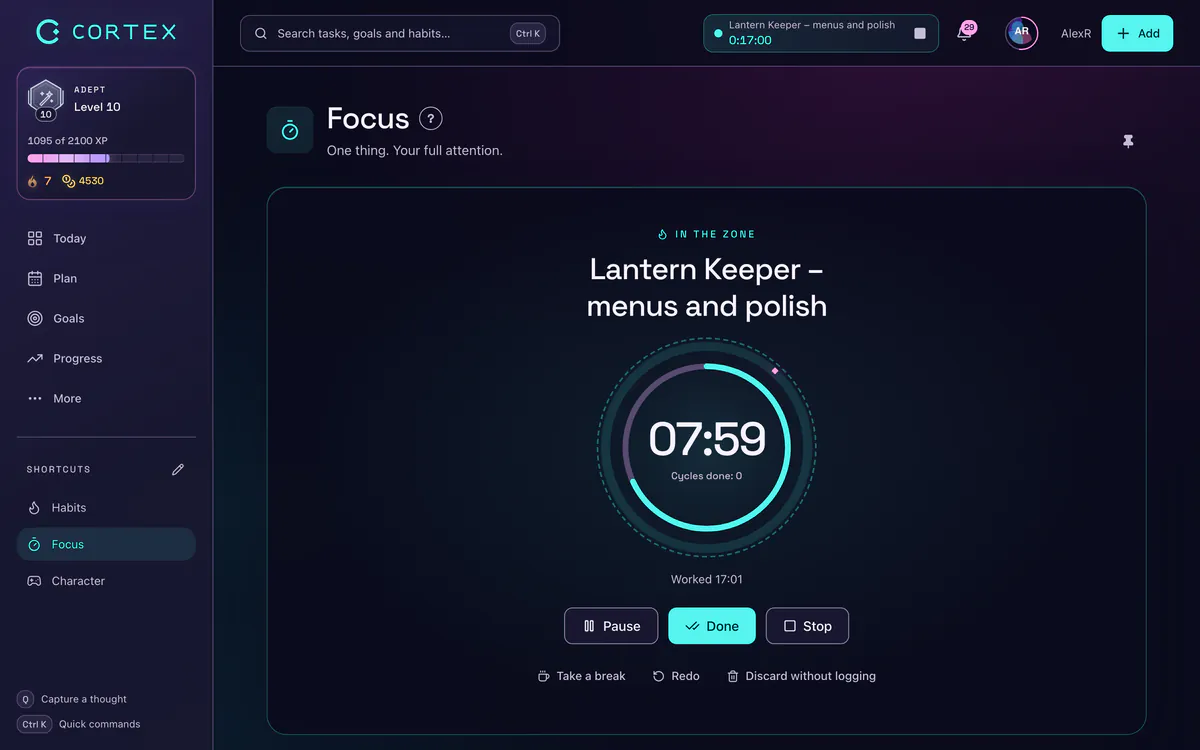
The Exam season template in CORTEX (free for everyone) builds this plan for you: a goal for the exam, a task to split the material into topics, study blocks of 25 + 5 minutes in your calendar, reviews before the exam, a practice test, a calm last day and a bedtime habit. Run the focus timer on each block and tick off the reviews as you go. If you have an account, open the Exam season template. For students who want the whole semester in one place, see the study planner app.
Frequently asked questions
What is the most effective way to study for exams?
Testing yourself and spacing your study over several days. Both are among the best-supported methods in learning research. Close your notes, recall what you can, check the gaps, and return to each topic a few days later.
How many days before an exam should I start studying?
For a typical exam, around two weeks of daily sessions is a good target. Bigger exams with many topics need more. The key is meeting each topic at least three times before the exam day.
Is it better to study the night before or sleep?
Sleep. Sleep helps consolidate what you studied, and a tired brain recalls less. Review lightly in the evening and go to bed at your usual time.
How long should I study without a break?
Most people do well with 25 to 50 minutes of focus followed by a 5 to 10 minute break. After a few blocks, take a longer break.
How can I study for an exam in one day?
Prioritise: list the topics most likely to come up, test yourself on them first, learn what you miss, and do one timed set of practice questions. Then sleep. It will not replace two weeks, but it is better than rereading all night.
Sources and further reading
- Dunlosky, J., Rawson, K. A., Marsh, E. J., Nathan, M. J. & Willingham, D. T. (2013): Improving students’ learning with effective learning techniques – Psychological Science in the Public Interest
- Roediger, H. L. & Karpicke, J. D. (2006): Test-enhanced learning: Taking memory tests improves long-term retention – Psychological Science
- Cepeda, N. J., Pashler, H., Vul, E., Wixted, J. T. & Rohrer, D. (2006): Distributed practice in verbal recall tasks: A review and quantitative synthesis – Psychological Bulletin
- Rohrer, D. & Taylor, K. (2007): The shuffling of mathematics problems improves learning – Instructional Science
- Ramirez, G. & Beilock, S. L. (2011): Writing about testing worries boosts exam performance in the classroom – Science
- Diekelmann, S. & Born, J. (2010): The memory function of sleep – Nature Reviews Neuroscience
Build a small study plan
Start from a ready-made study template and fit its tasks and study blocks to your timetable.
Build my study plan