How to make a study schedule that lasts all the way to the exam
A good study schedule starts from your exam dates and your real time, not from the textbook: list your exams, split the material into chunks of 25 to 50 minutes, work out how many hours a day you actually have, and spread a first pass, spaced reviews and practice tests across your calendar – with at least 20% kept free as a buffer. Learning research is unusually clear here: spaced practice and testing yourself are among the most effective techniques, while rereading and highlighting help little.
- Practice testing and spaced practice got the highest ratings in a review of study techniques; rereading and highlighting low ones (Dunlosky et al., 2013).
- Learning spread over several days is remembered much better than the same time crammed into one session (Cepeda et al., 2006).
- Students predict when they will finish work too optimistically, even when they know it took longer last time (Buehler et al., 1994).
- A concrete “when and where I’ll study” plan makes it more likely you actually start (Gollwitzer & Sheeran, 2006).
- The steps: deadlines, chunks, capacity with a buffer, first pass, spaced reviews, practice tests, a weekly re-plan.
Why study schedules fall apart
Most study schedules look great on day one. By week two they no longer fit, because they were built for an ideal student: eight hours a day, never tired, no other commitments. Roger Buehler and colleagues (1994) found that students consistently predict too optimistically when they’ll finish their work – even when they know it took longer last time.
The second mistake is about content: a plan that says “read chapters 1–10” schedules reading, not learning. John Dunlosky and colleagues (2013) compared ten popular techniques. Practice testing and spaced practice came out best; rereading and highlighting brought little. So a good schedule has more self-testing than reading.
A study schedule in seven steps
- List your exams and deadlines. Every exam, test and hand-in with its date. Sort them by date and mark how hard each one is (1–3).
- Split the material into chunks. Topics, chapters or lectures, sized so one chunk takes 25 to 50 minutes. Mark how well you know each (1 = not at all, 3 = well).
- Work out your real capacity. How many hours a day you actually study, not how many you’d like to. Subtract classes, work, travel and sleep. Plan only 80% of the result – the rest is a buffer for illness and delays.
- Plan the first pass. Go through every chunk once and test yourself without notes at the end of each block. Put the hardest subjects in the part of the day when you have the most energy.
- Add spaced reviews. For each chunk, plan a review a few days later, a week later and just before the exam. Review by testing, not rereading (more in spaced repetition).
- Schedule practice tests. A week and a few days before the exam, do an old paper or your own questions, timed and without notes. It shows your gaps while there’s still time to fill them.
- Re-plan once a week. Move what you didn’t finish into the buffer. When the buffer runs low, cut details – fewer new facts, more review of the essentials.
Example: an exam in 14 days
Statistics, 12 topics, two hours a day (four 25-minute blocks), six days a week:
- Days 1–6: first pass, two topics a day. Five questions from memory at the end of each block.
- Day 7: a day off or buffer.
- Days 8–10: review by testing, four topics a day. The ones marked 1 get the most time.
- Day 11: a timed practice test, then mark it and fill the gaps.
- Days 12–13: review weak topics, a second shorter test.
- Day 14: a light run through your own questions, nothing new, bed at your usual time.
Study schedule
Exam: ____________________ · Date: ____________ · Hours a day: ______
| Day | Subject and topic | Type: new / review / test | Done |
|---|---|---|---|
For the last two weeks before a test, follow the 14-day plan in how to study for exams, or let the study planner app schedule it from the exam date.
Paper, calendar or app?
- A paper table. Quick to fill in, hangs above your desk where you can see it. Weak spot: re-planning means rewriting it.
- A calendar. Study blocks next to classes and work, so you see right away whether the plan fits. Weak spot: it doesn’t show which topics you still don’t know.
- An app with tasks and a calendar. You plan reviews once and they remind you; moving unfinished blocks takes one tap. Weak spot: a plan on your phone tempts you to open something else “just for a moment” – so put the phone away while you study.
How to get started when you don’t feel like studying is covered in how to get motivated to study, and turning study into a game in how to gamify studying.
Common mistakes
- No buffer. The first cold or unexpected shift breaks it. Keep at least 20% free.
- Reading only. A page you’ve read feels learned until you try to quiz yourself.
- Everything in the last week. Crammed learning is remembered worse and eats into the sleep your brain needs to store it.
- No days off. One day a week without studying isn’t laziness – it’s a buffer and rest.
Try it now in CORTEX
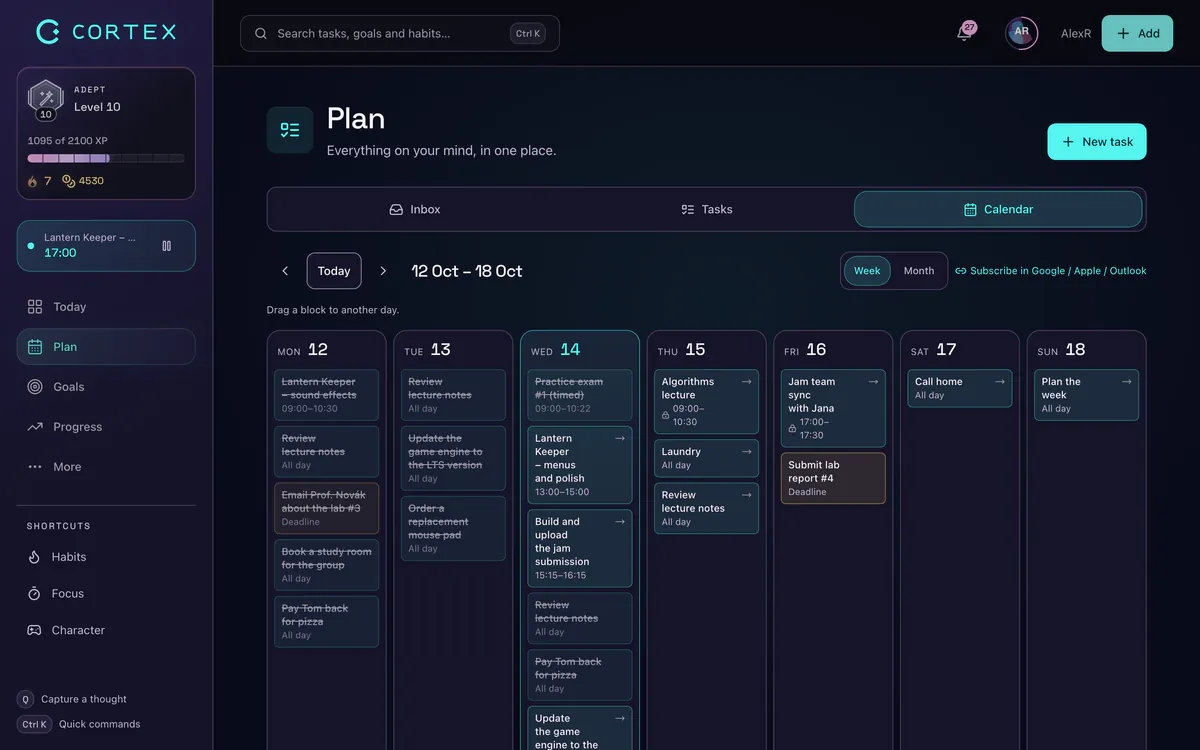
In CORTEX (free for everyone) the Exam season template (More → Templates) builds a plan for one exam: you enter the exam date, subject, the days you study, your start time and how many hours a day. The template creates a goal, study blocks, reviews 14, 7, 3 and 1 day before, a practice test and a bedtime reminder. You then run the blocks in Focus. If you have an account, open the Exam season template; for final exams there is “Final exams: the countdown”.
Frequently asked questions
How do I make a study schedule?
List your exams with dates, split the material into 25–50 minute chunks, work out how many hours a day you really have and plan only 80% of that. Spread a first pass, spaced reviews and a practice test across your calendar and re-plan once a week.
How many hours a day should I study for exams?
There’s no universal number. Two to four focused hours in blocks with breaks beat eight hours over a book. It depends on how much time you actually have and how many days are left.
When should I start studying for an exam?
Early enough for one full pass and at least two reviews a few days apart. For a typical exam that’s two to three weeks ahead; for hard or cumulative exams, earlier.
Is it better to study one subject or switch?
For memory it helps to spread reviews over several days, so switching subjects across the week makes sense. Within one block, stick to one topic so you’re not switching back and forth.
What if I fall behind my schedule?
Move unfinished blocks into the buffer and cut details, not reviews. Fewer new facts, more testing of the essentials. When the buffer is gone, decide which exam takes priority.
Sources and further reading
- Dunlosky, J., Rawson, K. A., Marsh, E. J., Nathan, M. J. & Willingham, D. T. (2013): Improving students’ learning with effective learning techniques – Psychological Science in the Public Interest
- Cepeda, N. J., Pashler, H., Vul, E., Wixted, J. T. & Rohrer, D. (2006): Distributed practice in verbal recall tasks: A review and quantitative synthesis – Psychological Bulletin
- Buehler, R., Griffin, D. & Ross, M. (1994): Exploring the “planning fallacy”: Why people underestimate their task completion times – Journal of Personality and Social Psychology
- Gollwitzer, P. M. & Sheeran, P. (2006): Implementation intentions and goal achievement: A meta-analysis of effects and processes – Advances in Experimental Social Psychology
Build a small study plan
Start from a ready-made study template and fit its tasks and study blocks to your timetable.
Build my study plan