Yearly plan for 2027: goals and monthly reviews
Start a yearly plan with a short look back and a choice of the areas that matter now. For each goal, define a recognisable result, one next action and a time to review the plan. The one-page template below is an adaptable example rather than a guarantee that your goals will last or be achieved.
- Specific, challenging goals lead to better results than “do your best” (Locke & Latham, 2002).
- Resolutions to start something succeeded more often than resolutions to stop: 59% vs 47% after a year (Oscarsson et al., 2020).
- People who regularly monitor and record their progress reach their goals more often (Harkin et al., 2016).
- Fresh starts – a new year, month or even a Monday – boost the urge to change (Dai et al., 2014). You don’t have to wait for January.
- A one-page plan: look back, three areas, at most three goals with a number, quarters, a monthly check-in.
Why yearly plans don’t last
In January you write ten goals, in February you remember three, and by March you don’t know where the paper went. The usual reasons: too many goals, vague ones (“be healthier”), no number to track progress, and nobody comes back to them during the year.
Edwin Locke and Gary Latham (2002) summarised 35 years of research: a specific, challenging goal leads to better results than a general “I’ll do what I can”. Martin Oscarsson and colleagues (2020) followed over a thousand people with New Year’s resolutions. After a year, those who set out to start something were more successful (59%) than those who wanted to stop something (47%).
A yearly plan in six steps
- Look back at the year (15 minutes). What went well? What drained you most? What do you want more of next year, and less of? No judgement, just notes.
- Choose three areas. For example health, work, relationships, learning, money, home. Three, not seven. The other areas you simply maintain.
- One goal per area, at most. Phrase it as something you move towards: “Run a half marathon” rather than “stop being lazy”. Add why it matters to you.
- Add a number. How will you know at the end of the year that it worked? “50 workouts”, “4 new clients”, “24 books”. The number isn’t a whip, it’s a compass.
- Split the year into quarters. For each goal, write where you want to be at the end of March, June, September and December. Three months is something you can see across; twelve isn’t.
- Schedule a monthly check-in. Fifteen minutes on the first Sunday of the month: note the current number, what helped, what got in the way, what to adjust. Harkin and colleagues (2016) showed that regularly monitoring and recording progress makes reaching a goal more likely.
A one-page yearly plan to print
Print it, fill it in and hang it where you’ll see it. At the end of each quarter, write the actual number next to the planned one:
Plan for 2027
What went well in 2026: ________________________________ · Why these goals matter to me: ________________________________
| Area and goal | Number by year end | Q1 | Q2 | Q3 | Q4 |
|---|---|---|---|---|---|
| 1. | |||||
| 2. | |||||
| 3. |
Try the focused follow-up: Year-end task triage: finish, renegotiate, defer. New Year’s resolutions that survive an ordinary week. A gentle year review: questions that lead to one useful choice.
When to start: you don’t have to wait for January
Hengchen Dai, Katherine Milkman and Jason Riis (2014) described the fresh start effect: after “landmarks” in the calendar – a new year, a new month, a Monday, a birthday – people are more likely to start a change. January helps, but the first Monday of November works just as well.
Practical tip: build your plan in December, when you have time to look back, and schedule the first steps for the first week of January. That way you won’t be starting from a blank page on 1 January.
Common mistakes
- Too many goals. Five goals means none gets time in a busy week. Three is enough.
- A goal without a number. “Read more” can’t be checked. “24 books” can.
- No first step. A goal without a step for this week stays a wish. For each goal, write what you’ll do in the first seven days.
- A plan that never changes. The monthly check-in exists so you can adjust – shrink, move or swap a goal. That’s not failure; that’s steering.
- Only “stop” goals. If you want to cut something back, phrase what you’ll do instead.
Try it now in CORTEX
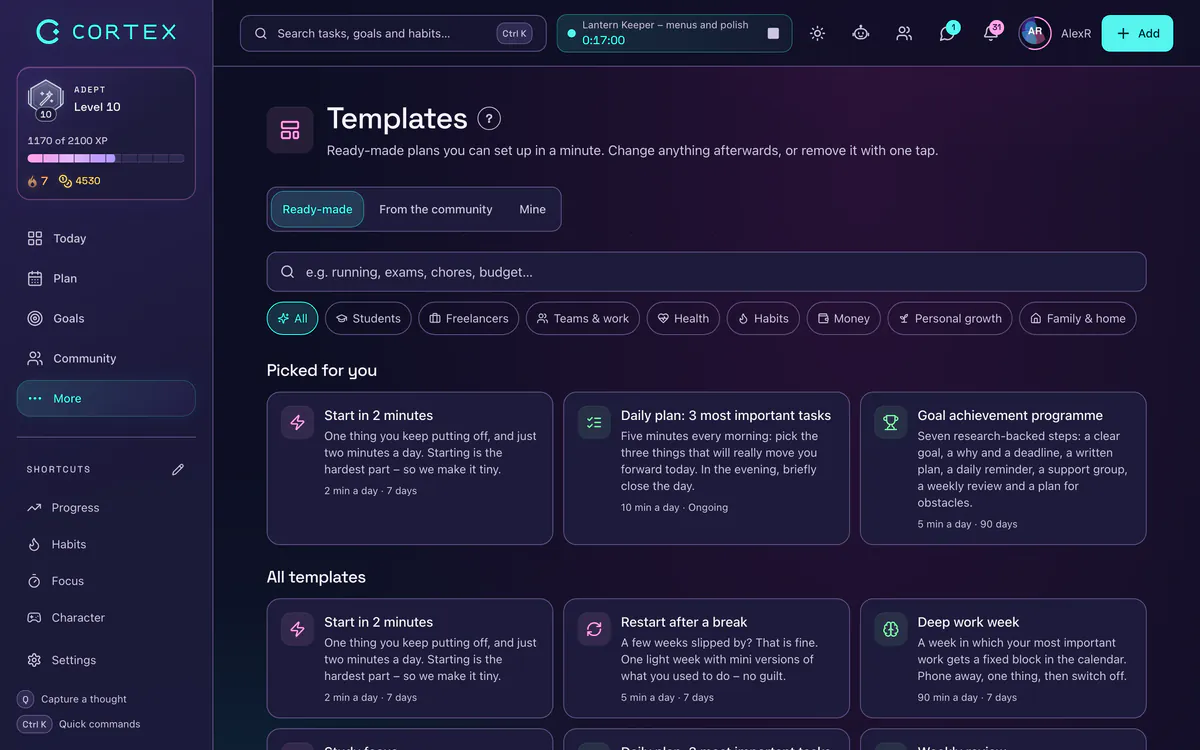
In CORTEX (free for everyone) the Year plan with measurable results template (More → Templates) builds the plan: you name your main goal, choose what you’ll measure and how much over the year, and optionally add a second goal. The template creates a goal with a number, quarterly milestones, a task to write down why the goal matters to you and a monthly check-in. You then see progress in Goals, with a vision board next to them if you like. If you have an account, open the Year plan template.
Plan January in December using an ordinary week
Check the real return to work or study and the fixed January dates first. Include travel, care and rest before choosing one opening action. Holiday availability is not a capacity estimate for the whole month. Keep detailed exam preparation in the existing study schedule and bring only the important outcome into the annual overview. Before a break, leave one return note: current project state, missing information and the first document to open. You do not need to settle all twelve months in December. Other ambitions can remain possibilities for a later review rather than simultaneous January commitments.
Frequently asked questions
How do I make a plan for the year?
Look back at the past year, choose three areas and at most one goal in each, add a number to each goal that tells you you’ve succeeded, split it into quarterly milestones and schedule fifteen minutes of review every month.
How many goals should I set for a year?
Three at most, ideally in different areas. More goals won’t fit into an ordinary week and start competing with each other. The other areas you simply maintain.
When should I start planning next year?
Ideally in December, when there’s time to look back. Then schedule the first steps for the first week of January. But you can start a plan any time – a new month or a Monday works as a fresh start too.
Why do my New Year plans never last?
Most often because there are too many, they are vague, they have no first step and nobody returns to them during the year. Fewer goals, a number for each and a monthly check-in help.
Which is better: a yearly or a quarterly plan?
Both. The yearly plan sets the direction; quarterly milestones are close enough to see and adjust. Many people set yearly goals and refine the plan for the next three months every quarter.
Sources and further reading
- Locke, E. A. & Latham, G. P. (2002): Building a practically useful theory of goal setting and task motivation: A 35-year odyssey – American Psychologist
- Oscarsson, M., Carlbring, P., Andersson, G. & Rozental, A. (2020): A large-scale experiment on New Year’s resolutions: Approach-oriented goals are more successful than avoidance-oriented goals – PLOS ONE
- Harkin, B., Webb, T. L., Chang, B. P. I. et al. (2016): Does monitoring goal progress promote goal attainment? A meta-analysis of the experimental evidence – Psychological Bulletin
- Dai, H., Milkman, K. L. & Riis, J. (2014): The fresh start effect: Temporal landmarks motivate aspirational behavior – Management Science
Turn a goal into next steps
Write the goal, add the first step and watch progress grow with every task you finish.
Set my first goal