How to stop doomscrolling: eight steps against the endless feed
The most reliable way to scroll less is to change your environment, not your willpower: find out when and why you reach for the phone, hide the tempting apps from your home screen and log out of them, have a replacement ready for bored moments and charge the phone outside the bedroom at night. An endless feed has no natural stopping point, so “one more video” easily turns into an hour. Research shows that decisions made in advance – limits, friction and a grayscale screen – help far more than resisting in the moment.
- The feed is built to have no end. The problem isn’t you – it’s that there is no point where you naturally stop.
- About a third of social media use comes from self-control problems, according to an experiment; limits set in advance reduced use (Allcott et al., 2022).
- A grayscale screen cut students’ phone time by tens of minutes a day (Holte & Ferraro, 2020).
- Using the phone in bed is linked with worse sleep and more fatigue (Exelmans & Van den Bulck, 2016).
- Eight steps: trigger, friction, grayscale, replacement, a question before unlocking, phone out of reach, an evening cut-off, clean evenings.
Why you can’t stop scrolling
A book has a last page, a series episode has an ending. A feed has neither. Every swipe might bring something interesting, and because you never know when, your brain keeps trying. Add tiredness: in the evening, when you have the least energy, scrolling is the easiest way to “rest” – even though you aren’t really resting.
In a large experiment, Hunt Allcott, Matthew Gentzkow and Lena Song (2022) estimated that roughly a third of social media use comes from self-control problems – people themselves wanted to spend less time on their phones. When they could set a limit in advance, their phone time dropped. So don’t look for a stronger will; look for decisions you make before the phone is in your hand.
Eight steps to stop doomscrolling
- Find your trigger. For two days, note when you reach for the phone: boredom, waiting, an unpleasant task, loneliness, bed. The trigger is where you can step in.
- Add friction. Move the apps you scroll most into a folder on your last screen, log out of them and turn off their notifications. A few extra seconds are enough to make a decision.
- Switch on grayscale. Colour makes the feed more tempting. In an experiment by Holte and Ferraro (2020), a grayscale screen cut students’ phone time by tens of minutes a day.
- Plan a replacement. Keep something else at hand for bored moments: a book, a short walk, a stretch, a podcast. Ideas in the dopamine menu.
- Ask a question before you unlock. “Why am I picking up the phone right now?” If you have an answer (a message, a map, a payment), do it and put the phone down. If you don’t, that’s the trigger.
- Keep the phone out of reach when you work or study. In another room or in your bag, not face down on the desk. You’ll save yourself dozens of little checks.
- Set an evening cut-off. From a set time, the phone charges in the hallway or kitchen. People who use the phone in bed sleep worse and feel more tired, according to Liese Exelmans and Jan Van den Bulck (2016).
- Count clean evenings, not minutes. Tick off every evening without scrolling in bed. If one goes wrong, you don’t start from zero – you carry on the next evening.
Scrolling in bed at night
The most common and most costly scrolling is the last one: in bed, with “just five minutes”. It costs twice – you lose sleep and start the next morning tired. Often it’s also bedtime procrastination: the day was full of obligations and the evening phone is the only time that’s just yours.
- Take your me-time earlier. Half an hour of something enjoyable before you go to the bathroom.
- Give your brain a different end to the day. A short evening routine: prepare tomorrow, wash up, a few pages of a book.
- A simple alarm clock. It removes the most common excuse for keeping the phone by the bed.
What doesn’t work
- Deleting everything and starting a new life tomorrow. A sudden ban usually lasts a few days. Smaller changes that stick are better.
- Guilt. Feeling bad after an hour of scrolling worsens your mood – and a low mood is a common trigger for more scrolling.
- A limit without friction. A screen-time limit you can skip with one tap helps less than an app hidden in a folder that you’re logged out of.
A full one-week plan to cut back on your phone and screens is in digital detox.
Try it now in CORTEX
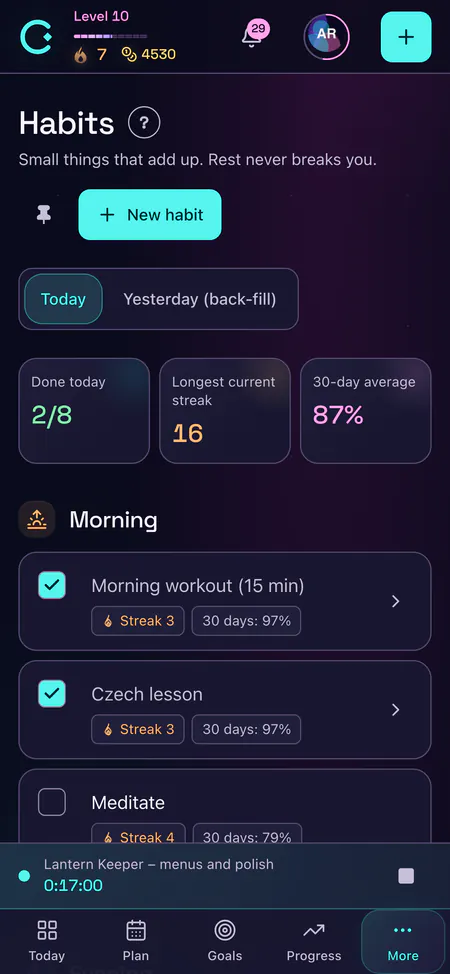
In CORTEX (free for everyone), create a Quit habit such as “Scrolling in bed”. CORTEX counts clean days, and if one evening goes wrong you get no minus points. Put a short “when and where” plan in the habit’s name – for example, “At 10 pm I put my phone on charge in the kitchen.” The “Evening switch-off” template (More → Templates) sets up an end-of-day routine that includes putting screens away. If you have an account, open Habits.
Frequently asked questions
How do I stop doomscrolling?
Change your environment: find your trigger, hide tempting apps from the home screen and log out of them, switch on grayscale, have a replacement ready for bored moments and charge your phone outside the bedroom at night. Decisions made in advance work better than resisting.
Why do I keep scrolling even when I don’t want to?
The feed has no end and rewards arrive unpredictably, so your brain keeps going. We scroll most when tired, bored or avoiding an unpleasant task. It isn’t weak character – it’s an environment designed to hold you.
How do I stop scrolling in bed at night?
Set a time when the phone goes on charge outside the bedroom, get a simple alarm clock and take your me-time earlier in the evening. A short evening routine gives your brain a different end to the day than the feed.
Does grayscale mode help?
According to an experiment with students, yes: grayscale cut their phone time by tens of minutes a day. Colour makes apps more tempting; a grey screen is less attractive. Try it for a week.
How much screen time is too much?
There is no universal number. More important than minutes is whether your phone takes away sleep, focus or time for people and things you care about. If it does, it’s time to cut back.
Sources and further reading
- Allcott, H., Gentzkow, M. & Song, L. (2022): Digital addiction – American Economic Review
- Holte, A. J. & Ferraro, F. R. (2020): True colors: Grayscale setting reduces screen time in college students – The Social Science Journal
- Exelmans, L. & Van den Bulck, J. (2016): Bedtime mobile phone use and sleep in adults – Social Science & Medicine
Set up your first habit
One habit with a cue and a daily target, ticked off on your phone, with a streak that grows.
Set up my first habit