How to cut down phone and social media use
Choose one situation where phone use crowds out something you care about, then prepare fewer unnecessary notifications and a real alternative. Use the week to test what helps rather than promising a complete disconnection. The research is mixed, so review the effects on your own day instead of expecting a guaranteed transformation.
- A review of 21 digital detox studies found mixed results: some show better well-being, others no effect (Radtke et al., 2022).
- Limiting social media to about 30 minutes a day for three weeks reduced students’ loneliness and depressive symptoms (Hunt et al., 2018).
- Notifications delivered in three daily batches improved well-being and sense of control; turning them off completely made some people more anxious (Fitz et al., 2019).
- An economics experiment estimated that about a third of social media use comes from self-control problems, not genuine wanting (Allcott et al., 2022).
- Instead of a ban: seven small steps, one a day, and at the end of the week you decide what to keep.
What a digital detox is – and isn’t
A digital detox is a period when you deliberately limit your smartphone, social media and other screens. It doesn’t have to be a week in a cabin without signal. It can be an evening without the phone in bed, a weekend without social media or a work morning with the phone in a drawer.
A digital detox is not a “dopamine fast”. Switching off your phone doesn’t drain or recharge dopamine – more in dopamine detox. The aim isn’t to punish yourself but to find out which phone use serves you and which takes your time, sleep and focus.
What research says about digital detox
- Going fully offline is no miracle. Theda Radtke and colleagues (2022) reviewed 21 studies. The results were mixed: for some people a detox improved well-being or relationships, elsewhere nothing changed, and sometimes people felt worse because they missed contact.
- Limiting helps more than banning. In an experiment by Melissa Hunt and colleagues (2018), students limited social media to ten minutes per platform per day for three weeks. Compared with a control group, loneliness and depressive symptoms went down, especially in those who felt worse at the start.
- Notifications in batches. Nicholas Fitz and colleagues (2019) had people’s notifications delivered three times a day. They felt less stressed, more focused and more in control. Those who turned notifications off entirely, though, were more often anxious about missing something.
- Self-control, not weak willpower. Hunt Allcott, Matthew Gentzkow and Lena Song (2022) estimated that roughly a third of social media use comes from self-control problems. Tools that let people set a limit in advance reduced their phone time. So changing your environment helps – not just gritting your teeth.
A 7-day plan
- Day 1: Measure where you are. Check your phone’s screen-time stats. Write down your daily average, the three apps you spend the most time in and how many times a day you unlock the phone. Don’t change anything, just look.
- Day 2: Batch your notifications. Turn off notifications for every app except calls, messages from people close to you and your calendar. Check the rest yourself, say at 10, 2 and 6.
- Day 3: Phone out of the bedroom. Move the charger to the hallway or kitchen. Get a simple alarm clock if you need one. Late-night scrolling is the most common sleep thief.
- Day 4: Add friction. Move the apps that pull you in most off your home screen into a folder, log out of them in the browser or switch on grayscale. Every extra second gives you room to decide.
- Day 5: Phone-free mornings. Don’t pick up the phone for the first 30 minutes after waking. Water, movement, breakfast and a plan for the day come first.
- Day 6: A screen-free block. Two to three hours in the afternoon or evening without the phone – a walk, sport, a book, people. Leave the phone at home or in your bag.
- Day 7: Review and choose what to keep. Compare your screen time with day one. Which two steps helped most? Keep those for good and feel free to drop the rest.
Digital detox: 7 days
Screen time day 1: ________ · day 7: ________
- ☐ Day 1: note average screen time, top 3 apps and number of unlocks
- ☐ Day 2: notifications only for calls, close people and calendar; check at 10, 2 and 6
- ☐ Day 3: charger outside the bedroom
- ☐ Day 4: tempting apps off the home screen, logged out, grayscale on
- ☐ Day 5: first 30 minutes after waking without the phone
- ☐ Day 6: 2–3 hours without a screen
- ☐ Day 7: compare with day 1 and keep two steps for good
A practical next step: How to stop gaming too much without removing all your leisure.
Apps, phone settings or willpower? An honest comparison
- Phone settings (app limits, sleep mode, grayscale, notifications). Free and effective because they change your environment. Weak spot: a limit can be skipped with one tap, so combine it with friction (apps off the home screen).
- Blocking apps. Useful if you keep getting around your phone’s own limits. Weak spot: yet another app on your phone, and the risk of moving your detox into a different app.
- Space rules (phone out of the bedroom, off the desk while you work, in your bag at meals). The simplest option, and research on self-control tools suggests deciding in advance works best.
- Willpower alone. Works worst. Apps are designed to keep you, and a tired brain loses in the evening.
For evening scrolling specifically, see how to stop doomscrolling. What to do instead of the phone when you need a quick lift is in the dopamine menu.
How to tell the detox is working
Don’t judge by minutes alone. Watch three things: whether you fall asleep earlier, whether you can focus on one thing for longer, and whether you feel that you use the phone rather than it using you. If even one of them improves, the detox did its job – even if your screen time dropped by only half an hour.
If you find you can’t put the phone down even when it is seriously harming you – at school, at work, in relationships – and that worries you, talk to a psychologist. This article is general information, not a professional diagnosis.
Try it now in CORTEX
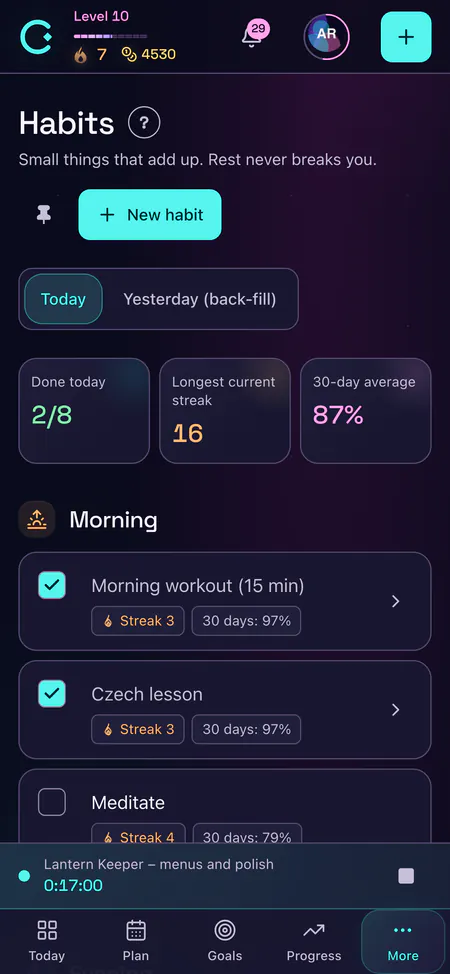
In Habits, track one replacement routine, such as putting your phone away before bed, at a realistic weekly frequency. Use Plan for preparing a charging spot outside the bedroom. In the journal’s evening reflection, note what helped and what needs changing. CORTEX does not block other apps, automatically measure phone use or assess addiction. Set any device limits in the device itself or another suitable tool.
Frequently asked questions
What is a digital detox?
A digital detox is a period when you deliberately limit your phone, social media and other screens. It can last an evening, a weekend or a week. The aim is to find out which use serves you and cut back the rest – not to punish yourself.
How long should a digital detox last?
There’s no fixed number. Studies usually look at one to three weeks. A practical start is seven days with one new step each day, after which you keep what helped.
Does a digital detox work?
Partly. A review of studies found mixed results for going fully offline. Targeted limits do better: less time on social media, notifications in batches and the phone outside the bedroom.
Should I turn off all notifications?
Probably not. In an experiment, notifications delivered three times a day in a batch helped, while switching them off completely made some people anxious about missing something. Keep calls, messages from close people and your calendar.
How do I know if I’m addicted to my phone?
Online tests are not a diagnosis. A warning sign is when you can’t put the phone down even when it seriously harms your studies, work, sleep or relationships, and repeated attempts to cut back fail. Then it’s worth talking to a psychologist.
Sources and further reading
- Radtke, T., Apel, T., Schenkel, K., Keller, J. & von Lindern, E. (2022): Digital detox: An effective solution in the smartphone era? A systematic literature review – Mobile Media & Communication
- Hunt, M. G., Marx, R., Lipson, C. & Young, J. (2018): No more FOMO: Limiting social media decreases loneliness and depression – Journal of Social and Clinical Psychology
- Fitz, N., Kushlev, K., Jagannathan, R. et al. (2019): Batching smartphone notifications can improve well-being – Computers in Human Behavior
- Allcott, H., Gentzkow, M. & Song, L. (2022): Digital addiction – American Economic Review
Prepare one phone-use habit
After registration and setup, open Habits and enter one action: put the phone in its prepared place before bed. Choose a frequency that fits your week.
Prepare my evening habit