How to start journaling: a five-minute method and 30 prompts
To start journaling, pick one short format and one fixed moment: in the morning, write one sentence about what matters most today; in the evening, write what went well and what you take into tomorrow. Five minutes is enough, and a prompt removes the blank page. Journaling is not about beautiful notebooks or long entries. It is a small daily habit of getting thoughts out of your head and onto a page, where they are easier to look at. Below are four formats, thirty prompts and a few honest notes on what writing can and cannot do.
- Start small: five minutes, one fixed moment a day, one format.
- Morning: one intention for the day. Evening: what went well, what you take into tomorrow.
- Gratitude lists and expressive writing have research behind them, with modest effects (Emmons & McCullough, 2003; Frattaroli, 2006).
- Writing a to-do list for tomorrow before bed helped people fall asleep faster in one sleep-lab study (Scullin et al., 2018).
- Missing a day is fine. Coming back the next day is the habit.
Why journaling helps (and what it does not do)
Thoughts that only live in your head tend to loop. On paper they become something you can sort: this is a worry, this is a task, this is something good that happened and you almost forgot. That is most of what journaling does.
Research supports a few specific formats. In a study by Robert Emmons and Michael McCullough (2003), people who wrote down things they were grateful for each week reported feeling somewhat better about their lives than people who wrote about hassles or neutral events. Expressive writing – writing about difficult experiences for a few sessions – has been studied for decades; a large review by Joanne Frattaroli (2006) found small but real benefits on average. And Michael Scullin and colleagues (2018) found that people who wrote a specific to-do list for the next days before bed fell asleep faster than those who wrote about tasks they had already completed.
Journaling is a useful everyday tool, not a treatment. If you are going through something heavy, writing can accompany talking to people you trust or a professional, not replace it.
How to start: five steps
- Choose a moment you already have. With the morning coffee, on the bus, right before you close the laptop, in bed before the light goes off. Attach journaling to it; you will not need to remember it separately (see habit stacking).
- Choose one format. The simplest: one sentence in the morning, three lines in the evening. You can try other formats later.
- Keep it short. Set a limit of five minutes. Short entries survive busy weeks; long ones get skipped.
- Use a prompt when nothing comes. A question is easier to answer than a blank page. Thirty are below.
- Don’t reread every day. Once a week or month is enough. The value is mostly in the writing itself; rereading shows patterns.
Four journaling formats to try
Morning intention and evening review
Morning: “What matters most today?” One sentence. Evening: “What went well?” and “What do I take into tomorrow?” A few lines each. This links the journal to your day and fits well with planning (see how to plan your day).
Three good things
Each evening, write three things that went well and, briefly, why. Small things count: a good lunch, a kind message, a task finished. It trains attention towards what works, which is easy to overlook on stressful days.
Brain dump
Five minutes of writing everything on your mind without sorting. Then mark what is a task and give it a place in your plan. Useful when your head feels full; see brain dump for the full method.
Worry time on paper
When a worry keeps coming back, write it down with the next concrete step you could take, or a note that there is nothing to do right now. Then close the notebook. More approaches in how to stop overthinking.
Evening reflection prompts for a five-minute review.
30 journal prompts
Morning
- What is the one thing that would make today a good day?
- What am I looking forward to today?
- What might get in the way today, and what will I do if it does?
- How do I want to treat people today?
- What can I let go of today?
- Which small step moves my biggest goal forward?
- How much energy do I have, and what does that mean for my plan?
- What would I do today if I were not afraid of doing it badly?
Evening
- What went well today, and what was my part in it?
- What drained me today? What gave me energy?
- What did I learn today?
- What would I do differently next time?
- Who made my day a little better?
- What am I still carrying in my head? Where can I put it?
- What is the first thing tomorrow?
- What am I proud of today, however small?
Gratitude
- Three things that went well today, and why.
- Something I usually take for granted.
- A person I am glad to have in my life, and one reason.
- A small comfort from today.
- Something that was hard but taught me something.
Reflection (weekly or monthly)
- What did I spend most of my time on this week? Is that what I want?
- Which habit helped me most this month?
- What am I avoiding, and what is the smallest first step?
- When did I feel most like myself recently?
- What do I want more of next month? Less of?
- What advice would I give a friend in my situation?
- What story am I telling myself that might not be true?
- What has changed since a year ago?
- What would make next week ten percent easier?
- What do I want to remember about this period of my life?
Common obstacles
- “I don’t know what to write.” Use one prompt and write three sentences. That is a complete entry.
- “It feels pointless.” Give it two weeks before judging, then reread. Patterns usually show up only over time.
- “Someone might read it.” Keep it somewhere private. Knowing it is only for you makes honest writing easier.
- “I keep forgetting.” Tie it to a fixed moment and make it visible: notebook on the pillow, or the journal as the first screen of your evening.
- “It makes me ruminate.” End every entry with one concrete next step or one good thing. If writing about something keeps making you feel worse, switch to a lighter format.
If you want journaling to become a lasting habit, the principles in how to build habits apply: small, at a fixed cue, and easy to restart.
Pennebaker and Beall studied expressive writing, which differs from a brief workday record. Sohal and colleagues reviewed varied journaling interventions; those findings do not establish that this journal or a five-minute routine treats a condition. Gratitude research also does not make a positive interpretation compulsory. For a bounded routine, use the evening reflection guide.
Journal in CORTEX
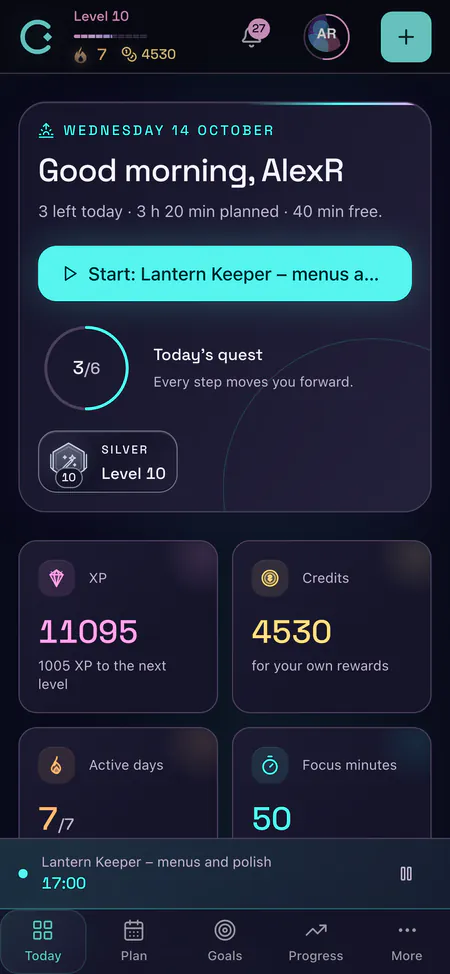
CORTEX (free for everyone) has a private Journal built around the morning-and-evening format: a morning intent (“What matters most today?”) with space for what you are grateful for and a quick rating of your energy, focus and mood, and an evening review with what went well, what you take into tomorrow, a note and an optional photo of the day. Nobody else can see it – not even friends or your alliance. A calendar shows which days you wrote, so you can reread a week or a month. If you have an account, open the Journal.
Frequently asked questions
How do I start journaling as a beginner?
Choose one fixed moment and one short format. For example, one sentence in the morning about what matters today and three lines in the evening about what went well and what you take into tomorrow. Five minutes is enough.
What should I write in a journal?
Whatever helps you sort your thoughts: what happened, how you feel about it, what you are grateful for, what worries you and what you will do next. If nothing comes, answer one prompt from the list above.
Is it better to journal in the morning or at night?
Both work. Morning journaling helps set an intention for the day; evening journaling helps you close the day and let go of open loops. Many people do one sentence in the morning and a short review at night.
How long should a journal entry be?
As long as it takes to say one useful thing. Three sentences is a complete entry. Short entries are easier to keep up than long ones.
Does journaling actually help?
Research on gratitude writing and expressive writing shows small, real benefits on average, and writing a to-do list before bed helped people fall asleep faster in one study. It is a helpful habit, not a cure.
Sources and further reading
- Emmons, R. A. & McCullough, M. E. (2003): Counting blessings versus burdens: An experimental investigation of gratitude and subjective well-being in daily life – Journal of Personality and Social Psychology
- Frattaroli, J. (2006): Experimental disclosure and its moderators: A meta-analysis – Psychological Bulletin
- Scullin, M. K., Krueger, M. L., Ballard, H. K., Pruett, N. & Bliwise, D. L. (2018): The effects of bedtime writing on difficulty falling asleep: A polysomnographic study comparing to-do lists and completed activity lists – Journal of Experimental Psychology: General
- Pennebaker & Beall (1986): Expressive writing
- Sohal et al. (2022): Journaling review
- Emmons & McCullough (2003): Gratitude
Write one sentence
After registration and setup, open Journal and enter one sentence about today yourself.
Open my journal