How to prevent burnout: the warning signs and seven steps while there’s still time
The best way to prevent burnout is to notice the first signs early – tiredness that doesn’t lift even after a weekend, growing cynicism and a sense that your work makes no difference – and to start reducing the load rather than pushing harder: less work in progress, a firm end to the day, planned recovery and an honest conversation about what drains you at work. The World Health Organization describes burnout as the result of chronic workplace stress that hasn’t been successfully managed. Research shows that the mismatch between you and your work matters most, not just the number of hours.
- The WHO describes burnout as an occupational phenomenon resulting from chronic workplace stress; it is not classified as a medical condition (ICD-11, 2019).
- It has three parts: exhaustion, distance and cynicism towards work, and a sense of not achieving anything (Maslach & Leiter, 2016).
- It grows in six areas: workload, control, reward, community, fairness and values.
- People who mentally detach from work in their free time are less exhausted and sleep better (Wendsche & Lohmann-Haislah, 2017).
- Prevention works best when it combines changes for the person and at work and is repeated over time (Awa et al., 2010).
What burnout is
The World Health Organization included burnout in the International Classification of Diseases (ICD-11) as an occupational phenomenon, not as a medical condition in its own right. It describes it as the result of chronic workplace stress that hasn’t been successfully managed, with three features: exhaustion, mental distance or cynicism towards your job, and reduced professional efficacy.
Christina Maslach and Michael Leiter, who have studied burnout for decades, stress that it is not an individual weakness. Burnout grows out of a mismatch between a person and their work – which is why a holiday alone won’t fix it if you come back to the same environment.
Warning signs to watch for
Burnout doesn’t arrive overnight. These signs don’t diagnose anything on their own, but if several of them stick around for weeks, it’s worth slowing down:
- Tiredness a weekend doesn’t fix. On Monday morning you feel as drained as on Friday evening.
- Cynicism. People and tasks you used to care about start to irritate you. You catch yourself thinking “it doesn’t matter anyway”.
- Feeling that nothing works. You do more and more but feel the results are getting worse.
- Work on your mind in the evening. You can’t switch off; your thoughts circle around work even in bed.
- What used to recharge you disappears. You put off sport, friends and hobbies because “there’s no time right now”.
Six areas where burnout starts
Maslach and Leiter (2016) describe six areas where a mismatch between person and job leads to burnout. Go through them and mark where things grind the most for you – that’s where to start:
- Workload: there is consistently more than can be handled, and no time to recover.
- Control: you can’t influence how or when you do your work.
- Reward: nobody sees your effort – neither in pay nor in words.
- Community: support from colleagues is missing, or relationships are tense.
- Fairness: rules and rewards feel unfair.
- Values: you do things you inwardly disagree with.
Seven steps to prevent burnout
- Measure your load. For a week, write down how many hours you work and how many things you have on the go at once. Estimates from memory tend to be kinder than reality.
- Limit work in progress. Fewer projects at once means less switching and more done. Renegotiate or decline what doesn’t fit (feeling overwhelmed).
- Set a firm end to your day. A short ritual that closes work helps you detach (shutdown ritual). In the meta-analysis by Wendsche and Lohmann-Haislah (2017), detachment was linked with less exhaustion and better sleep.
- Schedule recovery like a meeting. Put exercise, friends and hobbies in your calendar before work. What isn’t in the calendar is the first thing to go in a hard week.
- Talk about what drains you. With your manager, clients or colleagues. Be specific: what is overloaded, what needs to change. Burnout is largely about the environment.
- Protect sleep and movement. They aren’t rewards for work done – they are the foundation without which the load can’t be carried.
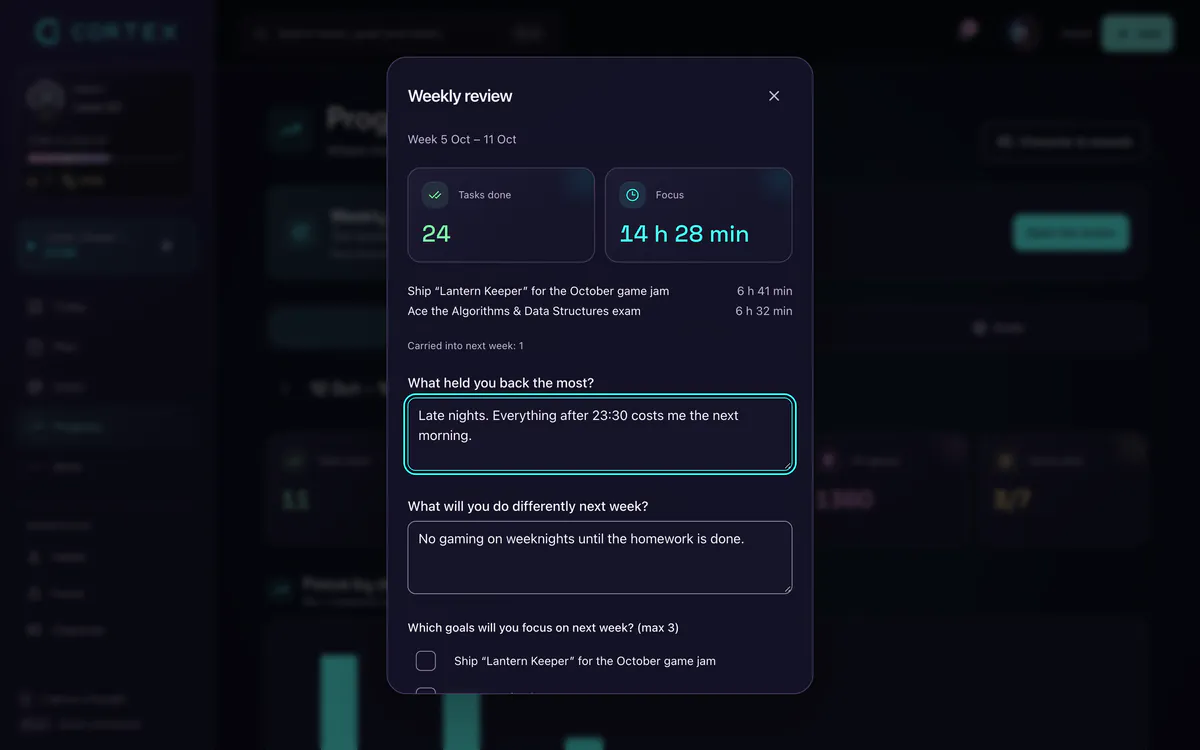
- Look back once a week. Five minutes: how much energy did I have, what took it, what gave it, what will I drop next week. You’ll see the trend before it becomes a problem.
A review of prevention programmes (Awa et al., 2010) found that most of them reduced burnout, but without refreshers the effect faded over time, and it lasted longest where changes involved both the person and the workplace. Prevention isn’t a one-off action; it’s a habit.
When to get professional help
See your doctor, a psychologist or a therapist if the exhaustion lasts for weeks and doesn’t improve after time off, if you sleep badly for a long time, if nothing feels enjoyable, or if physical symptoms join in. Similar symptoms can also come from depression or another condition that belongs in professional hands.
If you work for yourself and nobody watches your workload for you, a fixed work schedule helps, along with a realistic idea of how many hours of focused work a day you can do.
Try it now in CORTEX
In CORTEX (free for everyone) you can log sleep, movement and energy each day in the Energy module – no scores, just for you. The Weekly review in Progress shows where your time went and asks two questions for next week. The “Evening switch-off” template (More → Templates) helps you set a firm end to the day, and when you need to slow down right away, the Calm module has breathing exercises. If you have an account, open your weekly review.
Frequently asked questions
How can I prevent burnout?
Watch for the first signs and reduce the load: limit work in progress, set a firm end to your day, schedule recovery like a meeting, talk about what drains you, protect sleep and movement, and look back once a week at how much energy you had.
What are the first signs of burnout?
Most often tiredness that a weekend doesn’t fix, growing cynicism towards work and people, and a sense of not achieving anything. Not being able to switch off and dropping things that used to recharge you often come along. They are not a diagnosis on their own – see a doctor if you’re struggling.
Is burnout a medical condition?
According to the World Health Organization, no: in ICD-11 burnout is described as an occupational phenomenon resulting from chronic workplace stress. Depression can cause similar symptoms, though, so it’s worth getting checked.
Will a holiday cure burnout?
In the short term it helps; in the long term it isn’t enough on its own. When you return to the same environment, the exhaustion usually comes back. A holiday helps more if you also change the workload, your hours or what drains you most.
What should I do if I feel really bad?
See your doctor or a psychologist as soon as you can. If you feel so bad that you don’t know how to go on, or you have thoughts of harming yourself, contact a crisis line – findahelpline.com lists them by country, and in the UK and Ireland Samaritans answer on 116 123. In an emergency, call your local emergency number.
Sources and further reading
- World Health Organization (2019): Burn-out an “occupational phenomenon”: International Classification of Diseases
- Maslach, C. & Leiter, M. P. (2016): Understanding the burnout experience: recent research and its implications for psychiatry – World Psychiatry
- Wendsche, J. & Lohmann-Haislah, A. (2017): A meta-analysis on antecedents and outcomes of detachment from work – Frontiers in Psychology
- Awa, W. L., Plaumann, M. & Walter, U. (2010): Burnout prevention: A review of intervention programs – Patient Education and Counseling
Take a short breathing break
Calm in CORTEX has guided breathing, a meditation timer and calming sounds.
Try a short breathing break